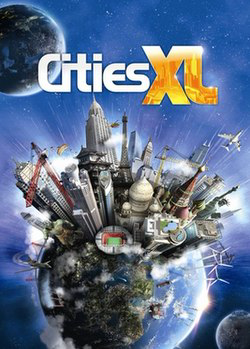
Cities XL (Planet Offer)
» see citiesxl.com as it lived, on the wayback machine
~ the obit ~
Cities XL wanted a monthly fee for the better half of itself. You bought the box in october 2009 and got a city builder, and then there was a second thing called the Planet Offer, a subscription that placed your city on a persistent shared planet beside other people's cities so the two could trade. Five months later the planets were empty enough that the studio switched them off.
It came from Monte Cristo, a Paris studio founded in 1995 that had spent its life on simulation games nobody outside the genre could name. Airline Tycoon in 1998, the Wall Street Trader series after it. The direct ancestor of Cities XL was City Life in 2006. The project carried the name Cities Unlimited until april 2008. The renaming to Cities XL came with the online ambition attached.
The announcement landed on 27 january 2010, three months after release. Monte Cristo wrote that the subscription rate was lower than what we expected. New subscriptions closed on 1 february. The planets went dark on 8 march at 0:00 GMT. Subscribers were promised the contents of the European pack free when Cities XL 2011 arrived, plus a bus system in the patch that shipped the same day the servers died. If you wanted to keep the city you had built online, there was a manual import procedure the company published and described as totally unsupported.
Monte Cristo did not survive its own game. Revenues of about a million euros in 2009 against a net loss of 2.82 million, bankruptcy in may 2010, and the franchise sold to Focus Home Interactive on 25 june. Focus shipped Cities XL 2011 that october, then 2012, then Platinum, then Cities XXL in february 2015, which scored 47 on Metacritic and ended the line.
The dead part of this game is the part I could not have bought anyway. A recurring monthly charge in 2009 meant an international card, and in Turkey that was a thing you arranged rather than a thing you had. The shared worlds I actually spent hours in were Turkish Ultima Online private servers, which asked for nothing and stayed up for years on somebody's stubbornness.
~ the rap sheet ~
| Born | 8 october 2009, with a subscription layer called the planet offer |
|---|---|
| Peak | a persistent shared planet of player-built cities trading with each other |
| Killed | 8 march 2010, servers off at 0:00 gmt |
| Lifespan | five months |
| Made by | monte cristo, paris |
| Killed by | a subscription rate the studio called lower than expected |
~ the pitch ~
The idea was better than its reputation suggests. Single-player city builders are closed systems where you are the only economy, so the designers have to invent scarcity by hand. Putting a few thousand cities on one map means your neighbor actually has the oil you lack, and the price of it is somebody else's decision rather than a number in a config file.
What the Planet Offer sold on top of that was avatar mode plus a set of exclusive maps and megastructures you could not build offline. That is the part that killed it. Charging a subscription for the shared economy is a defensible trade. Charging a subscription and also fencing the good buildings behind it made the offline game feel like a demo of itself.
~ what the subscribers got ~
Nothing that could be moved. The trade system and the blueprint mechanics were folded back into solo play, which meant the mechanics survived and the other players did not. A city that had grown by trading with strangers for four months became a city on an empty map, and the tool for carrying it across was a set of instructions with a warning attached.
Everyone who had paid got the European pack for free when the next version shipped nine months later. It was a fair gesture from a company that no longer existed by the time it was honored, since Focus inherited the promise along with the code.
~ the long tail ~
Cities XL is still sold and still played, which is why it reads as a strange grave. The game did not die. The thing that died was the reason it was named XL in the first place, and once that was gone the series spent five more years being an ordinary offline city builder that reviewers kept comparing unfavorably to a fourteen-year-old SimCity.
Then Cities: Skylines arrived one month after Cities XXL and took the whole genre. It was single player, it had no subscription, and it shipped with the mod tools that let its players build the shared world themselves, on their own machines, for free.
~ leave a rose ~
an anonymous tribute. one rose per visitor per day.
@}-->-- ... roses left here
~ leave a wreath ~
a rose fades by morning. a wreath stays on this grave for good, with your name on it.
from $1, paid once through stripe. it keeps the graveyard running: the hosting and the nightly digging. adopt it and the headstone reads "maintained in memory by" you. the groundskeeper plants new wreaths at the next tending, usually within a day.
» one email a week: new graves and the anniversaries of the dead. subscribe
other gaming: Star Wars 1313, Duelyst, Accolade, LEGO Minifigures Online
also died in 2010-2014: Narod.ru, VCR Plus+, Star Wars 1313
~ leave a note ~
visitors before you have left these graveside notes. anonymous welcome.