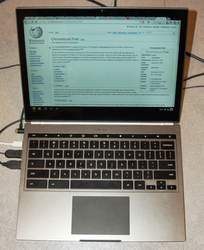
Chromebook Pixel
» see google.com/chromebook/pixel as it lived, on the wayback machine
~ the obituary ~
The screen was sharper than the one in a MacBook Pro and there was almost nothing you could put on it. 2,560 by 1,700 pixels across 12.85 inches works out to 239 per inch, against 220 on the retina Pro of the same year. Behind that glass sat Chrome OS, which in February 2013 meant a browser and a file manager that mostly pointed at Google Drive.
Google announced it on 21 February 2013 and sold it the same day. $1,299 for the wifi model and $1,449 for the LTE one, which shipped in April with 100 MB a month of Verizon data attached to it. The aspect ratio was 3:2 at a point when every other laptop maker had settled on 16:9, on the argument that web pages are tall and films are not.
The second model arrived in March 2015 at $999, with a $1,299 version carrying a Core i7 and 16 GB of memory. It was one of the first laptops anywhere with USB-C, shipping alongside Apple's twelve-inch MacBook rather than after it. Google discontinued the cheaper one in April 2016 and let the expensive one sell out over the summer. On 30 August it confirmed there was no plan to restock.
This was never a product I could have bought, and the reason is not the price or the customs form. Google said what it was: a proof of concept. The machine existed to show Acer and Samsung what Chrome OS looked like with the cost engineering taken out, and the audience for that argument was a handful of hardware planners at other companies. Chromebooks did reach Turkey eventually, cheap plastic ones running the same operating system, which means the argument arrived here with the object left behind.
~ the case file ~
| Born | february 21, 2013, announced and on sale the same day |
|---|---|
| Peak | the 2015 model at $999, one of the first laptops anywhere with usb-c |
| Killed | august 2016, no restock once the last units sold |
| Lifespan | three and a half years across two models |
| Made by | google, built in-house rather than through an oem partner |
| Killed by | a demonstration that had already made its point |
~ the terabyte was worth more than the laptop ~
Every Pixel came with a terabyte of Google Drive for three years. Drive charged $49.99 a month for that much space in 2013, so the storage carried a list value of about $1,800 attached to a laptop that cost $1,299. Reviewers kept pointing this out because it made the arithmetic strange. You could read the whole machine as a hardware bonus stapled to a storage plan.
It also tells you what Google thought the thing was. A laptop with 32 GB of local storage is not a computer that holds anything. The terabyte was where your files lived and the SSD was a cache for the trip between your desk and the connection.
~ a light bar that told you nothing ~
The lid carried a strip of LED in the four Google colors, angled so it caught your eye when the machine was open. It pulsed while the computer slept. Knock twice on the closed lid and it showed the battery level in segments, which is the only functional thing it ever did.
Nothing about it improved the computer. It was there because somebody wanted the object recognizable from across a room, the way a lit apple was. That instinct is the whole product in one detail: money spent on the physical presence of a machine whose software was deliberately identical to the free version running on a $199 Acer.
~ addressed to the other manufacturers ~
The reviews landed in the same place from different directions. PC Magazine called it a thin client notebook with a brilliant screen. Forbes measured it against a MacBook at the same money and found the comparison unkind. Neither was wrong and neither mattered, because the buyer Google cared about was not reading laptop reviews.
The Pixelbook, announced on 4 October 2017, took the same argument and put a hinge on it. By then the point had carried. Chromebooks with decent screens and metal bodies were normal, and the expensive one no longer had to exist to prove they could be built. The 2013 model stopped receiving Chrome OS updates in August 2018, five and a half years after it went on sale, which is a long support life for hardware nobody bought.
~ leave a rose ~
an anonymous tribute. one rose per visitor per day.
@}-->-- ... roses left here
~ leave a wreath ~
a rose fades by morning. a wreath stays on this grave for good, with your name on it.
paid once through stripe. payments are handled by OÜ Lakeview, the small company that keeps rip.so running. the money pays for the hosting and the nightly digging. adopt it and the headstone reads "maintained in memory by" you. the groundskeeper plants new wreaths at the next tending, usually within a day.
» one email a week: new graves and the anniversaries of the dead. subscribe
other gadgets: Fujitsu FM-7, Amazon Fire Phone, Slingbox, Keecker
also died in 2015-2019: Wii U, Darkfall, Windows Easy Transfer
~ leave a note ~
visitors before you have left these graveside notes. anonymous welcome.