Caledonian Mercury
» see caledonianmercury.com as it lived, on the wayback machine
~ the obit ~
Scotland's first newspaper is usually said to be the Mercurius Caledonius, which managed twelve issues across 1660 and 1661 and then stopped. Sixty years later somebody in Edinburgh picked up half the name and did considerably better with it. The Caledonian Mercury put out number one on Thursday 28 April 1720 and kept going, three times a week, until April 1867.
It was not the prestigious paper in town. That was the Edinburgh Evening Courant, and the Mercury's lower standing came partly from being sold by a bookseller with open political loyalties and partly from an editorial habit of not bothering much with recent news from the rest of Britain or from Europe. During the Malt Tax riots of 1725 the rival factions in Scottish politics went looking for papers to speak through, and a letter from Andrew Millar to Robert Wodrow shows the Mercury being treated as one of the available mouths.
Robert Chambers later credited it with being the first newspaper in Scotland to blend literary criticism with political matter. Put less generously, it reviewed books because it could not fill the space with politics. James Boswell wrote for it. In 1815 Thomas Allen & Co bought it and ran it from 265 High Street on the Royal Mile. The Scotsman bought it in 1867 and closed it, and the last number came out on 20 April that year.
~ the rap sheet ~
| Born | Thursday 28 April 1720, number I, Edinburgh |
|---|---|
| Peak | Issue numbering ran past 24,000 before the end |
| Killed | 20 April 1867, bought and closed by The Scotsman |
| Lifespan | 146 years and 11 months |
| Made by | An Edinburgh bookseller, then Thomas Ruddiman's family from 1729 |
| Killed by | its own rival buying it |
~ what the first page promised ~
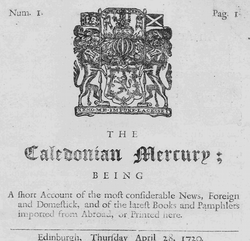
The front of number one survives and it is mostly a mission statement under the royal arms of Scotland. The title sits in italics, and underneath it the paper describes itself as a short account of the most considerable news, foreign and domestick, and of the latest books and pamphlets imported from abroad, or printed here. Then the dateline: Edinburgh, Thursday April 28, 1720.
Two things in that sentence do a lot of work. Putting foreign news before domestic was a claim about ambition, and putting imported books in the masthead at all tells you who the paper thought was buying it. This was a product for people in Edinburgh who wanted to know what had arrived from London and the continent, which in 1720 was a genuinely scarce thing to know.
~ the Ruddiman century ~
From 1729 to 1772 the paper was owned and run by Thomas Ruddiman and his family, after which John Robertson took it over. Forty three years under one household was unusual for an eighteenth century newspaper, and it covers the period when the Mercury settled into the shape it kept: short and frequent, with book notices around the edges, and politically for hire in a way nobody at the time found shocking.
The issue numbering eventually ran past 24,000. The British Newspaper Archive and Findmypast have digitized the run back to 1720 and count somewhere above 23,000 surviving numbers, the gap being the usual story of what nobody kept. For a paper that came out three times a week from 1720 to 1867, that is a remarkably complete record of what Edinburgh was told.
~ the name came back ~
Late on the night of 24 January 2010, going into Burns Night, a new Caledonian Mercury went live as Scotland's first web-only daily. It was set up by Stewart Kirkpatrick, who had run The Scotsman's website, along with Graham Jones and Tony Purcell, out of an office on Hanover Street in Edinburgh, and it paid its writers out of a share of revenue rather than a wage.
Kirkpatrick left in August 2012 to run digital for the Yes Scotland campaign and David Calder took over the following month. Archived copies of the site show the output thinning out after that: seventeen posts in May 2014, then one in July, one in August, one in September, and then nothing. The domain is now a Thai sports-betting page running on WordPress, which has filled it with gambling copy and kept the title tag. Two separate newspapers carried that name, 290 years apart, and the squatter who ended up with the address had no idea either of them existed.
~ leave a rose ~
an anonymous tribute. one rose per visitor per day.
@}-->-- ... roses left here
~ leave a wreath ~
a rose fades by morning. a wreath stays on this grave for good, with your name on it.
paid once through stripe. payments are handled by OÜ Lakeview, the small company that keeps rip.so running. the money pays for the hosting and the nightly digging. adopt it and the headstone reads "maintained in memory by" you. the groundskeeper plants new wreaths at the next tending, usually within a day.
» one email a week: new graves and the anniversaries of the dead. subscribe
other news: Commodore Force, Look, A Plus, Architectural Forum
also died in the pre-1980s: Shockley Semiconductor Laboratory, Look, Architectural Forum
~ leave a note ~
visitors before you have left these graveside notes. anonymous welcome.