Buddah Records
~ the eulogy ~
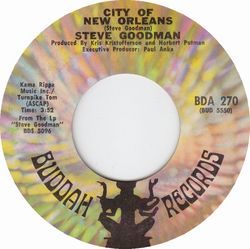
Art Kass ran Kama Sutra Records, whose Lovin' Spoonful records had been propping up MGM's profits through 1965 and 1966, and he was tired of MGM's distribution terms. So in 1967 he founded his own label in New York with his Kama Sutra partners Artie Ripp, Hy Mizrahi, Phil Steinberg and, allegedly, the mobster John "Sonny" Franzese. He named it Buddah, with an h in the wrong place, and from 1968 the label art carried a silhouette of Shiva rather than a Buddha. Both of those stayed uncorrected for the label's entire life.
To run it day to day he hired Neil Bogart, who was 24. Bogart had been a general manager at MGM and a sales director at Cameo-Parkway, and he arrived with the Cameo-Parkway promotion department and a set of producers in tow: Jerry Kasenetz and Jeffry Katz, and the Ohio Express, who were signed to their production company. The first Buddah single was "Yes, We Have No Bananas" by the Mulberry Fruit Band. The first album was Captain Beefheart's Safe as Milk. Nobody was running a coherent strategy yet.
What they found was bubblegum. The Ohio Express and the 1910 Fruitgum Company turned Buddah into the house that sold deliberately simple pop records to children, with the Kasenetz-Katz Singing Orchestral Circus behind both of them, and in February 1968 the Lemon Pipers gave the label its first number one with "Green Tambourine", produced by Paul Leka. Then bubblegum stopped selling and Buddah had to become something else or close. This is where Bogart's reputation was made. Music historian Bob Hyde's estimate is that Buddah and its associated labels charted more than a hundred singles, with roughly one in five releases making the charts, against the one in twenty a major label expected in the same years.
All of this happened roughly forty years before I was buying music, in a business whose whole mechanism was a New York office pushing 45s at American top 40 radio stations. The songs got out anyway, and they got out with the company detached from them. "Ain't No Sunshine" was still in circulation in Turkey decades later, and so was the Super Fly soundtrack, and nobody playing either one was thinking about an imprint that had stopped pressing records before I started school.
~ the dossier ~
| Born | 1967, New York City, founded by Art Kass |
|---|---|
| Peak | over 100 charting singles, roughly one in five releases |
| Killed | 1983, final release of new product |
| Lifespan | 16 years |
| Made by | Art Kass, with the Kama Sutra partners |
| Killed by | Viewlex's bankruptcy and the debt of buying itself back |
~ the labels it carried ~
Buddah's second business was distribution, and the list of imprints that went through it is more impressive than the Buddah catalog itself. Curtis Mayfield's Curtom came through from 1968. The Isley Brothers brought T-Neck in 1969. Holland-Dozier-Holland, having left Motown, ran Hot Wax through Buddah from 1969. Clarence Avant's Sussex arrived in 1971, which is how Bill Withers ended up in the Buddah orbit. Kama Sutra itself became a wholly owned subsidiary in 1969 once its MGM deal lapsed.
The strangest entry is Charisma, Tony Stratton Smith's British label, distributed in America by Buddah from 1971 to 1973, which put Genesis and Monty Python on the same distribution pipe as the 1910 Fruitgum Company. Buddah liked Charisma's typography enough to steal it: in 1973 it adopted the Gill Ultra Bold face from Charisma's "Mad Hatter" label so that its key imprints would share one look in the racks.
~ the hits ~
Between 1969 and 1973 the label and its satellites ran a hit streak that is hard to believe when you see it written down in one place. 1969 brought "It's Your Thing" from the Isley Brothers and "Oh Happy Day" from the Edwin Hawkins Singers. 1970 was the heaviest year: "O-o-h Child" by the Five Stairsteps, Melanie's "Lay Down (Candles in the Rain)", "One Toke Over the Line" by Brewer and Shipley, and "The Rapper" by the Jaggerz with a young Donnie Iris on it. Honey Cone's "Want Ads" came in 1971, and in 1973 the label had both "Brother Louie" by Stories and Charlie Daniels' "Uneasy Rider".
Bill Withers delivered "Ain't No Sunshine" in 1971 and then "Lean on Me" and "Use Me" in 1972, with Still Bill charting as an album in a company that mostly thought in singles. Curtis Mayfield delivered "Freddie's Dead" and the Super Fly soundtrack the same year. And shortly before Bogart left in 1974 to start Casablanca, Gladys Knight and the Pips arrived from Motown's Soul imprint and immediately recorded the biggest records of their career for Buddah, including "Midnight Train to Georgia". Six years earlier the same label had been selling "Yummy Yummy Yummy" to children.
~ bought back with borrowed money ~
Viewlex, a New York visual aids company, had bought a controlling interest in Buddah back in 1968, and the three other founding partners left at that point, leaving Kass and Bogart in charge. In 1976 Viewlex declared bankruptcy. Art Kass bought the label back out of it, and the debt he took on to do that is the thing that actually ended Buddah: new releases thinned out immediately and never recovered.
Norman Connors came in as musical director in 1976 and pushed the label toward R&B and disco, which produced "More, More, More" by the Andrea True Connection and Chic's first single, though Chic's record only charted when Atlantic reissued it. Arista took over distribution from 1978 to 1983 and gradually took the artists too, Connors and Phyllis Hyman among them. Buddah's last new release came in the middle of 1983, Michael Henderson's "Fickle" and the album of the same name. Kama Sutra managed one more the following year, a self-titled single by the Fat Boys, who were still called the Disco 3 when they made it.
~ who owns it now ~
Kass sold the label to Essex Entertainment, which ran the catalog until 1993 and then sold it to BMG. In September 1998 BMG switched the name back on as Buddha Records, spelled with the h in the conventional place this time, purely as a reissue operation. On 1 January 2002 that was reorganized into BMG Heritage. The catalog now belongs to Sony Music and is administered by Legacy Recordings, which means every record discussed above is in print and none of it comes from a label that exists.
~ leave a rose ~
an anonymous tribute. one rose per visitor per day.
@}-->-- ... roses left here
~ leave a wreath ~
a rose fades by morning. a wreath stays on this grave for good, with your name on it.
paid once through stripe. payments are handled by OÜ Lakeview, the small company that keeps rip.so running. the money pays for the hosting and the nightly digging. adopt it and the headstone reads "maintained in memory by" you. the groundskeeper plants new wreaths at the next tending, usually within a day.
» one email a week: new graves and the anniversaries of the dead. subscribe
other media music: Radio.Blog.Club, SpiralFrog, Trama Virtual, Prostopleer
also died in the 1980s: Synapse Software, Living Videotext, Spectravideo
~ leave a note ~
visitors before you have left these graveside notes. anonymous welcome.