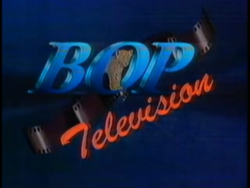
Bop TV
~ the last words ~
Bophuthatswana was one of the bantustans, declared independent in 1977 by the South African government and recognized as a country by nobody else on earth. It had a president in Lucas Mangope and a capital at Mmabatho. From the turn of 1984 it also had a television station. Pretoria paid for it, at around 105 million rand a year, out of the budget of the Foreign Affairs Ministry, because the fiction required that money going to Bophuthatswana be foreign aid.
The start date is a small mess worth straightening out. English Wikipedia says 31 December 1983, resting on one Singapore newspaper report that cannot now be read. The British magazine Radio and Electronics World, writing in April 1984 with a photograph of the opening caption in front of it, says the service began on 2 January 1984 and that the first program shown was a Woody Woodpecker cartoon. The New York Times said that July that Bop-TV had started beaming programs "last January". The channel was set up by Tim Ellis, who within two years had also helped start the SABC's TV4 and then M-Net.
What made it matter was the fiction itself. Apartheid ran television through the SABC, which decided what the country was allowed to see, and imported series arrived with the race jokes cut out of them. Because Bophuthatswana was nominally sovereign, none of that applied, and before the channel launched senior South African officials traveled there to seek assurances that the programs would not offend Calvinistic morality. The assurances were apparently thin. News roundups came in from UPITN, the agency jointly owned by United Press International and ITN, and by February 1984 the schedule carried Ironside, Benson, The Rockford Files and Mod Squad with the jokes still in them.
Nothing about this reached me. Bop TV first broadcast in January 1984 and stopped in July 2003, which makes it almost exactly my own age, and it was never once within reach. South Africa arrived in Turkey during those years as a news story about one man leaving prison, not as a schedule. That a livelier channel had been beaming into Johannesburg's suburbs the whole time is something I only learned while writing this.
~ the record ~
| Born | 2 January 1984, with a Woody Woodpecker cartoon out of Mmabatho |
|---|---|
| Peak | 350,000 licensed sets on a nine hour broadcast day by 1990 |
| Killed | 31 July 2003, announced by the minister on 29 May |
| Lifespan | 19 years, 6 months |
| Made by | Bophuthatswana Broadcasting Corporation, Mmabatho |
| Killed by | a cabinet decision and a regional service that never launched |
~ what a new aerial bought you ~
Bophuthatswana could not apply for its own broadcast frequency, because the international bodies that hand those out did not consider it a country. It used air wave space granted by the SABC, and to reach Soweto it had to send its signal to an SABC tower in Johannesburg for relay. The SABC made the beam as narrow as it could. It spilled anyway, into the white suburbs on the south-western edge of the city, and because the SABC broadcast on VHF and Bop went out on UHF, picking it up meant buying a different aerial for about 175 dollars.
White Johannesburg bought them in quantity. Hardware shops could not keep UHF antennas in stock. Newspapers printed maps showing which suburbs could get the off-limits signal, and estate agents ran classified ads listing a house as three bedrooms, two bathrooms, swimming pool, Bop-TV. The Estate Agents Board told a visiting American journalist that good reception added about a thousand dollars to the value of a property. The number of white viewers went from roughly 50,000 in the first quarter of 1984 to 81,000 in the second. In Soweto, the channel overtook the SABC's Black service within three months of launching.
The SABC fought this with engineering and with press releases. It warned suburbanites not to waste money on antennas because the spillage would be mopped up shortly, and budgeted a million dollars in one year on equipment to do it. A man named Steve Roos, who had spent about 350 rand on four new aerials and then lost the picture anyway, stood in a Randburg shopping area one Saturday in July 1984 with eight friends and collected more than 3,800 signatures on a petition to Parliament. The opposition Progressive Federal Party backed him. His line to the New York Times was that this was segregation the other way round.
~ the clause in the contract ~
There was a contract between the two governments, and South Africa had written a clause into it saying that neither side could broadcast anything contrary to any rule or law operative in either country. The enforcement mechanism was not a fine. It was the Johannesburg relay, which the SABC controlled and could switch off.
Bop TV tested the clause anyway. It ran a documentary on Steve Biko. It showed a clip of a press conference given in Zimbabwe by Oliver Tambo, the exiled president of the banned ANC, and it broadcast an interview with Winnie Mandela. Both were people South African law did not allow anyone to quote. Late in 1984 South Africa lodged a formal protest with the homeland government, and after that the station toed the line more carefully.
~ what the SABC would not run ~
The SABC had turned down Alex Haley's Roots while giving record runs to The A-Team and Dallas. Bop TV ran Roots. It also ran labor disputes with union leaders saying what they thought, and after unrest it interviewed Black people who had been there rather than only the police commander who had dispersed them. By 1990 its head of programs, Richard Magau, was filling a nine-hour broadcast day for about 350,000 licensed sets with Knots Landing, Santa Barbara, Married with Children and Cheers. He was trying to buy The Simpsons before M-Net could, and was very interested in The Arsenio Hall Show.
In 1986, four years before that, the South African government had finally restricted the signal to Bophuthatswana itself, using the argument that the International Telecommunication Union does not let a foreign broadcaster transmit into somebody else's country. The channel had spent two years being too popular to be left alone. An executive put the counter-case bluntly to a visiting Chicago Tribune reporter: Bop TV operated without censorship, and its stand was totally anti-apartheid.
~ the week the homeland ended ~
On 7 March 1994 Mangope went on his own television to say that Bophuthatswana's attachment to independence and freedom was being underestimated, and that it would boycott the April elections. The next day 350 employees of the Bophuthatswana Broadcasting Corporation occupied the television station at Mmabatho and took the corporation's chairman, Eddie Mangope, the president's son, hostage. Masked homeland police went in through tear gas and got him out. On 10 March Mangope dismissed the broadcaster's staff and shut down three radio stations and two television stations. He was gone himself within two days, and the Bophuthatswana government was abolished on 12 March.
The channel survived all of it on a technicality, which is fitting, because it had been born on one. The Former States Broadcasting Reorganisation Act of 1996 abolished the three other homeland broadcasters and handed them to the SABC, but it contains no section abolishing the Bophuthatswana corporation, because a separate North West Broadcasting Corporation Act had been passed the year before. Bop Broadcasting's management spent 1996 pointing this out and refusing to integrate. The Department of Communications took over the funding in 1997, the SABC took over the management, and the subsidy from the national treasury finally stopped in November 2001, after which the SABC was paying for the whole thing itself and said it had spent over 120 million rand doing so.
~ the switch-off ~
The cabinet decided in March 2003. On Thursday 29 May the communications minister, Ivy Matsepe-Casaburri, announced it in Parliament in two sentences of pure policy language: the Broadcasting Amendment Act provided for regional television stations in two regions of the country, so it had been decided to close the Bop Broadcasting operation and replace it with a service delivering the indigenous languages of the northern region. The SABC confirmed it the next day. Its chief executive, Peter Matlare, said there had been ongoing communication with the Bop staff and that he knew the closure was a very difficult matter for all concerned.
One hundred and eighty-one people lost their jobs. Bop by then was two radio stations and one television channel, and all of them went off at the end of July 2003, the channel reaching around half a million viewers at the end. The replacement was supposed to reach up to fifteen million.
It never launched. ICASA granted the frequencies, the SABC talked about channels by 2005 or 2006, and nothing went on air. A study of regional television written a few years later found that the skilled staff at Mafikeng had left after the station closed and the equipment that had been modern was sitting unused. In 2007 the SABC was still being sued over the wreckage, by the Public Investment Corporation for canceling the lease on the Mmabatho building and by Sentech over the transmitters, for something over 400 million rand between them.
~ leave a rose ~
an anonymous tribute. one rose per visitor per day.
@}-->-- ... roses left here
~ leave a wreath ~
a rose fades by morning. a wreath stays on this grave for good, with your name on it.
paid once through stripe. payments are handled by OÜ Lakeview, the small company that keeps rip.so running. the money pays for the hosting and the nightly digging. adopt it and the headstone reads "maintained in memory by" you. the groundskeeper plants new wreaths at the next tending, usually within a day.
» one email a week: new graves and the anniversaries of the dead. subscribe
other phenomena: Swatch Internet Time (.beats), It Died, L!VE TV, C7 Sport
also died in the 2000s: Sesam, Procomm Plus, SmartMedia
~ leave a note ~
visitors before you have left these graveside notes. anonymous welcome.