Amazon Mechanical Turk
» see mturk.com as it lived, on the wayback machine
~ the obituary ~
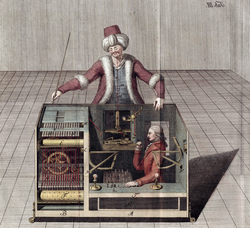
In 1770 a Hungarian engineer named Wolfgang von Kempelen built a chess-playing machine for the Habsburg court. It was a wooden cabinet with a life-size figure seated behind it, dressed in Ottoman robes and a turban. It played Benjamin Franklin in Paris and Napoleon in Vienna, and it toured Europe for decades as evidence that gears could think. There was a man folded into the cabinet working the arm. Amazon picked that story on purpose.
Mechanical Turk went public on 2 November 2005, built out of a patent disclosure Venky Harinarayan had written inside Amazon in 2001. The unit of work was a HIT, a Human Intelligence Task, and it was deliberately tiny: tag this photo, transcribe this receipt. Requesters posted HITs with a price attached, usually a few cents. Workers picked them off a list and got paid on approval. Bezos described the inversion to the New York Times in 2007 as artificial artificial intelligence, the computer calling a human instead of the other way round.
By January 2011 there were more than 500,000 registered workers in over 190 countries. The active population was always far smaller, a few thousand people at any given moment doing most of the volume, and the pay was the permanent scandal. A 2013 measurement put the effective rate around a dollar an hour. A 2018 study of real task logs found a median closer to two. Requesters had the right to reject finished work without paying for it, and some used it, which The Nation wrote up in 2014.
I have never posted a HIT or taken one, and I still work directly on top of what those workers produced. The object categories I train detectors against trace back to ImageNet, which was annotated between 2007 and 2009 by tens of thousands of MTurk workers spread across more than a hundred countries. Computer vision does not say that out loud very often. The benchmark the whole field grew up on is a pile of human judgments bought at a few cents each.
~ the case file ~
| Born | 2 November 2005, out of a 2001 Amazon patent disclosure by Venky Harinarayan |
|---|---|
| Peak | over 500,000 registered workers across more than 190 countries by January 2011 |
| Killed | 30 September 2026, announced 25 August |
| Lifespan | just under 21 years |
| Made by | Amazon Web Services |
| Killed by | an AI data market that moved to paid expert annotators |
~ the name ~
Von Kempelen's Turk was a European cabinet with a European idea of a Turk bolted to the front. The costume sold the illusion better than a plain mannequin could, and above the waist that was the entire engineering of it. Edgar Allan Poe published an essay in 1836 reasoning out that a person had to be inside. The machine burned in a Philadelphia museum fire in 1854.
As product names go, Amazon's was candid. It stated in the brand that the intelligence on offer came from a person the buyer would never see, and reporters covering invisible labor in the AI supply chain spent twenty-one years using that word against the company.
~ what the labels built ~
Two industries ran on it. The first was academic. By the early 2010s a large share of published psychology and behavioral economics experiments recruited their subjects through MTurk, cheaply and at sample sizes a campus lab could not reach, which started a long argument about whether an MTurk panel could stand in for a population. The second was machine learning. Training sets need labels and labels need people, so for a decade this was the default place to buy them: image classification and speech transcription at first, later the human preference ratings used to tune early language models.
~ the last five weeks ~
AWS had already signaled it. The 30 June 2026 service availability update moved Mechanical Turk into maintenance, and new customer sign-ups stopped a month later. On 25 August a notice went up on mturk.com saying that after an internal assessment Amazon had decided to close the marketplace, with a hard date of 30 September. Requesters got five weeks to drain their queues. Workers got five weeks to submit whatever they had open, after which unsubmitted HITs expired.
Amazon never gave a public reason past the assessment. The read from outside was that demand had moved to firms like Scale AI and Mercor, which supply vetted specialists at professional rates, because the work worth paying for is now grading a model's answer in a field you actually know rather than tagging a photo. mturk.com still answers. The page says Mechanical Turk is no longer available and points at an FAQ.
~ leave a rose ~
an anonymous tribute. one rose per visitor per day.
@}-->-- ... roses left here
~ leave a wreath ~
a rose fades by morning. a wreath stays on this grave for good, with your name on it.
from $1, paid once through stripe. it keeps the graveyard running: the hosting and the nightly digging. adopt it and the headstone reads "maintained in memory by" you. the groundskeeper plants new wreaths at the next tending, usually within a day.
» one email a week: new graves and the anniversaries of the dead. subscribe
other online services: GOOG-411, Nature Precedings, BitPass, Radish Fiction
also died in the 2020s: Gundam Evolution, Suntuubi.com, Sameroom
~ leave a note ~
visitors before you have left these graveside notes. anonymous welcome.