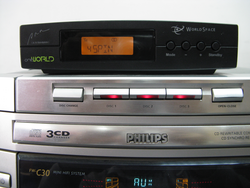
WorldSpace
» see worldspace.com as it lived, on the wayback machine
~ the obit ~
There is a version of the last thirty years where the satellite gets to the underserved parts of the world before the cable and the cell tower do. WorldSpace is what that version looked like when somebody actually built it. Noah Samara, an Ethiopian-American lawyer, founded the company in 1990 under the name AfriSpace, and the first thing it accomplished was not a product at all. Working with Thomas van der Heyden, Samara got the ITU at the 1992 world radio conference to carve out a new L-band allocation, 1452 to 1492 megahertz, dedicated to broadcasting satellite services. He had the spectrum before he had the satellites.
AfriStar went up in 1998 and AsiaStar followed in 2000. Broadcasting started on 1 October 1999 over Africa. The proposition was straightforward in a way that later satellite radio never quite matched: buy a receiver with a small flat antenna, point it roughly at the sky, and you had clean digital audio anywhere under the beam with no local transmitter needed. At its largest the network carried 62 channels, 38 of them from outside providers including the BBC and NPR, the rest produced in company studios that ran out of Washington and Bangalore.
None of this reached me and it was never going to. AfriStar's footprint clipped southern Europe and the Middle East, so Turkey was technically inside a beam, but the receivers were sold in Indian and East African electronics shops and the subscriber base was Indian by an overwhelming margin. What Turkey got in exactly those years was cheap ADSL from TTNet, which solved the same problem from the ground up and did not require anyone to buy a dedicated box.
~ the rap sheet ~
| Born | 1 October 1999, first broadcast over Africa from AfriStar |
|---|---|
| Peak | over 170,000 paying subscribers, more than 95 percent of them in India |
| Killed | 31 December 2009 |
| Lifespan | just over ten years on air |
| Made by | WorldSpace Inc, founded 1990 in Silver Spring, Maryland by Noah A. Samara |
| Killed by | a satellite build it could not pay for, and a receiver nobody outside India would buy |
~ the rise ~
India was the one market that worked. WorldSpace receivers were built by local manufacturers under names like BPL and sold as an upmarket alternative to FM, at a moment when Indian FM was heavily regulated and thin on content. Classical and jazz channels with no advertising and no local equivalent were the draw. The Indian operation was profitable on its own, and Forbes India later put the count there at 450,000 subscribers across the run.
Everywhere else the numbers stayed small. The company held a license to broadcast to the Americas and never used it. A third satellite, built and paid for, was never launched. The four WorldSpace-produced music channels that reached American listeners did so through a distribution arrangement with XM Satellite Radio, and that arrangement ended in 2008 along with everything else.
~ how it actually ended ~
The satellites cost far more than the subscriptions ever brought in. The 2007 accounts show revenue of $13.78 million against a net loss of $169.51 million, which is not a business with a bad year, it is a business with a structural hole in it. In July 2008 the company rebranded itself 1worldspace, redesigned the website and issued a press release about its new corporate identity. Three months later, on 17 October 2008, WorldSpace and its US subsidiaries filed for Chapter 11 in Delaware.
European operations were liquidated in the spring of 2009. On 25 December 2009 the company sent notices to every Indian subscriber saying the service would end on 31 December, six days later, with no refunds on prepaid subscriptions. Some of those people were holding multi-year plans. Liberty Media circled the assets for a while and walked away, and in June 2010 the satellites went to Yazmi USA for $5.5 million, a company run by Samara himself.
~ what got buried with it ~
The receivers are the part that stings. A WorldSpace set was a real purchase in Bangalore or Nairobi, and on 1 January 2010 every one of them became a box with a working antenna pointed at a satellite that no longer sent anything down. There was no migration path and no partial service. The hardware did not break, the broadcast simply stopped, which is a specific kind of death that only happens to things you receive rather than things you connect to.
Timbre Media relaunched the WorldSpace name in India in 2011 with Saregama, streamed over the internet and over direct-to-home television, and the old receivers explicitly did not work with it. The satellites themselves are still up there under Yazmi, repurposed toward satellite-to-tablet delivery of educational material. The band Samara talked the ITU into creating in 1992 is still allocated. The listeners are the only part that did not survive.
~ leave a rose ~
an anonymous tribute. one rose per visitor per day.
@}-->-- ... roses left here
~ leave a wreath ~
a rose fades by morning. a wreath stays on this grave for good, with your name on it.
from $1, paid once through stripe. it keeps the graveyard running: the hosting and the nightly digging. adopt it and the headstone reads "maintained in memory by" you. the groundskeeper plants new wreaths at the next tending, usually within a day.
» one email a week: new graves and the anniversaries of the dead. subscribe
other connectivity: Supra Corporation, VPNLab, Clearwire (CLEAR), Cingular Wireless
also died in the 2000s: SegaSoft, Active Desktop, Presto Studios
~ leave a note ~
visitors before you have left these graveside notes. anonymous welcome.