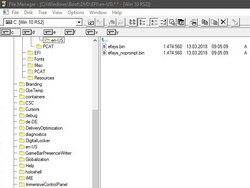
Windows File Manager
~ the last words ~
File Manager arrived with Windows 3.0 on 22 May 1990, though the design predates that. Microsoft had shipped the same idea in OS/2 1.1 in November 1988 under the name File System, and WINFILE.EXE was the Windows port of it. The layout was a directory tree in the left pane, file listing in the right, and a strip of drive letter buttons along the top. You picked a drive, walked the tree, and dragged files between two windows tiled next to each other.
It was rewritten as a 32-bit application for Windows NT 3.1 and kept current through NT 4.0, with the final build, 4.0.1381.318, arriving in Service Pack 6a in 1999. The 16-bit version had a longer and stranger run. Windows 95 introduced Explorer and made it the default, which should have been the end, and File Manager shipped anyway in 95, then in 98, then in Windows Me. Windows Me was released on 14 September 2000 and that was the last time the program came in a Windows box. Windows 2000 dropped it, and nothing after that carried it.
The reason it survived Explorer by five years is that a huge number of people had learned a Windows 3.1 machine and were not going to relearn file handling to get to their documents. Explorer put a single pane in front of you and expected you to open a second window if you wanted to copy something. File Manager had always shown you both ends of the operation at once. Microsoft kept the old program in the box for the same reason it kept a DOS prompt there, because removing it would have broken how a large part of the installed base actually worked.
My first Windows was 98, at home in Turkey on a dial-up line, and winfile.exe was sitting in the Windows directory with no shortcut pointing at it. That is how most people my age found it, by opening Run and typing the name because somebody on a forum said to. It looked ten years older than the rest of the desktop, and for moving a folder of mp3 files off a shared drive it was faster than anything Explorer offered.
~ the record ~
| Born | 22 May 1990, in Windows 3.0, as WINFILE.EXE |
|---|---|
| Peak | the default file tool on Windows 3.x, shipped again in 95, 98 and Me |
| Killed | 14 September 2000, the release date of its last host |
| Lifespan | 10 years in the box |
| Made by | Microsoft |
| Killed by | Windows Explorer, five years after Explorer shipped |
~ the two-pane argument ~
The tiled two-pane layout is the oldest live argument in file management, and File Manager was the mainstream Windows expression of it. Norton Commander had established the pattern on DOS and XTree had its own version. Explorer broke with all of them by treating the file system as one tree you browse rather than two locations you move things between. Thirty years later the argument is unresolved, which is why Total Commander and Midnight Commander still have devoted users. Explorer eventually conceded part of it by adding a navigation pane and then tabs in Windows 11, which is a two-pane layout arrived at by a longer road.
~ the 16-bit tail ~
The version shipping in Windows Me in September 2000 was still a 16-bit executable, which means the file manager in Microsoft's last consumer DOS-based operating system was built for an architecture two generations behind the machines running it. It could not see long paths properly and it did not know about anything the shell had learned since 1993. It ran because Windows Me still had the 16-bit subsystem underneath for exactly this kind of cargo.
That is the actual date of death. Windows XP shipped in October 2001 on the NT kernel with no 16-bit consumer baggage, and File Manager had nowhere left to run on a home machine.
~ the github years ~
On 6 April 2018 Microsoft published the File Manager source under the MIT license at github.com/microsoft/winfile, adapted so it would build and run on Windows 10. In late January 2019 it turned up in the Microsoft Store as a free download. Somebody at Microsoft spent real effort resurrecting a program the company had stopped shipping eighteen years earlier.
The repository was archived on 4 March 2025 and maintenance stopped. The code is still there and still builds, which makes this one of the few graves on this site where you can download the deceased and run it this afternoon. What died in 2000 was File Manager as a thing that came with your computer, and that has not come back.
~ leave a rose ~
an anonymous tribute. one rose per visitor per day.
@}-->-- ... roses left here
~ leave a wreath ~
a rose fades by morning. a wreath stays on this grave for good, with your name on it.
from $1, paid once through stripe. it keeps the graveyard running: the hosting and the nightly digging. adopt it and the headstone reads "maintained in memory by" you. the groundskeeper plants new wreaths at the next tending, usually within a day.
» one email a week: new graves and the anniversaries of the dead. subscribe
other utilities: Xmarks, abload.de, DiggBar, WhenU SaveNow
also died in the 2000s: CherryOS, KOL (AOL Kids Online), Suck.com
~ leave a note ~
visitors before you have left these graveside notes. anonymous welcome.