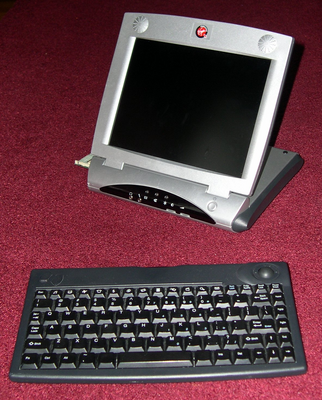
Virgin Webplayer
» see virginconnect.com as it lived, on the wayback machine
~ the obituary ~
In 2000 a dial-up account in Turkey was billed by the minute and the phone company took its cut of every one of them, so the arithmetic of sitting online was something you did in your head before you connected. The American offer that year was the opposite arithmetic: a company would hand you a computer and unmetered access, and take payment in attention. The Virgin Webplayer is what that offer looked like as an object.
Virgin Entertainment Group put the device out through Virgin Connect, giving away ten thousand units to people who agreed to have their usage monitored and to see targeted advertising while they browsed. The other tier was fifty dollars for the hardware and three years of unlimited dial-up, carried by Prodigy. The screen was a ten inch 800 by 600 panel, input came from an infrared keyboard with a trackball in it, and there was a 56k modem in the back. No hard drive, no floppy, nothing to install.
It lasted months. On 9 November 2000 the news went around that Virgin Connect was finished, and the service was switched off at midnight on 15 November. Subscribers were told they were no longer bound by the member agreement, offered prepaid shipping labels to send the hardware back, and given gift certificates for virginmega.com. Charter members who had signed up for a three year deal eleven months earlier noticed the size of the gap between what they were promised and what they got.
~ the case file ~
| Born | 2000, ten thousand units given away to users who accepted monitoring and on-screen ads |
|---|---|
| Peak | the $50 offer: the box plus three years of unlimited prodigy dial-up |
| Killed | 15 november 2000, service off at midnight |
| Lifespan | under a year on the market |
| Made by | virgin entertainment group, hardware built by acer and also sold as the boundless ibrow |
| Killed by | an ad-funded free-access model that stopped funding anything in late 2000 |
~ the terms ~
The business case only worked if the advertising paid for the hardware and the dial-up forever, against a user base selected for wanting a free computer. Advertising rates were collapsing through the second half of 2000 and the free-ISP companies went first, because they had the fewest other things to sell. Virgin was in a better position than most, with record stores behind it and the option of calling the whole thing a marketing expense, and it still closed the service before the first year was out. The device itself was fine: a competent small computer with a Cyrix MediaGX at 200MHz, 64MB of RAM and a 48MB flash module standing in for a disk. What killed it was that the box had exactly one purpose, dialing an ISP that had stopped existing.
~ what people did with the hardware ~
Liquidators got the leftovers, and the hobbyists went after them. A co-op of more than fifty people bought a lot of Webplayers together at around a hundred dollars each. The operating system was locked to Virgin's dial-in, but there was a password-protected setup screen, and someone wrote a utility that guessed the rotating password often enough to let an owner point the modem at any ISP they liked.
That was not enough for most of them, because Virgin's interface was still Virgin's interface. Attention moved to the BIOS, an insider leaked the password as schwasck, and after that the Webplayer was a normal x86 machine with a 44 pin IDE header waiting for a disk. People fitted cut-down Windows 98 images into the 48MB of flash, added Ethernet and 802.11 cards through the Mini-PCI slot, and generally got more use out of the thing after Virgin abandoned it than during the eleven months it was a product.
~ the category it died with ~
The internet appliance wave lasted about three years and every entrant found the same wall. Netpliance sold the i-Opener at a loss and watched the hack community take the hardware without ever starting the subscription that was supposed to pay for it. The Webplayer is the version where the subsidy came from advertising instead of a monthly fee, which turned out to be the more fragile of the two arrangements by a wide margin.
Nothing replaced these boxes, because the thing they were built for stopped being a separate activity. Households that wanted a cheap second screen for the internet got a cheap laptop instead, and then a phone. The appliance only made sense in the short window when a PC was expensive and the internet was a place you visited.
~ leave a rose ~
an anonymous tribute. one rose per visitor per day.
@}-->-- ... roses left here
~ leave a wreath ~
a rose fades by morning. a wreath stays on this grave for good, with your name on it.
from $1, paid once through stripe. it keeps the graveyard running: the hosting and the nightly digging. adopt it and the headstone reads "maintained in memory by" you. the groundskeeper plants new wreaths at the next tending, usually within a day.
» one email a week: new graves and the anniversaries of the dead. subscribe
other gadgets: Prológica, Ambient Orb, HP Pavilion, New Internet Computer
also died in the 2000s: Yahoo! World of Star Wars, Stormfront Studios, Atlas.cz
~ leave a note ~
visitors before you have left these graveside notes. anonymous welcome.