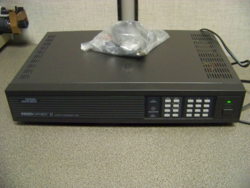
VideoCipher
~ the eulogy ~
In 1986 I was two years old and on the wrong continent. This grave is entirely a paper trail for me, and it is worth saying why the object itself never traveled: the thing VideoCipher was defending against was a specifically American arrangement, a household with enough land to plant a ten foot dish and pull down raw network feeds for nothing. Turkey got satellite dishes later and smaller, aimed at broadcast television nobody was scrambling in the same way.
VideoCipher was scrambling and descrambling equipment for cable and satellite, invented at Linkabit in 1983. M/A-COM bought Linkabit in 1985 and General Instrument bought the division in 1987, so the brand outlived two owners before Motorola picked it up along with General Instrument in 2000. What it did was simple to describe and expensive to build: it made a satellite feed useless without a box that had been told to work.
The date that matters is 15 january 1986. HBO and Cinemax had been encrypting the west coast feeds part time through 1985, and on that day the encryption went full time. Contemporary reporting called it S-Day. A few hundred thousand people who had bought large dishes on the understanding that the sky was free discovered they had bought a subscription antenna instead.
~ the dossier ~
| Born | 1983, at Linkabit in San Diego |
|---|---|
| Peak | 15 january 1986, the day HBO scrambled and the dish owners found out |
| Killed | 31 december 2008, when Motorola stopped authorizing decoders |
| Lifespan | twenty-five years |
| Made by | Linkabit, then General Instrument from 1987 |
| Killed by | the analog satellite band going digital |
~ the origin ~
Scrambling is not really a technical problem, it is a billing problem wearing a technical costume. The satellite industry had a genuine grievance: cable systems paid for programming and dish owners took the identical signal for free. VideoCipher was the mechanism that let the first group's business model survive contact with the second group's hardware.
It worked in the sense that a subscription market appeared where none had existed. It failed in the sense that the security lasted about as long as it took interested people to open the box. Modified descramblers were a recognized trade almost from the start, and General Instrument spent years shipping revisions against them, arriving at VideoCipher II Plus in 1992 with renewable security modules. The renewable part was an admission that the fixed part had lost.
~ the funny part ~
On 27 april 1986, twelve weeks after S-Day, a satellite dish dealer named John MacDougall took over HBO's transponder from the uplink facility where he worked a night shift. Subscribers watching a movie got several minutes of color bars and text signed Captain Midnight, complaining about the monthly fee. He was traced within weeks and fined five thousand dollars with a year of probation.
It is remembered as a prank and it was closer to a market signal. One employed adult with access to an uplink was annoyed enough to jam a national premium channel over a pricing decision. The industry read it as a security incident. The more useful reading was that they had just converted a large group of enthusiastic customers into people who felt robbed, and enthusiasm turned that direction does not go quiet.
~ the day it died ~
General Instrument stopped building the VC II Plus RS modules in 1998, which is when the platform stopped having a future and started having an installed base. Ten years later, in october 2008, Motorola announced that its authorization center would issue no further authorizations after 31 december 2008, and the remaining analog channels would move to digital behind that date.
The very end came later and quieter. The Weather Channel kept an analog feed running until 26 june 2014, long after there was any commercial reason to, which means the last thing protected by a twenty-five year old encryption system was the weather. Nothing about this technology survives except the pattern: build a lock, watch it get picked, ship a better lock, and eventually change the format underneath so the whole argument becomes irrelevant.
~ leave a rose ~
an anonymous tribute. one rose per visitor per day.
@}-->-- ... roses left here
~ leave a wreath ~
a rose fades by morning. a wreath stays on this grave for good, with your name on it.
from $1, paid once through stripe. it keeps the graveyard running: the hosting and the nightly digging. adopt it and the headstone reads "maintained in memory by" you. the groundskeeper plants new wreaths at the next tending, usually within a day.
» one email a week: new graves and the anniversaries of the dead. subscribe
other protocols: Do Not Track, Web SQL Database, Microsoft ActiveX, X.25
also died in the 2000s: DotComedy, HD VMD, Caldera OpenLinux
~ leave a note ~
visitors before you have left these graveside notes. anonymous welcome.