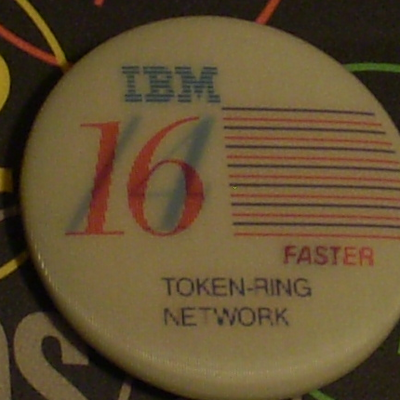
Token Ring
~ the last words ~
I can still draw it: the ring, and the token going around it that a station has to wait for before it is allowed to speak. Token Ring sits on the syllabus of every computer engineering department that teaches networking, right next to Ethernet as the other answer, IEEE 802.5 against 802.3. That is where I met it and it is the only place I ever met it. Every cable I have physically pushed into anything has been Ethernet.
IBM shipped the first product on 15 October 1985 at 4 Mbit/s, out of work done at its Zurich Research Laboratory by Werner Bux and Hans Müller. A 16 Mbit/s version followed in 1988 and the IEEE standardized the design as 802.5 in 1989. The technical argument was real. A station transmits only while it holds the token, so nothing ever collides, and the worst case delay before your turn comes round is a figure you can work out on paper. Ethernet at the time could not promise anybody anything of the sort.
Under load IBM was right, which is the frustrating part of the story and the reason the thing stays on the syllabus. Token Ring degraded gracefully in exactly the conditions where early Ethernet fell apart. Had the question been settled on behavior at high utilization, it would have won it comfortably.
~ the record ~
| Born | 15 october 1985, ibm's first token ring product at 4 mbit/s |
|---|---|
| Peak | the early 1990s, standard issue anywhere ibm had sold the mainframe |
| Killed | 21 july 2012, when linux 3.5 shipped without it |
| Lifespan | twenty-seven years, most of them spent losing |
| Made by | ibm zurich research laboratory, werner bux and hans müller |
| Killed by | 10base-t ethernet at a third of the price per port |
~ why it lost ~
The question was settled on the price of a card. A Token Ring adapter cost something like three times an Ethernet adapter, and router ports were worse. Then 10BASE-T arrived and put Ethernet onto the ordinary unshielded telephone-grade copper already sitting in the walls, while Token Ring still wanted shielded twisted pair and a Multistation Access Unit in the closet.
The other thing that happened is that Ethernet stopped being the thing IBM had been arguing against. Switching gave every station its own collision domain, which quietly deleted the contention problem that was Token Ring's whole case. By the time Fast Ethernet shipped there was nothing left to defend. Cisco walked away from the 100 Mbit/s High Speed Token Ring effort in 1998 citing an absence of demand, and that was effectively that. The gigabit standard, 802.5z, was published on 4 May 2001 and no product was ever built to it.
~ the patent ~
There is a detail here that people who worked with the hardware never forgot. The token-passing idea was covered by a patent held by Olof Söderblom, who did not work for IBM, and every vendor building Token Ring equipment paid him a license fee that went straight into the price of every card. He collected something in the region of $20 million.
Robert Madge of Madge Networks refused to pay from the beginning, arguing that peer-to-peer local networking under IEEE 802.5 was simply not what the patent described. A British court agreed on 24 June 1990 and ruled the patent invalid, although it had already expired in the UK two years earlier. The American patent ran until 1998. So through the years when Token Ring was competing hardest on price, it was carrying a royalty that a court eventually said should never have been charged.
~ the death certificate ~
Standards do not get switched off, so there is no announcement to point at. The closest equivalent arrived in May 2012, when Paul Gortmaker found the token ring subsystem getting in the way of some cleanup work in the Linux kernel and went looking for anybody who still used it. His conclusion was that even the enthusiasts poking at it had given up somewhere between 2003 and 2005 and had never moved off their 2.4 kernels.
He wrote a patch deleting the entire subsystem. David Miller did not treat it as a conversation starter, he merged it directly into net-next, and Linux 3.5 shipped on 21 July 2012 without token ring in it. Someone commenting on the announcement said he was sure all three people on the planet running Linux on a token ring adapter were up in arms about it. Nobody was.
~ the long tail ~
The interesting thing about a losing standard is where it surfaces afterwards. Deterministic media access, the exact property Token Ring existed to guarantee, is what industrial and automotive networks actually need, and it came back years later inside Ethernet itself through the time-sensitive networking work at IEEE 802.1. The idea won on its own. The cabling and the license fee did not come with it.
What is left is a diagram on a whiteboard in a networking lecture, drawn every year by someone who has never seen the hardware, for students who never will. That is the best afterlife a dead standard gets. Not a museum, a teaching aid.
~ leave a rose ~
an anonymous tribute. one rose per visitor per day.
@}-->-- ... roses left here
~ leave a wreath ~
a rose fades by morning. a wreath stays on this grave for good, with your name on it.
from $1, paid once through stripe. it keeps the graveyard running: the hosting and the nightly digging. adopt it and the headstone reads "maintained in memory by" you. the groundskeeper plants new wreaths at the next tending, usually within a day.
» one email a week: new graves and the anniversaries of the dead. subscribe
other protocols: OSCAR protocol, NexTView, Ceefax, UUCP
also died in 2010-2014: Handango, Peek, On2 Technologies
~ leave a note ~
visitors before you have left these graveside notes. anonymous welcome.