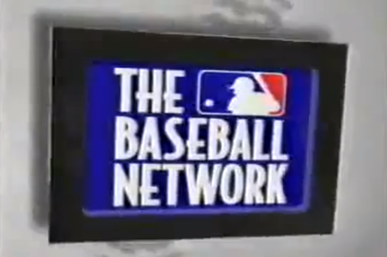
The Baseball Network
~ the last words ~
On 28 May 1993 the owners of major league baseball voted, overwhelmingly, to stop selling their sport to television. CBS had been paying them $1.057 billion over four years and losing money on it, and nobody was going to pay that again. So the league built its own network instead, a joint venture with ABC and NBC in which the league produced every telecast and the two networks bought the airtime. Each of them put up $10 million in start-up money. The league kept 85 percent of the first $140 million of advertising revenue. This was the first television network in the United States owned by a sports league. The quieter half of that description is that it ran closer to an infomercial than to a broadcast deal.
The first thing it ever put on air was the All-Star Game on NBC from Pittsburgh on 12 July 1994, and the first regular broadcast was four nights later from Seattle, under a title that promised something the product could not deliver: Baseball Night in America. There was no national game. Every market got whichever game it was closest to, up to about 14 of them in a season, and on the twelve dates the networks had locked up nobody else could show baseball at all. The regionalizing carried into October. In 1995 the Mariners and Yankees played a division series that only about a fifth of the country could watch in full, and only the World Series was guaranteed to go out everywhere.
Understanding this network meant knowing which of the 28 clubs was yours. Ankara has never appeared on that list and none of this went out on Turkish television in any form, so what is written above comes off the trade press rather than off a memory of watching it. The venture sold proximity to a local team, and nothing in it was built for anybody standing outside the map.
~ the record ~
| Born | 12 July 1994, the All-Star Game on NBC from Pittsburgh |
|---|---|
| Peak | a 6.2 rating for Baseball Night in America in 1994, against CBS at 3.8 the year before |
| Killed | 28 October 1995, game six of the World Series on NBC |
| Lifespan | 15 months on air, 29 months from the owners' vote |
| Made by | Major League Baseball with ABC and NBC |
| Killed by | the 1994 players' strike, then both networks walking away |
~ what the networks bought ~
The logo tells the story faster than the contract does. On screen it was a blue card reading THE BASEBALL NETWORK with the league's own silhouetted batter sitting inside the lettering, the mark of the rights holder printed into the name of the broadcaster. Bob Costas, who was calling games for NBC at the time, put the problem plainly: it was baseball's objective to market itself nationally, and this made it a local sport. Tom Verducci in Sports Illustrated called the result America's regional pastime.
The ratings were not the disaster the reputation suggests. Baseball Night in America averaged 6.2 in 1994 and 5.8 in 1995, well up on the 3.8 CBS had managed in 1993, and the 1995 World Series drew a 19.5 with a 33 share. What the model broke was the shape of the audience rather than its size. The All-Star Game slid from 14.79 million households in 1994 to 13.26 million in 1995, and the postseason arrived in pieces, with roughly 55 percent of the country able to see the American League championship series and 45 percent the National.
~ 12 august 1994 ~
Thirty-one days after the first broadcast, the players went on strike. Bud Selig canceled the rest of the season on 14 September, including the World Series, which had not been missed since 1904. The networks had sold something like $130 million of advertising, about $100 million of it against a postseason that no longer existed. NBC lost its entire regular-season slate before it had aired a single game of it. The strike ran 232 days and ended on 2 April 1995. The venture went into its second summer with the first one cut off a month in.
~ the final numbers ~
ABC and NBC decided on 22 June 1995 to get out, and said so publicly the next day, before the season they were still broadcasting had finished. Dick Ebersol of NBC Sports described a trail of broken promises, and Dennis Swanson at ABC said baseball was incapable at this point in time of living with any long-term relationship. Ken Schanzer, who ran the network, said only that he was saddened by it. The actual grievance was narrower than the quotes: Selig would not commit to 1996, and the networks forced the question rather than wait.
The last thing it transmitted was game six of the World Series on NBC on 28 October 1995. Costas signed off by calling it a strange and in a sense scarred baseball season ending in glory. On 7 November, ten days later, the league announced a five-year package worth about $1.68 billion with Fox and NBC, ESPN alongside them. Fox paid roughly $575 million of it. Under the old CBS contract each club had been taking around $14 million a year. Under the new one it was about $6.8 million.
~ leave a rose ~
an anonymous tribute. one rose per visitor per day.
@}-->-- ... roses left here
~ leave a wreath ~
a rose fades by morning. a wreath stays on this grave for good, with your name on it.
paid once through stripe. payments are handled by OÜ Lakeview, the small company that keeps rip.so running. the money pays for the hosting and the nightly digging. adopt it and the headstone reads "maintained in memory by" you. the groundskeeper plants new wreaths at the next tending, usually within a day.
» one email a week: new graves and the anniversaries of the dead. subscribe
other streaming: Silence, on Court!, Kakao TV, Zip.ca, CS Link
~ leave a note ~
visitors before you have left these graveside notes. anonymous welcome.