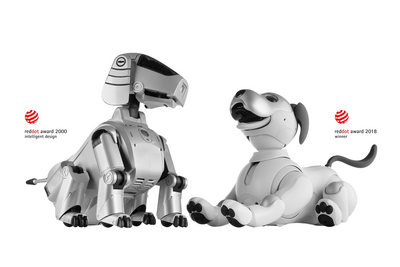
Sony AIBO (original line, 1999-2006)
~ the last words ~
in 1999 i was fifteen, on a 33.6k modem at home in ankara, the aibo was a 2500-dollar robot dog for sale in tokyo and a handful of us cities. that price point did not exist in turkish consumer life for a non-essential household object. the import market for japanese consumer electronics was niche enough that you mostly read about products like this in cnn or wired or saw them in magazines. by 2006 when the line was wound down i was finishing university and the gap had not closed.
the ers-110 launched on may 11 1999 in japan at 250000 yen with an initial production run of three thousand units, all sold out within twenty minutes of going on sale. the us launch followed shortly with the same hardware at around 2500 dollars and a similar small allocation. the name was an acronym for artificial intelligence robot, also a homophone for the japanese word aibo meaning companion. toshitada doi led the digital creatures laboratory inside sony where the device was developed, hajime sorayama designed the original case shape and a later generation that ended up in the moma collection and the smithsonian.
the line iterated through several generations across the seven-year run: ers-110, ers-111, ers-210, ers-220, ers-31x and the final ers-7 from 2003 at around 2000 dollars. the ers-7 was the most capable model with face and voice recognition, wifi, a charging dock the dog would walk to on its own when battery ran low. across the full line sony shipped around 150 thousand units worldwide, with japan and the us as the main markets and small european allocations.
on january 26 2006 sony announced the discontinuation of the aibo line as part of howard stringer's restructuring of the consumer-electronics division to focus on profitable categories. the last unit was produced in march 2006. the digital creatures laboratory was dissolved. sony continued offering paid repair service for existing units for a few more years, then phased out parts support around 2014. the 2018 ers-1000 revival under sony's new ai division is a separate product on different hardware, not a continuation of the 1999 line.
~ the record ~
| Born | may 11 1999 in tokyo, ers-110 launch at 250000 yen and ~2500 dollars in the us |
|---|---|
| Peak | ers-7 launch in 2003 at around 2000 dollars, total line shipped around 150k units |
| Killed | january 26 2006 announcement, march 2006 last unit, parts support phased out by 2014 |
| Lifespan | about 7 years as a shipping product |
| Made by | sony's digital creatures laboratory, toshitada doi led the program |
| Killed by | howard stringer's 2006 cost cuts, sony exited the consumer robotics segment |
~ what it actually did ~
the aibo was a quadruped robot with around twenty degrees of freedom across the legs, neck, tail, ears, and mouth. on-board sensors included a color camera in the nose, stereo microphones, touch sensors on the head and chin, an accelerometer, and a paw-pressure sensor. the runtime was aperios, sony's own real-time operating system, with a behavior layer that simulated emotional state through internal variables like joy, sadness, fear, and curiosity, each modulated by sensor inputs and time-of-day cycles. the dog had life stages: it shipped as a puppy and grew over months of use into an adult through a progression unlocked by interaction time.
the third-party programming side was a real research community. sony released the open-r sdk for academic developers, the robocup four-legged league used aibo units as the standard platform from 1998 through about 2008, university robotics labs ran behavioral and locomotion experiments on the hardware for the entire commercial life of the product. when sony killed the program in 2006 the open-r community lost the device they had built their research on, the four-legged league transitioned to humanoid platforms over the next few years.
~ the funny part ~
the most-cited aibo cultural fact is that japanese owners held funeral ceremonies for units that had failed and could no longer be repaired after sony withdrew parts support. the kofukuji temple in chiba prefecture held a group funeral service in 2015 for over a hundred broken aibos brought in by their owners, with a buddhist priest performing a memorial ritual before the dogs were sent to a-fun, a small repair company staffed by ex-sony engineers, to be disassembled for parts to keep other units running. the funeral story made global news at the time, mostly as a curiosity about japanese attitudes toward objects with personality.
the underlying logistical fact was that sony's parts withdrawal had left a community of long-term owners without an official repair path, the a-fun engineers running the gray-market repair service were the only people left who could keep the original line working. the funerals were the visible end of that supply chain, the dogs whose mechanical or electronic faults could not be sourced anymore had to be retired with whatever ritual the owner chose. the 2018 ers-1000 revival did not restore parts support for the original line.
~ leave a rose ~
an anonymous tribute. one rose per visitor per day.
@}-->-- ... roses left here
~ leave a wreath ~
a rose fades by morning. a wreath stays on this grave for good, with your name on it.
from $1, paid once through stripe. it keeps the graveyard running: the hosting and the nightly digging. adopt it and the headstone reads "maintained in memory by" you. the groundskeeper plants new wreaths at the next tending, usually within a day.
» one email a week: new graves and the anniversaries of the dead. subscribe
other gadgets: Holden, MasPar, Amplify Tablet, VCR Plus+
also died in the 2000s: The Cincinnati Post, Ruckus Network, ClarkNet
~ leave a note ~
visitors before you have left these graveside notes. anonymous welcome.