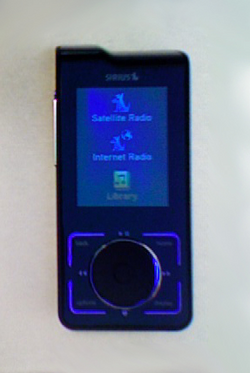
Sirius Stiletto
» see sirius.com as it lived, on the wayback machine
~ the obituary ~
Before the Stiletto, a portable Sirius radio was portable in the way a lamp is portable. The S50 that preceded it could be carried, but it could not hear the satellites unless it was sitting in a dock, so what you actually carried was a few hours of recorded programming and a device that went deaf the moment you left the car. The Stiletto 100 shipped in October 2006 with an antenna good enough to pull the live signal out of the sky while you walked, which was the entire point and a genuinely hard thing to build.
Inside it was two gigabytes of storage, worth about a hundred hours of Sirius audio, running off a battery good for roughly thirty hours. It also carried Wi-Fi, which streamed the same channels over the internet when a roof got between the antenna and the sky. It ran Linux, and the interface on top of that was built on Mono, the portable.NET implementation, which is a peculiar thing to find inside a radio. Ziba Design did the industrial design and the underlying technology came from Zing, a company Dell later absorbed. Wired called it a serious threat to the iPod, which was the framing everyone reached for that year.
Satellite radio was a subscription you could only buy if you lived under the correct satellites, and Turkey was not under them. Sirius broadcast to the United States and Canada and stopped there, so the premise this device rested on, that radio was a thing worth a monthly fee, never had to be argued about where I was. Radio here was FM and it was free, and the portable audio question had already been settled by mp3 files and a cheap player. Reading about the Stiletto now, the hardware is not the strange part. The strange part is that a hundred channels of somebody else's programming was a product you paid for every month.
~ the case file ~
| Born | October 2006, the Stiletto 100, designed by Ziba Design |
|---|---|
| Peak | November 2007, when the slimmer Stiletto 2 arrived with a microSD slot |
| Killed | early 2010, discontinued with no successor on the shelf |
| Lifespan | three years and a few months |
| Made by | Sirius Satellite Radio, on technology from Zing |
| Killed by | the merger with XM, and then the phone in everyone's pocket |
~ how it landed ~
Sirius sold it as one radio for every room you had, with a home kit and a vehicle kit so the same unit slid into a cradle on the desk or on the dashboard and became the stereo in either place. Partnerships with Napster and Yahoo Music filled the storage with material that had nothing to do with satellites. There were three models in the end. The Stiletto 100 was the full one. The Stiletto 10 was a cut-down revision with 256 megabytes, no Wi-Fi and no mp3 playback, which gained one feature the others never had: a seek function that watched for a named artist across every channel and told you when they came on.
The Stiletto 2 arrived in November 2007, slimmer than the original, with a microSD slot hidden behind the battery for your own files and Wi-Fi that finally understood WPA. It was the best version of the idea and it was also the last one. Fourteen months after it shipped, Sirius and XM had merged and the company had far larger problems than a hardware line.
~ the day it died ~
There was no announcement worth the name. Sirius simply discontinued the Stiletto line in early 2010, and the replacement, the Lynx, did not reach the market for more than two years afterward. That left a hole in the middle of the company's own product range that it apparently did not consider a hole.
The advice given to Sirius subscribers during those two years is the detail that says everything. If you wanted a portable radio, you were told to buy the XMp3i and subscribe to XM, which is the other company's hardware on the other company's service. Then you paid a further fee on top of that to receive Sirius channels on it. A merged company was selling its own customers a competitor's hardware and charging them a surcharge to hear what they had already subscribed to.
~ the long tail ~
Later in 2010 the smartphone apps arrived, on iPhone and Android first, and they streamed the channels over a data connection perfectly well. They also gave up the thing the Stiletto had been built to prove. A phone streaming over cellular is not receiving a satellite. It is receiving a server, and the satellite is a detail in the supply chain that the listener has stopped being able to perceive.
That is the ordinary way this ends. Whenever a device exists to solve the problem of getting a signal to a person in a field, and then the field gets covered by a network, the device stops being a category and becomes a feature of something else. The Stiletto was good at the hard problem for about three years, and then the hard problem was quietly deleted.
~ leave a rose ~
an anonymous tribute. one rose per visitor per day.
@}-->-- ... roses left here
~ leave a wreath ~
a rose fades by morning. a wreath stays on this grave for good, with your name on it.
from $1, paid once through stripe. it keeps the graveyard running: the hosting and the nightly digging. adopt it and the headstone reads "maintained in memory by" you. the groundskeeper plants new wreaths at the next tending, usually within a day.
» one email a week: new graves and the anniversaries of the dead. subscribe
other gadgets: JooJoo, Maťo, eMachines, AT&T Sceptre
also died in 2010-2014: JooJoo, Nokia Sync, Haystack
~ leave a note ~
visitors before you have left these graveside notes. anonymous welcome.