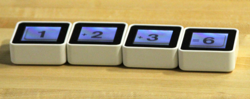
Sifteo Cubes
» see sifteo.com as it lived, on the wayback machine
~ the obituary ~
The idea arrived before the company did. David Merrill and Jeevan Kalanithi built a research prototype at the MIT Media Lab called Siftables, and Merrill demonstrated it at TED in February 2009 to the kind of reception that turns a lab project into a startup. The demo was a handful of small square screens on a table. You moved them around and pushed one against another, and the software knew exactly what you had just done.
Sifteo the company came out of that in 2009, and the first commercial Sifteo Cubes went on sale in September 2011 after a debut at CES that January. Each cube was an inch and a half across with a color screen on top and an ARM processor under it. A radio and a three-axis accelerometer let every cube work out which of its siblings was beside it and on which side. A set of three cost about $150.
The games were the argument. There were word games where you slid letters together into a cube-sized answer, and puzzle games where the board got rearranged by hand instead of by a controller. It was the first mass-market attempt at a screen that cared about its own position relative to other screens, and reviewers liked it in the way reviewers like things they are not going to buy.
Two generations shipped over three years and neither found enough customers. On 29 July 2014, 3D Robotics announced it had acquired Sifteo, price undisclosed, and the founders posted a farewell letter saying the team was moving to drones.
~ the case file ~
| Born | September 2011, after a debut at that January's CES |
|---|---|
| The prototype | Siftables, MIT Media Lab, shown at TED in February 2009 |
| Hardware | 128x128 color LCD, 32-bit ARM and an accelerometer per cube |
| Second generation | shipped 23 November 2012, no computer required |
| Killed | 29 July 2014, when 3D Robotics bought the company |
| Support ended | August 2015 |
| Made by | David Merrill and Jeevan Kalanithi |
| Killed by | a $150 toy that took a paragraph to explain |
~ what the cubes actually did ~
The interesting engineering was in the sensing. Each cube used a proprietary near-field system to detect neighbors, so the software always had a live map of the arrangement on your table. Games could ask questions no touchscreen can answer, like which cube is to the left of which, or what happens when a player picks one up and shakes it in isolation.
Everything else about the hardware was ordinary for 2011. A 128 by 128 display, eight megabytes of flash, a lithium polymer cell good for about four hours, and a 2.4 GHz radio. The first generation needed a computer nearby running the game and talking to a USB dongle, which meant a toy for ages six and up came with a system requirement.
~ the second generation ~
Sifteo announced the second version on 30 August 2012 and shipped it on 23 November, in time for the holidays. The important change was removing the computer. A small base station now held the games and drove the cubes, so the whole thing worked on a table with nothing else plugged in.
That fixed the objection everyone had made about the first version, and it did not move the numbers. The remaining problem was harder than a dongle. A parent standing in a store had to be told what the product was, and every honest description of Sifteo took longer than the shelf gave you.
~ where the team went ~
3D Robotics was Chris Anderson's drone company, and in 2014 it was hiring consumer hardware people faster than it could find them. Sifteo's engineers had shipped two generations of a battery-powered wireless device with a screen and a radio, which is most of what a camera drone is. The farewell letter promised support for existing owners through August 2015, and on 23 December 2014 the development software went to GitHub with parts of the platform open sourced.
Nothing about the cubes was ever going to reach me in Turkey. It shipped from a San Francisco startup into American toy retail at a price that would have doubled by the time it cleared customs, for a category no shop here had a shelf for. The part I recognize is the ending, since drones and machine vision are what I work on now, and in 2014 a drone company was hiring exactly the people a failed toy company had spent five years training.
~ leave a rose ~
an anonymous tribute. one rose per visitor per day.
@}-->-- ... roses left here
~ leave a wreath ~
a rose fades by morning. a wreath stays on this grave for good, with your name on it.
from $1, paid once through stripe. it keeps the graveyard running: the hosting and the nightly digging. adopt it and the headstone reads "maintained in memory by" you. the groundskeeper plants new wreaths at the next tending, usually within a day.
» one email a week: new graves and the anniversaries of the dead. subscribe
other gadgets: Trinitron, Kaypro, MovieBeam, Sony Reader
also died in 2010-2014: Transpac, Yahoo! Meme, Ya.com
~ leave a note ~
visitors before you have left these graveside notes. anonymous welcome.