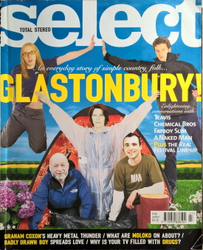
Select
~ the eulogy ~
Select was launched in July 1990 to take money off Q, and Billboard said so at the time in a headline that reads like a verdict: "Select Magazine is Launched, Right on Q". Q had proved that people who kept buying records into their thirties would buy a monthly written for adults, and United Consumer Magazines wanted a share of that. Prince was on the first cover. It sold 100,000 copies, then settled to about 75,000 a month across the rest of 1990, which Music Week reported in February 1991.
EMAP Metro bought it in April 1991, parking it under the same roof as the magazine it had been built to attack. Under Mark Ellen the early editorial line was baggy and Madchester, the sound that was actually happening in Britain when the magazine started. What it became famous for arrived two years later and was a different thing entirely.
The run is unusually tidy for a magazine of its era. One hundred and twenty-seven issues, July 1990 through January 2001, monthly, with no gaps and no double issues anywhere in the sequence. A fan-run scan archive has every cover in order, and you can watch a decade of British guitar music go past in a single scrolling page.
~ the dossier ~
| Born | July 1990, launched by United Consumer Magazines against Q |
|---|---|
| Peak | 100,000 copies of the first issue, with Prince on the cover |
| Killed | January 2001 |
| Lifespan | 10 years, 6 months, 127 consecutive issues |
| Made by | United Consumer Magazines, then EMAP Metro from April 1991 |
| Killed by | a 13 percent circulation fall, and indie going mainstream |
~ yanks go home ~
The April 1993 issue is the reason anyone still writes about Select. The cover stood Brett Anderson of Suede in front of a Union Flag with The Auteurs, Denim, Saint Etienne and Pulp around him, under the words Yanks Go Home. Inside, Stuart Maconie's piece carried the title "Who Do You Think You Are Kidding Mr. Cobain?". It was a music magazine declaring a trade war, and the thing it was declaring war on was selling very well at the time.
Credit for the word itself gets overstated and is worth stating carefully. The Guardian wrote in 2003 that Select "not only coined the word Britpop, but soon came to define it", and that line has been repeated for twenty years. Britpop was already circulating in the British music press before April 1993, used by writers including John Robb. What the cover did was give the word a context and a picture, and the picture is what traveled. Both The Independent and Pitchfork have since called that front page a decisive moment in setting Britpop's tone against American grunge.
In April 1993 I was nine, in school in Turkey, about as far from a British newsagent as geography allows. By 1998, with a modem of my own at last, Oasis and Blur had already arrived here under their own power, the way music was starting to arrive everywhere. The records crossed without any trouble. The magazine could not, because a monthly print object only exists where somebody physically stocks it, and the argument Select was having about whether British guitar music should beat American guitar music was an argument you had to be standing in Britain to overhear. From anywhere else, the war it declared just looked like a genre.
~ five promises in ten years ~
Select kept rewriting what it was for, and the evidence is in the strapline under its own logo. Pop Babylon! around 1994. You Love it by 1995. Music and Beyond by 1998, then Music for Tomorrow by 2000. The July 2000 cover carries Total Stereo in the top corner, so that one is datable to the last year. Five different claims about the same product inside ten years.
The later editorial history follows the same drift. John Harris stepped down and EMAP replaced him with Alexis Petridis, poached from Mixmag in December 1999 to widen the magazine out from indie toward what he described as a wide range of music fans. It did not take. Petridis later gave Paul Gorman the most quoted explanation of why, in Gorman's history of the music press: "No matter how many features we did on Destiny's Child, people still thought we were a magazine about Oasis." His other line on it is shorter and worse: they were forever associated with a music in decline.
~ kingsize ~
The trade press reported Select as already closed on 7 December 2000, after what it called a succession of declining circulation figures, with the latest ABC round showing 13 percent of the circulation base gone. EMAP's explanation was that indie music had moved into the mainstream. The last issue is stamped January 2001. One week after that December report, IPC axed the Melody Maker, and the Melody Maker's own obituary records that IPC had considered going monthly and decided against it precisely because EMAP had just shown a rock monthly could not hold its market.
EMAP then tried to fill the hole it had made. Kingsize launched in March 2001 at three pounds, edited by the former Q writer Ben Mitchell, aiming at US metal and hip-hop with snowboarding and skateboarding alongside. First print run was 60,000 for the UK and 20,000 overseas, against a projected circulation of about 35,000. It was closed on 31 July 2001 after four issues, with a spokesperson explaining that Kingsize had only ever been launched as a trial and the market was not right. Select lasted ten years and six months. Its replacement lasted four.
~ leave a rose ~
an anonymous tribute. one rose per visitor per day.
@}-->-- ... roses left here
~ leave a wreath ~
a rose fades by morning. a wreath stays on this grave for good, with your name on it.
paid once through stripe. payments are handled by OÜ Lakeview, the small company that keeps rip.so running. the money pays for the hosting and the nightly digging. adopt it and the headstone reads "maintained in memory by" you. the groundskeeper plants new wreaths at the next tending, usually within a day.
» one email a week: new graves and the anniversaries of the dead. subscribe
other media music: NEC Avenue, Style Jukebox, Epitonic, Clammr
also died in the 2000s: Microsoft Tafiti, Crawfish Interactive, OS/2
~ leave a note ~
visitors before you have left these graveside notes. anonymous welcome.