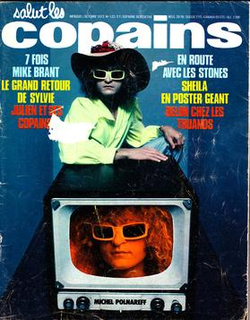
Salut les copains
~ the eulogy ~
The radio show came first. Europe 1 put the first Salut les copains on air on 24 September 1959, half an hour on a Thursday evening, presented by an American woman billed as Cindy. Daniel Filipacchi took it over shortly after and ran it as Onc' Dan, and from 19 October it went daily, two hours every weekday afternoon. At its height between 1961 and 1967 it was reckoned to be reaching up to forty percent of French twelve to fifteen year olds. Numbers like that belong to a country with one station worth listening to and nothing else aimed at anybody that age.
The magazine was the written extension of it, launched at the end of June 1962 by Filipacchi with his partner Frank Ténot, with issue one cover-dated July and August. French Wikipedia calls it exactly that, le prolongement écrit, and the structure explains the thing: a daily radio audience was handed a monthly object with photographs of the people they had been listening to. The covers were Johnny Hallyday and Sylvie Vartan, over and over, and the readership was the generation that had just been given its own music and no name for itself yet.
From that first issue it carried a hit parade, and the reason that mattered is physical. A radio show cannot be referred back to. A printed chart could be cut out and held against next month's, and for a reader of fourteen in 1962 it was the only written record that the music existed at all.
~ the dossier ~
| Born | July 1962, issue one cover-dated July-August, as the print arm of a Europe 1 show running since 1959 |
|---|---|
| Peak | 1,049,237 copies of the December 1963 issue, celebrated at a party in Paris in March 1964 |
| Killed | April 2006, under the name Salut, by then a bimonthly down to about 71,000 copies |
| Lifespan | Forty-four years as a title, ending under a different name |
| Made by | Frank Ténot and Daniel Filipacchi |
| Killed by | Falling sales at Edi-Presse, from 151,520 copies in 2002 to 71,000 across 2004 and 2005 |
~ 22 June 1963 ~
Europe 1 announced a free concert at the Place de la Nation two or three days in advance, on the radio, with Johnny Hallyday headlining and Sylvie Vartan on the bill, billed as the magazine's first birthday. Estimates of the crowd that turned up run from a hundred and fifty thousand to two hundred thousand, and the French and English accounts have never agreed which end of that range to print. It is remembered in France as la folle nuit de la Nation, the mad night of the Nation, and it is where the movement got its name: Edgar Morin wrote the event up in Le Monde afterward and used the word yé-yé, which stuck to all of it, magazine included.
~ one million and forty-nine thousand ~
The circulation peak is unusually well documented because somebody threw a party for it. In late March 1964 the publisher gathered people at Les Ambassadeurs in Paris to celebrate the print run of the December 1963 issue, and the figure given that evening was one million forty-nine thousand two hundred and thirty-seven copies, precisely. The same witness says the magazine was printing over a million before it was two years old. The body text of the French article is more cautious and says only that it passed a million copies sold at its peak. One figure is what came off the press and the other is what left the kiosk.
~ the title outlived the magazine ~
The title was sold to Edi-Presse at some point and renamed Salut, and the two Wikipedias cannot agree on when. The French article says it existed as Salut from 1976 with a different formula; the English one says it was renamed in January 1994. The Paris music library's holding is the most useful evidence either way, because it runs from number one in 1962 to number 164 in 1976 and then stops, exactly as it would if the original magazine ended there and something else took over the numbering.
The shape of the decline is not in dispute. Salut became a bimonthly for teenagers with a general youth remit. It sold 151,520 copies in 2002 and was down to around 71,000 across 2004 and 2005, and it stopped with the April 2006 issue. The French sentence is flat about it: ce nouveau titre arrête définitivement sa parution en avril 2006. This new title definitively ceases publication in April 2006.
The afterlife is all reissue. There were anniversary box sets and books in 2009, and a stage musical built out of the songs. The domain is the part worth checking: salutlescopains.com still works, and it does not go to anything about a magazine. It redirects to europe1.fr, the radio station the magazine was spun out of in 1962, which has quietly ended up holding the name of its own spin-off.
~ leave a rose ~
an anonymous tribute. one rose per visitor per day.
@}-->-- ... roses left here
~ leave a wreath ~
a rose fades by morning. a wreath stays on this grave for good, with your name on it.
paid once through stripe. payments are handled by OÜ Lakeview, the small company that keeps rip.so running. the money pays for the hosting and the nightly digging. adopt it and the headstone reads "maintained in memory by" you. the groundskeeper plants new wreaths at the next tending, usually within a day.
» one email a week: new graves and the anniversaries of the dead. subscribe
other media music: GarageBand.com (the music community), MP3tunes, Artemis Records, Next Big Sound
also died in the 2000s: StarForce, Network Computing Devices, Flektor
~ leave a note ~
visitors before you have left these graveside notes. anonymous welcome.