Rusty n Edie's BBS
~ the goodbye ~
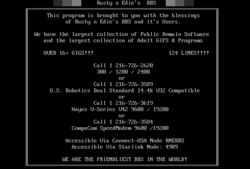
It opened on 11 May 1987 and it was a house. Russell and Edwina Hardenburgh ran Rusty n Edie's BBS from a residential address in Boardman, Ohio, and over six years that house filled up with modems. At the end it answered on 124 lines. It carried over 100,000 files, it had signed up more than 14,000 subscribers across North America and Europe at $89 for the year, and at its height it was logging something like 3.4 million calls at a rate above four thousand a day. Its own ad screen ran the pitch in exclamation marks, OVER 16+ GIGS!!! on one side and 124 LINES!!!! on the other, with four dial-in numbers underneath for four different grades of modem. The last line of it claimed this was the friendliest BBS in the world. The rules page ended with "Have fun, End of rules."
How the library filled up is what the courts cared about later. Subscribers could only pull down a limited number of files a month, but uploading earned credits that raised the ceiling, so the library grew because the customers were paid in download quota to grow it. Everything that came in landed first in an upload directory where a staff member had a quick look to decide whether it was acceptable, meaning not pornographic and not obviously copyrighted, and whatever passed was moved into the areas everybody could reach. Around fifty thousand of the files on offer were GIFs. About forty thousand of those were adult photographs.
The barrier at my end was the invoice rather than the hardware. Eighty-nine dollars had to clear in American funds every year, the call was an international one to Ohio metered by the minute by a state phone monopoly, and in January 1993 I was nine with no modem in the house to dial it from anyway. A board like this was somewhere you paid American money to sit. That payment relationship is also exactly why the FBI walked out of the house with a subscriber list worth reading.
~ the chronicle ~
| Born | 11 May 1987, two sysops in a house in Boardman, Ohio |
|---|---|
| Peak | over 14,000 subscribers at $89 a year across 124 lines |
| Killed | 30 January 1993, an FBI raid built with the Software Publishers Association |
| Lifespan | 5 years and 8 months as a going concern |
| Made by | Russell and Edwina Hardenburgh |
| Killed by | a piracy raid, then a copyright ruling that outlived the board by four years |
~ the morning of January 30 ~
A software author named Bob Fairburn tipped the FBI off about finding his own program, Expert Home Design, on the board. The Software Publishers Association was already circling bulletin boards at the time and worked the case alongside the agents for several months. On Saturday 30 January 1993 they came to the house and left with the computers, the drives, the telecom gear and the subscriber records, an estimated $200,000 of equipment. One board with fourteen thousand callers went off the air in a single day.
No criminal conviction of the Hardenburghs appears in any of the surviving accounts of the raid. What the seizure did instead was end the thing operationally: Rusty talked about coming back, patched together what hardware he could and eventually put up a page on the web, which the archive still holds a 1996 copy of. It never returned to anything like its former size.
~ what the court decided ~
Playboy Enterprises filed suit on 11 March 1993 over 412 GIFs that were scans of photographs out of its magazines, claiming copyright infringement and a Lanham Act violation on top. The defense was the obvious one for a sysop: we did not know, our subscribers put those there. On 25 November 1997 the district court for the Northern District of Ohio granted Playboy summary judgment on both direct and contributory infringement.
The reasoning is why the case still gets cited. Running a bulletin board, the court said, is not by itself enough for direct infringement, because that requires some element of direct action or participation. Two facts supplied it here. The Hardenburghs encouraged uploads with their credit scheme, and their employees looked at every uploaded file and moved the acceptable ones into general circulation. Those two things, the opinion held, transformed the defendants from passive providers of a space in which infringing activity happened to occur into active participants in it. The moderation was the liability.
~ the receipts ~
The Lanham Act claims were left for a jury and never got there. Case 1:93-cv-00546 was dismissed on 3 February 1998 after a settlement, five years and four days after the agents arrived at the house in Boardman. The board had been gone for most of that.
What survives is paperwork and anger. The raid produced a wave of furious text files that still circulate, one of them arguing that confiscating a man's computers over suspected software puts every magazine subscriber one tip-off from losing a PC. The docket survives because federal dockets do. Nobody archived the file library, which is the part the 14,000 of them had been paying for.
~ leave a rose ~
an anonymous tribute. one rose per visitor per day.
@}-->-- ... roses left here
~ leave a wreath ~
a rose fades by morning. a wreath stays on this grave for good, with your name on it.
paid once through stripe. payments are handled by OÜ Lakeview, the small company that keeps rip.so running. the money pays for the hosting and the nightly digging. adopt it and the headstone reads "maintained in memory by" you. the groundskeeper plants new wreaths at the next tending, usually within a day.
» one email a week: new graves and the anniversaries of the dead. subscribe
other file sharing: Multiupload, Boerse.bz, TNTVillage, FilesTube
also died in the 1990s: KC 85, VLSI Technology, Supra Corporation
~ leave a note ~
visitors before you have left these graveside notes. anonymous welcome.