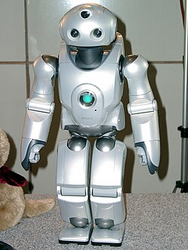
QRIO
~ the obituary ~
My working days go into machines that have to look at something and decide what to do about it without asking a server first. The constraint is always the same one. The compute has to ride on the thing, and the thing has a battery. QRIO solved a version of that problem in 2003 inside 7.3 kilograms, and then Sony put it in a drawer.
The project began in 2000 under the name Sony Dream Robot, SDR for short. The SDR-3X of 2001 was a walking demonstrator, a proof that the gait worked. The SDR-4X generation that followed was aimed at people instead: voice and face recognition good enough to remember who you were and what you had said you liked. In September 2003 Sony renamed the fourth-generation machine QRIO, short for Quest for cuRIOsity.
It stood about 60 centimeters tall and weighed 7.3 kilos. On 18 December 2003 Sony announced it had made the robot run, which in this field carries a strict definition: both feet leaving the ground at the same instant, with power and control carried on board rather than fed down a cable from a rack. Nothing had managed it before. The 2005 edition of the Guinness World Records wrote it down.
Then came the demonstrations that people actually remember. In March 2004 QRIO stood in front of the Tokyo Philharmonic and conducted Beethoven's Fifth. In 2005 a group of them danced through Beck's video for "Hell Yes". Sony ran daily shows at its Ginza building in Tokyo where as many as ten robots performed routines that had taken programmers three weeks to choreograph.
~ the case file ~
| Born | the Sony Dream Robot project, 2000, renamed QRIO in september 2003 |
|---|---|
| Peak | first bipedal robot to run on its own power, 18 december 2003 |
| Killed | 26 january 2006 |
| Lifespan | six years, none of them on sale |
| Made by | Sony |
| Killed by | a restructuring that closed the entertainment robotics division |
~ what got buried with it ~
On 26 January 2006 Sony announced it was stopping QRIO development. The same announcement discontinued AIBO, which had at least been a product people could buy since 1999. QRIO never was. In six years it was never given a price or a release date. The daily dances at Ginza stopped around the same week.
The reasons given were the ordinary ones. Sony was cutting costs and narrowing its focus, and a bipedal entertainment robot with an hour of battery life did not survive that arithmetic. What went with it was harder to replace than the robot: a division of people who had spent six years learning how to balance a walking machine in real time on hardware small enough to carry. That knowledge does not sit in a warehouse waiting for the market to improve.
~ the next chapter ~
Sony eventually came back to consumer robotics, releasing a new aibo in 2018 with a lot more compute and four legs. The biped work never returned. Honda kept ASIMO going for years longer before retiring it too, and the running humanoid became a research problem again rather than a thing that danced in a shop window in Tokyo.
The part that has aged strangely is the constraint. In 2003 the hard trick was doing perception and balance entirely on board, because there was no network fast enough to help and the battery gave you an hour. Twenty years later there are networks fast enough, and the industry has spent a lot of effort learning why you still cannot depend on them. QRIO was solving the right problem. It was just doing it for an audience of shoppers who were never invited to buy one.
~ leave a rose ~
an anonymous tribute. one rose per visitor per day.
@}-->-- ... roses left here
~ leave a wreath ~
a rose fades by morning. a wreath stays on this grave for good, with your name on it.
from $1, paid once through stripe. it keeps the graveyard running: the hosting and the nightly digging. adopt it and the headstone reads "maintained in memory by" you. the groundskeeper plants new wreaths at the next tending, usually within a day.
» one email a week: new graves and the anniversaries of the dead. subscribe
other gadgets: MASSCOMP, Cray Computer Corporation, Apple Newton MessagePad, Google Clips
also died in the 2000s: CyberCash, Yahoo LAUNCHcast, Netbul
~ leave a note ~
visitors before you have left these graveside notes. anonymous welcome.