Nintendomagasinet
~ the last words ~
Number 9 of 1994 was supposed to be in Swedish shops on 14 September. It never came out. The Swedish record of that games year marks the date as the closure itself, which is an unusual way to date a magazine: not by the last issue printed but by the first one that failed to appear.
Atlantic Förlag started it in August 1990 out of Bromma, under a license from Nintendo, running ten issues a year with Gunnar Lindberg as editor. In its early form it was closer to a comic book than to a games magazine, carrying strips drawn from the Nintendo catalog alongside the news and the guides, and subscribers got a supplement of their own called Power Player. The number of comic strips was cut back in April 1992, which is the first visible sign that somebody at the publisher had decided what the title was going to be when it grew up.
I turned ten the year this stopped, nowhere near Sweden and not reading Swedish. A magazine printed under license travels exactly as far as the license does, which is a much shorter distance than the thing it writes about. Cartridges crossed borders whether or not anyone had been licensed to carry them. The magazine about the cartridges crossed nothing.
The PlayStation was still a year away from Europe. What ended the magazine came from inside the same publisher: in March 1993 Atlantic launched a second Nintendo title called Super Power, edited by Jonas Svensson, a thicker magazine for an older reader with the comic strips left out. The two ran side by side from March 1993 to July 1994, both of them covering the same consoles for the same country. Then Atlantic stopped printing the older one.
~ the record ~
| Born | August 1990, Atlantic Förlag, Bromma |
|---|---|
| Peak | ten issues a year, plus a subscriber supplement called Power Player |
| Killed | 14 September 1994 |
| Lifespan | 4 years, 1 month |
| Made by | Atlantic Förlags AB, under a Nintendo license |
| Killed by | Super Power, its own publisher's second Nintendo magazine |
~ the comic that became a magazine ~
The thing worth noticing about the comic strips is that they were the original product. A licensed magazine for a console audience of children in 1990 was allowed to be mostly pictures, and the writing grew up inside the comic rather than the comic being added to the writing. Tobias Bjarneby made his debut as a writer here, and he went on to edit the magazine that replaced this one until November 2004.
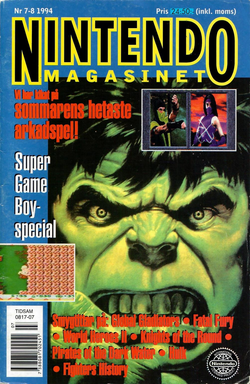
The last cover is a Super Game Boy special, marked Nr 7-8 1994, priced 29:50 including tax, promising tests of the summer's hottest arcade games across the top. Fatal Fury and Knights of the Round are listed along the bottom edge in a strip of small type. It does not read like a final issue, because nobody writing it had been told that it was one.
~ its own replacement ~
Super Power kept going. It added Sega coverage in 1995, hoping to pick up readers from the recently closed Sega Force and expecting about three hundred of them. It renamed itself Super PLAY in 1996, outlived its publisher's sale twice over, and ran until October 2009, when the advertising collapse of that year took it along with a motorsport title at the same house. That is fifteen years of afterlife for the magazine that finished off Nintendomagasinet. It should not be mistaken for the British Super Play that Future Publishing ran out of Bath in the same decade, which is a different magazine with a grave of its own.
~ the issue that never came ~
The English encyclopedia gives the last issue as July 1994. The Swedish games-year record gives 14 September 1994. Both are correct and they are counted from opposite ends: one is the final thing printed, the other is the first appointment missed. This grave uses the September date, because an ending that happens on a schedule is easier to see than one that happens on a press.
Almost everything published in English about this magazine rests on a single book, Martin Lindell's history of the eight-bit years and Nintendo's march into Swedish homes, and the Wikipedia article carries a one-source tag that says so plainly.
What survives is the object itself. A Swedish double issue at 29:50 with a Super Game Boy guide inside, and a date in September that the publisher had already decided to let pass.
~ leave a rose ~
an anonymous tribute. one rose per visitor per day.
@}-->-- ... roses left here
~ leave a wreath ~
a rose fades by morning. a wreath stays on this grave for good, with your name on it.
paid once through stripe. payments are handled by OÜ Lakeview, the small company that keeps rip.so running. the money pays for the hosting and the nightly digging. adopt it and the headstone reads "maintained in memory by" you. the groundskeeper plants new wreaths at the next tending, usually within a day.
» one email a week: new graves and the anniversaries of the dead. subscribe
other news: Vice.com, TGcom, Bajtek, Scout.com
also died in the 1990s: Number Nine Visual Technology, Music Boulevard, Photon Paint
~ leave a note ~
visitors before you have left these graveside notes. anonymous welcome.