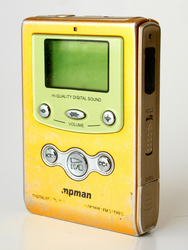
MPMan F10
» see saehan.com as it lived, on the wayback machine
~ the eulogy ~
the mpman f10 was the first device anybody could walk into a store and buy that played mp3 files from internal flash memory. saehan information systems in seoul shipped it in march 1998 with 32 megabytes of storage, a 90-by-70 millimeter brick of plastic that weighed 65 grams, and a docking cable that transferred files over the parallel port. japanese retailers stocked it in may. eiger labs imported a rebranded version into north america later that year for around 250 dollars.
this part of the story usually goes to the diamond rio because the rio is the one that got sued by the riaa. that lawsuit (recording industry of america vs diamond multimedia, ninth circuit 1999) is what made the rio the household name and the mpman a footnote. the rio shipped in october 1998, six months after the mpman, but it shipped into a country with a music industry willing to litigate, and the publicity from losing the lawsuit gave it a marketing budget the mpman never had.
i missed the mpman by both region and time. korean consumer electronics in early 1998 did not reach turkey in any retail form i could see from a 33.6k modem dialing into ttnet, and the diamond rio was already gone-from-stores by the time i had real broadband and could read about mp3 players online without timing out. my first portable music device was a discman a cousin brought from istanbul in 2000. flash-based mp3 players landed in turkey through the iaudio and creative zen wave around 2003 and by then the mpman was four years dead.
~ the dossier ~
| Born | March 1998, South Korea |
|---|---|
| Peak | May 1998, Japanese launch of 32MB and 64MB models |
| Killed | around 2000, eclipsed by Diamond Rio and the wider category |
| Lifespan | roughly 2 years on the market |
| Made by | Saehan Information Systems (Seoul) |
| Killed by | Diamond Rio PMP300 and the post-Napster mp3 player boom |
~ how it actually worked ~
you plugged the dock into the back of your pc through the parallel port, which was the same port your printer used and which transferred data at roughly 200 kilobytes per second on a good day. you ran a software utility that came on a cd, you dragged mp3 files into a window, the parallel port copied them across. 32 megabytes meant about eight songs at 128kbps, which was the standard bitrate of the napster era. you took the device off the dock and listened on headphones for maybe four hours on two aa batteries.
the audio quality was fine for the bitrate. the device had no display worth mentioning, no album metadata, no shuffle, no playlist. you queued songs by the order you copied them and you skipped tracks with a forward button. this was the entire interaction model for portable music on flash memory for the next two years.
~ what really happened ~
the mpman never really had a moment of death. saehan stopped manufacturing around the year 2000 as the category exploded with newer flash players from creative, iriver, samsung, and rio's own successors. the company kept selling other consumer electronics. eiger labs stopped importing the rebranded units. the brand did not get formally killed, it just stopped being on shelves.
the riaa response is worth pulling out separately. when the mpman launched, the riaa called it a device with "no function other than playing material that was stolen", which is a sentence that aged in a specific direction. by 1999 they were also calling it "a unique device, something we haven't seen on the market before", which is the closest thing the original mpman ever got to industry acknowledgment that the category was here to stay.
~ what it left ~
every flash-based mp3 player that came after copied the basic shape. small box, headphone jack, internal flash, transfer cable to a pc. the only major change before the ipod was usb mass storage replacing the parallel port. the ipod itself shipped in october 2001 with a hard drive instead of flash and a click wheel instead of a forward button, and the entire category split into hard-drive ipods and flash sticks for the next four years.
the mpman name still appears occasionally on cheap chinese-manufactured tablets and players using the brand under license. that is not a continuation. the saehan device that shipped in seoul in march 1998 is the one that matters, and it is gone.
~ leave a rose ~
an anonymous tribute. one rose per visitor per day.
@}-->-- ... roses left here
~ leave a wreath ~
a rose fades by morning. a wreath stays on this grave for good, with your name on it.
from $1, paid once through stripe. it keeps the graveyard running: the hosting and the nightly digging. adopt it and the headstone reads "maintained in memory by" you. the groundskeeper plants new wreaths at the next tending, usually within a day.
» one email a week: new graves and the anniversaries of the dead. subscribe
other gadgets: Drobo, Emberlight, Logitech Revue, Microsoft Kinect
also died in the 2000s: Times File, Bert is Evil, Geosign
~ leave a note ~
visitors before you have left these graveside notes. anonymous welcome.