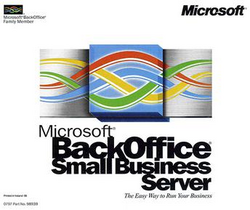
Microsoft BackOffice Server
» see backoffice.microsoft.com as it lived, on the wayback machine
~ the obit ~
In 1994 Microsoft had a problem that was not technical. Windows NT Server existed, and so did SQL Server, SNA Server, Systems Management Server and Mail Server, all of which ran on it, all of which were sold and licensed and supported separately. A company that wanted a working server room had to buy five things and reconcile five license agreements. BackOffice 1.0 arrived in late 1994 and made that one purchase.
The bundle grew with the product line rather than with any plan. Version 2.0 in April 1996 folded in the first Internet Information Services and swapped Mail Server for Exchange 4.0. Version 2.5 that December added Proxy Server and Index Server. By BackOffice Server 4.0 on 9 December 1997 the box contained Exchange 5.5, Transaction Server, Site Server and FrontPage 98, which is a strange list until you notice that every one of them was something Microsoft wanted installed before somebody else's got there first.
The name told you the audience. This was for the back office, meaning branch operations and small businesses, meaning organizations that did not have a person whose job was picking servers. That is a real market and Microsoft eventually understood it well enough to stop selling it a bundle and start selling it a product. In 2000 the small-business edition was lifted out of the BackOffice brand and became Windows Small Business Server. The parent was discontinued on 1 October 2001.
In 1994 I was ten years old and four years away from my first modem, so none of this reached me for a long time. It is also not the sort of software that reaches anybody. Nobody encountered BackOffice, they inherited it, walking into a job where the mail and the database were already running and somebody two managers up had signed for the whole thing at once.
~ the rap sheet ~
| Born | late 1994, as BackOffice 1.0 built around Windows NT Server 3.5 |
|---|---|
| Peak | BackOffice Server 4.5 on 12 January 1999, with SQL Server 7.0 and Exchange 5.5 inside |
| Killed | 1 October 2001 |
| Lifespan | seven years across six versions |
| Made by | Microsoft |
| Killed by | Windows Small Business Server, which took the only edition still selling |
~ the rise ~
The high point was version 4.5 on 12 January 1999, and it is worth reading the contents like a snapshot. Windows NT Server 4.0 with Service Pack 4, IIS 4.0, SQL Server 7.0, SMS 2.0, Exchange 5.5 with Service Pack 2, Internet Explorer 5.0, FrontPage 2000 and Visual InterDev 6. An operating system, a database, a mail server, a web server, a management system and the tools to build against all of them, shipped together on the assumption that a company would want one vendor for the entire stack.
That assumption was correct for about five years, and it is why the bundle worked at all. The alternative in 1999 was assembling the same functions from four vendors who had no reason to test against each other. Microsoft was selling integration, and integration is genuinely hard, and a bundle is a plausible way to promise it even if it does not quite deliver.
~ what it became ~
The last release was BackOffice Server 2000, which shipped on 28 February 2001 and was discontinued seven months later. By then the shape of the market had reversed. Nobody with a real data center wanted a fixed bundle, because they were buying at a scale where they picked each component and negotiated each license. Nobody without a data center wanted five separate products, because they wanted one installer and a wizard.
So the brand split in the direction of the second group. Windows Small Business Server carried the BackOffice idea forward for another decade and a half, and it was the more honest version of the pitch: not a discount for buying everything, but a single setup path for a company with one server and no administrator. The bundle died. The thing the bundle was actually for outlived it by years.
~ leave a rose ~
an anonymous tribute. one rose per visitor per day.
@}-->-- ... roses left here
~ leave a wreath ~
a rose fades by morning. a wreath stays on this grave for good, with your name on it.
from $1, paid once through stripe. it keeps the graveyard running: the hosting and the nightly digging. adopt it and the headstone reads "maintained in memory by" you. the groundskeeper plants new wreaths at the next tending, usually within a day.
» one email a week: new graves and the anniversaries of the dead. subscribe
other software: Novell, Windows Live Toolbar, Spyglass, Inc., Libranet
also died in the 2000s: ManBeef.com, Spyglass, Inc., GooglyMinotaur
~ leave a note ~
visitors before you have left these graveside notes. anonymous welcome.