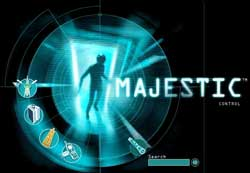
Majestic
» see majesticthegame.com as it lived, on the wayback machine
~ the obituary ~
In the summer of 2001 I was seventeen, in Turkey, on a dial-up connection and on MSN like everyone I knew. Majestic wanted a US telephone number it could ring and an AOL Instant Messenger account to reach you on. AIM was an American thing and it stayed an American thing, our whole cohort was on MSN and none of it was ever going to intersect. So this one was locked out at the phone line, which is about as hard a regional lock as a product can have.
The pitch was the tagline: it plays you. Electronic Arts launched episode one on 24 july 2001 and the design was to leak out of the computer. The clues came by email and by instant message, then a phone number would ring at your house with a recorded voice on the other end, or a fax would come through with a page of something. the fiction wrapped around itself. The game was credited to a development studio called Anim-X, and Anim-X was not real, it was EA. Part of the story was that Anim-X's offices had burned down under suspicious circumstances, so the studio that made the game was itself inside the conspiracy the game was about.
It worked as a demonstration. Best Original Game at E3 2001, Most Innovative from PC Gamer that year, a nomination at the Game Developers Choice Awards after. Around eight hundred thousand people registered for the free pilot. the trouble started at the point where the pilot ended, which is where EA wanted 9.95 a month through its Platinum service, and roughly seventy thousand of that eight hundred thousand had even finished the free part.
~ the case file ~
| Born | 24 july 2001, episode one |
|---|---|
| Peak | around 800,000 signed up for the free pilot episode |
| Killed | 30 april 2002, too few paying players |
| Lifespan | nine months |
| Made by | Electronic Arts, credited to a studio called Anim-X that did not exist |
| Killed by | september 2001, then the subscription that followed it |
~ what september did to it ~
On the afternoon of 11 september 2001 EA suspended the game. Jeff Brown speaking for the company said there were elements that might be objectionable to some people in light of that morning. that is a mild way to put what the actual problem was.
The problem was structural rather than thematic. Majestic's plot involved bombings that nobody would explain, which is bad enough on its own. Worse was the delivery: the entire product was built on ringing your telephone without warning and refusing to admit it was fiction. In a week when a great many people in the United States were sitting by a phone waiting to hear whether somebody they knew had gotten out, a game whose core mechanic was an unexplained call could not be allowed to run for an afternoon longer. i watched that week on television from a long way off, like most of the world did. The design that made Majestic interesting is the exact thing that made it unrunnable, and there was no setting to turn down.
EA expected to restart within a week. It took longer, and by the time the game resumed the subscriber count had fallen to somewhere near ten thousand. Episodes two through four came out through the autumn, the last on 16 november 2001. The season was meant to run to five.
~ what really happened ~
On 30 april 2002 EA shut it down, citing a player base too small to carry it. The paying number never got past the low tens of thousands against an investment somewhere around twenty million dollars, and the company is reported to have written off five to seven of that. for whatever reason, the postmortems have always leaned on september, and september certainly took the audience. But the drop from eight hundred thousand curious people to seventy thousand who finished a free episode happened before any of that.
The rest of it was that the thing cost real money to run in a way games do not. Phone calls have a per-minute price. Faxes have a per-page price. Every player was a recurring bill rather than a copy of something already manufactured, so the economics only worked at a subscriber count Majestic never came close to reaching.
~ what carried over ~
Majestic and The Beast are the two things everybody points back to when they talk about where alternate reality games came from, and they landed three months apart in 2001. The Beast was free marketing for a Steven Spielberg film, and it worked. Majestic was the product itself, asking ten dollars a month, and it did not.
The industry read that result and drew the obvious conclusion, which is why for the next fifteen years almost every ARG of any size was a promotional campaign for something else rather than a thing sold on its own. i saw this part from a distance, mostly. the idea that a game could reach into an ordinary day did survive, it just went into phones, where you agreed to the notifications in advance and everyone involved knew it was a game.
~ leave a rose ~
an anonymous tribute. one rose per visitor per day.
@}-->-- ... roses left here
~ leave a wreath ~
a rose fades by morning. a wreath stays on this grave for good, with your name on it.
from $1, paid once through stripe. it keeps the graveyard running: the hosting and the nightly digging. adopt it and the headstone reads "maintained in memory by" you. the groundskeeper plants new wreaths at the next tending, usually within a day.
» one email a week: new graves and the anniversaries of the dead. subscribe
other gaming: Color Dreams, Infinity Blade, Battleborn, Kemono Friends (mobile game)
also died in the 2000s: 3D Maze, Colombo-BT, ePods
~ leave a note ~
visitors before you have left these graveside notes. anonymous welcome.