MacsBug
~ the last words ~
There were almost no Macs where i grew up. In 1990s Turkey they were rare, expensive imports that lived in prepress rooms and design studios, and the machine in an ordinary house was a PC. So MacsBug is a grave i am writing from the outside, about a piece of software whose entire reason for existing was one design decision Apple lived with for about a decade longer than it should have.
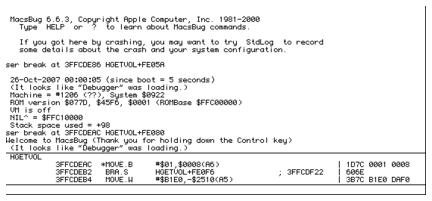
The name is not what it looks like. MacsBug stands for Motorola Advanced Computer Systems debugger, and it was written at Motorola in 1979 for 68000 development boards before anyone had a Macintosh to put it on. It was ported into the Mac project three years before there was a Macintosh to sell, and the banner on the last version still says Copyright Apple Computer, Inc. 1981-2000, which is a piece of software carrying its own birth and death dates on its face. What it did was step 68k and later PowerPC code at the assembly level, sitting underneath the operating system rather than inside it.
What made it famous was not the debugging. The classic Mac OS had no memory protection and no process isolation, so any application could write over anything, and when one did, the machine put up a bomb icon with a single Restart button. Everything you had open went with it. Every unsaved document in every other program died because one program had made a mistake in memory that did not belong to it.
Apple gave MacsBug away free. You dropped it in the System Folder and forgot about it until the day the bomb showed up. Then, instead of reaching for the power switch, you typed two letters. ExitToShell, abbreviated es, killed the offending application and dropped you back to the Finder with the rest of your session intact. There were siblings for the worse cases, rs to restart cleanly with the disks unmounted properly, and a Programmer's Key on the side of the machine to break in when nothing else responded.
~ the record ~
| Born | 1981 on the Macintosh project, out of a Motorola 68000 debugger written in 1979 |
|---|---|
| Peak | the mid-1990s, on the hard drive of anyone who took classic Mac OS crashes seriously |
| Killed | 14 september 2000, final release 6.6.3, no Mac OS X version ever |
| Lifespan | nineteen years, by its own copyright line |
| Made by | Motorola, then Apple Computer |
| Killed by | protected memory, which removed the problem it existed to survive |
~ what two letters were worth ~
A debugger that ordinary users install is a strange object, and MacsBug got there honestly. It was not a productivity tool and it did not make the Mac more stable in any real sense. It just meant that the failure mode of an unstable operating system stopped being total. Losing one application's work is an annoyance. Losing all of it, including the four other things you had open, is the reason people learn to save every ninety seconds.
Developers used it for what it was built for, of course. It was the standard way to look at a crash on the Mac, and bug reports of the era came with MacsBug stack output pasted in. But the wider install base was people who never typed a command in it except the one, and who thought of it roughly the way you think of a fire extinguisher.
~ the postmortem ~
Version 6.6 arrived in 1999 and 6.6.3 on 14 september 2000 was the last. There was never a Mac OS X version, and there was never going to be. OS X had protected memory from the start, so a crashing application took itself down and nothing else, and it came with a real Unix debugger for the people who needed one. The problem MacsBug solved had been solved a different way, at the level where it should have been solved all along.
It kept working inside the Classic environment for a few more years, which gave it a strange half-life running old software inside a new operating system that did not need it. When Apple moved to Intel and dropped Classic entirely, that ended too.
~ what got buried with it ~
The habit went with the software. Anyone who used a Mac before 2001 has muscle memory for the bomb dialog and a reflex about saving that people who started later simply do not have. The tool that made that survivable was a Motorola debugger from 1979 that Apple handed out for free and never charged a cent for, and its finest feature was a two-letter command that meant only some of your afternoon was gone.
~ leave a rose ~
an anonymous tribute. one rose per visitor per day.
@}-->-- ... roses left here
~ leave a wreath ~
a rose fades by morning. a wreath stays on this grave for good, with your name on it.
from $1, paid once through stripe. it keeps the graveyard running: the hosting and the nightly digging. adopt it and the headstone reads "maintained in memory by" you. the groundskeeper plants new wreaths at the next tending, usually within a day.
» one email a week: new graves and the anniversaries of the dead. subscribe
other utilities: Digital Post Australia, Onavo, Microsoft Anti-Virus, Wikimapy.cz
also died in the 2000s: Third Voice, Dreamarena, Alias|Wavefront
~ leave a note ~
visitors before you have left these graveside notes. anonymous welcome.