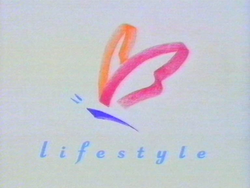
Lifestyle
~ the obituary ~
Lifestyle went on air on 30 October 1985 as a daytime service for British cable subscribers, carried by operators such as Rediffusion Cablevision and, across the Irish Sea, by Cablelink. It was owned by WHSmith, the newsagent, through a television arm that nobody outside the industry had heard of. The parent company held 47 percent of a venture called British Cable Programmes; the remainder sat with two ITV contractors and the Dundee publisher DC Thomson at 17.7 percent each. The company that sold newspapers at railway stations was now programming British afternoons.
The first logo was a 3D face assembled out of computer graphics, which was what 1985 thought the future looked like. After a relaunch in November 1987 it became an animated pastel butterfly over a flute tune, and that is the mark most people remember. In-vision continuity came from David Hamilton, a radio broadcaster of long standing, who sat in shot between the shows and talked to the camera.
From February 1989 the channel moved onto transponder 5 of the Astra satellite, which took it out of the cable ghetto and into the dish market. That August the hours were stretched to run from 10 in the morning until 6 in the evening, and Lifestyle started appearing in Sky's own advertising for the Astra platform, as one of the reasons to buy the hardware. The schedule was American game shows and daytime chat, with film noir from the 1940s filling the gaps.
The ratings never arrived. WHSmith had by then renamed its television arm European Television Networks and was losing money across the whole of it, and in early 1993 the shareholders agreed to shut the channels down. Lifestyle's last transmission was on Sunday 24 January 1993.
~ the case file ~
| Born | 30 October 1985, on British cable systems including Rediffusion Cablevision |
|---|---|
| Peak | eight hours a day on Astra transponder 5, inside Sky's own satellite advertising |
| Killed | 24 January 1993 at 7.57pm, by a company leaving television entirely |
| Lifespan | 7 years and 86 days |
| Made by | WHSmith Television, with Yorkshire Television and TVS alongside |
| Killed by | a transponder worth more to somebody else |
~ transponder 5 ~
A satellite transponder in 1990 was too expensive to leave idle, so Lifestyle's one slot ran a shift system. The channel itself held the daytime. From 10 at night until 6 in the morning the same frequency carried the Lifestyle Satellite Jukebox, a music video request service, and the hours in between were sold to a home shopping outfit called Sell-a-Vision. For a while The Children's Channel took the early morning before Lifestyle started.
The jukebox is the part worth preserving. It was run by six people, five of them in a unit in Abingdon, Oxfordshire, and it served viewer requests off five Philips LaserDisc players fed by a telephone system that took the calls automatically. The discs were custom cut and swapped once a month. Near the end a single S-VHS deck was added so the channel could play advertisements between the videos.
~ the last weekend ~
The closedown was not a corporate statement. It was two announcers on a Sunday evening doing what they had done for years, except with gifts to exchange on air and an ending to read out. At 7.57pm Kate Ricketts told the audience that this brought them to the end of weekend Lifestyle, and sadly to the end of the Lifestyle channel. She and David Hamilton thanked the viewers for having made it such a good channel to work for.
Then the credits rolled, listing every member of staff who had worked for the channel. The ident played a final time and the butterfly dissolved.
On the cable feed, just after 7.59, the operator Videotron pushed a scrolling message of its own over the top, telling subscribers what it had been told by the channel's owner. The satellite audience got something blunter: a VOX logo with a line of text under it reading that from 25 January 1993, this channel would be theirs.
~ who got the audience ~
Sky One took the shows worth taking. The women's daytime audience that Lifestyle had spent seven years assembling was handed to UK Living, which launched on 1 September 1993 inside the Sky Multichannels package and did the same job with more money behind it. Screensport, the sports channel from the same stable, lasted five more weeks and closed at the end of February. That was the end of WHSmith in television.
What survives is the ident. The butterfly and its flute tune sit on video sharing sites now, uploaded by people who pointed a recorder at a dish at the time and kept the cassette. A channel that never made its numbers has better documentation than most of the ones that did.
~ leave a rose ~
an anonymous tribute. one rose per visitor per day.
@}-->-- ... roses left here
~ leave a wreath ~
a rose fades by morning. a wreath stays on this grave for good, with your name on it.
paid once through stripe. payments are handled by OÜ Lakeview, the small company that keeps rip.so running. the money pays for the hosting and the nightly digging. adopt it and the headstone reads "maintained in memory by" you. the groundskeeper plants new wreaths at the next tending, usually within a day.
» one email a week: new graves and the anniversaries of the dead. subscribe
other streaming: BuzzVideo, MyToons, UULA, VyRT
also died in the 1990s: Dinamic Software, Hi-Tec Software, ROSS Technology
~ leave a note ~
visitors before you have left these graveside notes. anonymous welcome.