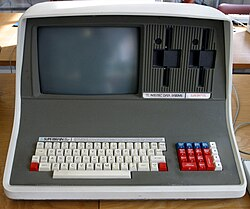
Intertec Data Systems
~ the obit ~
William M. Wells III spent four years at IBM and left after the company turned down his ideas for a microcomputer-based printer. In 1973 he started Intertec Data Systems in Columbia, South Carolina, more or less alone, and for six years the business was video terminals sold cheaper than anyone else sold them. The terminals paid the bills.
What made the name arrived in July 1979, when Intertec announced the SuperBrain. It was an all-in-one: a 12-inch monochrome screen, a keyboard and two floppy drives in one molded case, running CP/M 2.2 off a Zilog Z80A at 4 MHz. The case was structural foam coated in a paint meant to feel like felt, the whole thing weighed 45 pounds, and it shipped that September at $2,995 with 32 KB of memory. Inside were actually two Z80s. The second one did nothing but drive the disks.
It sold. Intertec earned $3.7 million on $17.2 million of sales in 1981 and took the company public the same year, raising about as much again. At the National Computer Conference that summer it had one of the larger booths on the floor. Then IBM shipped the Personal Computer in August 1981, an industry assembled itself around that machine instead, and Intertec's sales peaked in 1982 and started down. Headcount went from roughly 600 people in 1983 to twelve by June 1985.
Chapter 7 came in May 1991, which is before my memory of computers begins at all. CP/M machines had no retail life in Turkey worth the name, and by 1998, when I got online, a SuperBrain was something you could only meet in a photograph.
~ the rap sheet ~
| Born | 1973, Columbia, South Carolina, as a maker of low-cost video terminals |
|---|---|
| Peak | About 600 employees in 1983, on the back of $17 million of sales in 1981 |
| Killed | May 1991, Chapter 7 liquidation |
| Lifespan | 18 years |
| Made by | William Wells, then his younger brother Ron Wells as Wells American |
| Killed by | The IBM PC, then its own PC compatible that was not compatible enough |
~ two z80s ~
The split-CPU trick is the detail people still repeat. One Z80 ran your program and the other handled floppy access, which in 1979 was a reasonable way to stop disk waits from freezing the whole machine. Expansion was close to nonexistent: an optional internal adapter converted the Z80 bus to S-100 and accepted exactly one card. Storage grew by model name rather than by slot, from the base 170 KB drives to the QD at 340 KB and the SD at 780 KB.
The CompuStar, introduced in 1980, took the same guts and made them multiuser. Up to 255 workstations could be daisy-chained through chaining adaptors onto a shared central disk system, with each unit given its own number on an eight-position DIP switch. Intertec also sold a dumb terminal called the Intertube and a smart one called the Emulator, which says something about where the company still thought its center of gravity sat.
~ the comeback ~
In December 1983 Intertec tried to answer IBM with the HeadStart, a semi-portable all-in-one carrying an Intel 8086 next to a Z80 so it could run both PC software and CP/M. It was advertised as more IBM PC compatible than it turned out to be, and it failed. By 1986 Ron Wells had taken over from his older brother and renamed the company Wells American, which then did what everyone else was doing and built straight PC clones. The A-Star arrived in April 1986. A new CompuStar followed in 1988 with slots for both IBM PC cards and the new PS/2 cards.
None of it worked. The Wall Street Journal, on 11 January 1990, had Wells American cutting production and suspending its marketing in the United States. Sales for that year came to $64,000. On 3 May 1991 the same paper carried a short item on page C13 saying the company had decided to file for bankruptcy liquidation.
~ what stayed behind ~
Columbia University wrote Kermit in 1981 because its students needed to move files between the DECSYSTEM-20 mainframes on campus and the CP/M microcomputers sitting next to them, and the microcomputers in question were Intertec SuperBrains. Frank da Cruz and Bill Catchings designed the protocol that spring and the first transfer ran in April. The mainframes are gone and the SuperBrains are in collections, and Kermit is still being maintained.
~ leave a rose ~
an anonymous tribute. one rose per visitor per day.
@}-->-- ... roses left here
~ leave a wreath ~
a rose fades by morning. a wreath stays on this grave for good, with your name on it.
paid once through stripe. payments are handled by OÜ Lakeview, the small company that keeps rip.so running. the money pays for the hosting and the nightly digging. adopt it and the headstone reads "maintained in memory by" you. the groundskeeper plants new wreaths at the next tending, usually within a day.
» one email a week: new graves and the anniversaries of the dead. subscribe
other gadgets: Nokia N9, Ferranti, Peloton Guide, Wii Speak
also died in the 1990s: Ionica, Cascade Communications, Apple Desktop Bus
~ leave a note ~
visitors before you have left these graveside notes. anonymous welcome.