Intel Optane
» see intel.com as it lived, on the wayback machine
~ the eulogy ~
A thousand times faster than NAND, with a thousand times the endurance. That was the number Intel and Micron put on stage on 28 July 2015, and it was the kind of claim that makes an entire industry stop and read the slide twice. The technology was called 3D XPoint, pronounced cross point, and the pitch was structural rather than incremental. There is a gap in every computer between memory that is fast and volatile and storage that is slow and permanent, and 3D XPoint proposed to fill it with something byte-addressable and non-volatile, priced in between.
Nobody would say what it was made of. Intel denied it was phase-change memory and denied it was a memristor, offering only that switching came from changes in the bulk resistance of the material. Independent teardowns and the patent record pointed at chalcogenide glass doing double duty as both the storage element and the selector, with a threshold switch standing in for the transistor that a conventional cell needs. Whatever the physics, the engineering worked.
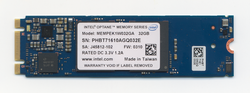
The products were not vaporware and they were not marginal. Intel shipped the brand as Optane from April 2017, in M.2 caching sticks for laptops, in the 900P and 905P for desktops, in data center drives, and eventually as persistent memory modules that plugged into DIMM slots and talked directly to the memory controller. Tom's Hardware described the 900P as a mythical creature you had to see to believe. StorageReview measured half a million sustained random IOPS at three to fifteen microseconds and concluded there was nothing else close.
This is one I watched properly, because it lands squarely in my working life. I have specified a lot of machines since 2017 and I read every Optane review as it came out, and I never once put one in a build. It was always the row in the price list you understood and then scrolled past. The honest reason is that the workloads in front of me were bound by other things, and paying several times the price per gigabyte of a good NVMe drive to fix latency that was not my bottleneck is a decision you can only justify if you already know your bottleneck is latency. Almost nobody's was.
~ the dossier ~
| Born | 28 July 2015, announced jointly by Intel and Micron as 3D XPoint |
|---|---|
| Peak | April 2017 to 2020, the fastest SSDs anyone could buy by a wide margin |
| Killed | 28 July 2022, wind-down announced on the Q2 earnings call |
| Lifespan | seven years from announcement, five on the open market |
| Made by | Intel and Micron Technology, fabricated at IM Flash in Lehi, Utah |
| Killed by | a price between DRAM and flash, and no software written to want it |
~ the origin ~
Development had started around 2012. The Lehi, Utah fab run by IM Flash Technologies, the Intel and Micron joint venture, made the first 128-gigabit chips in 2015 by stacking two 64-gigabit planes. Micron announced its own brand, QuantX, and estimated pricing at roughly half of DRAM per bit while sitting four to five times above flash. Intel designed chipset support in, so Cascade Lake could treat the stuff as a caching layer or as slow, enormous, persistent main memory.
That last mode was the interesting one and it was also where the trouble lived. Persistent memory only pays off if the software above it knows the memory is persistent. Databases and allocators both assume a hard line between what survives a power cut and what does not, and moving that line means rewriting the parts of a stack that nobody rewrites casually. Intel funded libraries and evangelism for years. The rewrites mostly did not happen, and a technology whose whole argument was a new tier ended up being sold as a very good SSD.
~ the actual end ~
It ended in stages over eighteen months. Intel quietly killed the consumer Optane desktop drives in January 2021. On 16 March 2021 Micron announced it was leaving 3D XPoint entirely, citing a lack of demand, and pivoting to Compute Express Link instead. The Lehi fab, which had never run anywhere near capacity, went to Texas Instruments for 900 million dollars. Intel said at the time that its ability to supply Optane was unaffected, which was technically true and read like a company buying time.
On 28 July 2022, on the Q2 earnings call, Pat Gelsinger confirmed the wind-down. In the numbers it appeared as a 559 million dollar inventory impairment. The business had lost over 576 million dollars in 2020 alone with a comparable figure expected for 2021, and Intel's language was that Optane, while a leading technology, was not aligned to its strategic priorities. Existing customer commitments would be met. Nothing new would be built.
~ what it left ~
The gap in the memory hierarchy is still there. What replaced Optane as the answer is not a new medium but a new interface: CXL, which lets you hang ordinary DRAM off a PCIe-style link and pool it across machines. Micron said so out loud when it quit. The industry decided the problem was topology rather than materials, and that decision looks correct so far.
Optane is worth remembering because it failed while being better. The drives measurably outperformed everything around them for five years and the technology still lost, because a component that is faster than its neighbors and more expensive than its neighbors needs software written specifically to exploit the difference, and that software has to be written by people who do not yet own the hardware. Optane never got out of that loop. Used P5800X drives still turn up cheap, and they are still faster at low queue depths than most of what you can buy new.
~ leave a rose ~
an anonymous tribute. one rose per visitor per day.
@}-->-- ... roses left here
~ leave a wreath ~
a rose fades by morning. a wreath stays on this grave for good, with your name on it.
from $1, paid once through stripe. it keeps the graveyard running: the hosting and the nightly digging. adopt it and the headstone reads "maintained in memory by" you. the groundskeeper plants new wreaths at the next tending, usually within a day.
» one email a week: new graves and the anniversaries of the dead. subscribe
other gadgets: Xelibri, Openmoko, Commodore 64, 10.or
also died in the 2020s: Project CARS 3, Super Mario Maker Bookmark, BobrDobr
~ leave a note ~
visitors before you have left these graveside notes. anonymous welcome.