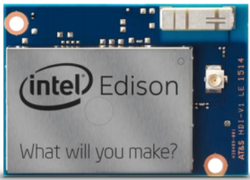
Intel Edison
~ the goodbye ~
At the CES opening keynote on 6 January 2014, Brian Krzanich held up a small board and said it was a full Pentium class PC in the form factor of an SD card. Dual-core Quark, 400 MHz, available in the middle of 2014. It was a good demo and it made the point Intel needed to make that year, which was that the company that had slept through phones was not going to sleep through whatever came next.
Almost none of that survived contact with manufacturing. In a blog post on 28 March 2014 Michael Bell, who ran Intel's New Devices Group, explained that Edison had been redesigned. What eventually shipped on 9 September 2014, at IDF rather than in the middle of the year, measured 35.5 by 25 by 3.9 mm with components on both faces, which is appreciably larger than an SD card. The Quark had been demoted: the production module ran a 22 nm Atom called Tangier with two Silvermont cores at 500 MHz, keeping a Quark core at 100 MHz alongside for low-power duty. The Edison that was promised never shipped at all.
What did ship was a serious module. 1 GB of LPDDR3 and 4 GB of eMMC, dual-band WiFi and Bluetooth 4.0 on a Broadcom BCM43340, all of it exposed through a 70-pin Hirose connector that made a carrier board mandatory. The bare module was $49.95, rising to $99.95 with the Arduino-compatible breakout. A Raspberry Pi of that era had no radio on board at all, so on wireless Edison was well ahead.
It lost anyway, on the parts that never appear in a spec table. A first program meant a Yocto build and a carrier board pinout, where the ARM competition had you at a shell prompt in ten minutes with a forum that had already answered your question. Hackaday's verdict was that across the whole life of these boards only a sprinkling of projects using them had ever come in, against a flood built on Arduino or Raspberry Pi.
~ the chronicle ~
| Born | announced at CES on 6 January 2014, shipped at IDF on 9 September 2014 at $49.95 |
|---|---|
| Peak | Intel's main bid for the maker market, with a prime-time TV show attached to it |
| Killed | 16 June 2017 by PCN115579-00, last orders 16 September, last shipments 16 December |
| Lifespan | two years and nine months on sale |
| Made by | Intel |
| Killed by | ARM boards that cost less and documented themselves better |
~ PCN115579-00 ~
Intel killed Edison on 16 June 2017. The commonly cited date is 19 June, which is when Hackaday and CNX-Software found out and wrote it up, and Wikipedia carries that date because it cites the press. Intel's own documents say the sixteenth, and so does the ARK database entry, which still lists an expected discontinuance of 06/16/2017 against a marketing status of Discontinued.
The form the announcement took is the part worth keeping. No blog post went up and no statement was made. Asked why, Intel told LinuxGizmos it was not commenting, and Engadget recorded the same silence. There were Product Change Notification PDFs posted to Intel's document management server, Edison's numbered PCN115579-00, with Joule and Galileo filed immediately either side of it in one contiguous block. Each set last orders at 16 September 2017 and last shipments at 16 December 2017. Hackaday called it a barely visible press release in an obscure corner of the Internet, and found it anyway.
The 2017 notices give no reason for the discontinuation whatsoever, where Intel's 2019 notice for the Quark chips does at least explain that demand had shifted to other Intel products. Intel's own Edison product page also said nothing for weeks: the notice is absent on 14 July 2017 and present on 13 August. Purchasing departments were told on 16 June, and the people building on the thing found out from a document written for somebody else.
~ what the edge actually wanted ~
My working days in 2026 go on edge computer vision for drones, a direct descendant of the question Edison was built to answer. How much processing can you bolt onto something small and battery-powered before the thermal envelope or the toolchain defeats you? The question has not aged in a decade. The hardware answers to it have turned over completely.
Intel's answer was to shrink x86 and assume instruction-set compatibility would carry the day. Galileo is where that assumption is easiest to see: a 400 MHz single-core Quark with a thermal design power of 12.5 watts, sold into a market where the competing board drew a fraction of that. The parts that won the edge were ARM systems-on-chip, then ARM with a dedicated accelerator bolted on, because the deciding number turned out to be performance per watt. By the time Intel left, the category had been redefined around a figure Edison could never have won on.
~ the television show ~
The scale of the commitment is what makes the exit strange. Intel co-produced a prime-time television series with Mark Burnett and MGM Television called America's Greatest Makers, which ran on TBS from 5 April to 24 May 2016, put 24 teams through a competition for a one million dollar prize, and seated Krzanich himself on the judging panel. The hardware the contestants built on was Intel's. Thirteen months after the TBS finale, the platform underneath all of it was discontinued in a PDF.
~ the wider retreat ~
Edison did not go alone. Galileo had been unveiled by Krzanich at Maker Faire Rome on 3 October 2013 as the first Arduino-certified x86 board, alongside a pledge to donate 50,000 of them to a thousand universities, and it reached buyers at the end of that November. Joule was announced in August 2016 as Edison's intended successor, close enough that Intel published a document on moving between the two, and it was discontinued on the same day as the thing it was meant to replace after roughly eight months on sale. Curie and the Arduino 101 it powered got their own notices a month later, with Curie's last shipment running to 17 July 2018.
Intel had not given up on connected devices at all. Its Internet of Things group grew revenue from $2.298 billion in 2015 to $2.6 billion in 2016 and $3.2 billion in 2017, and reported a record quarter weeks after the last Edison shipped. The boards were never counted in that group: they sat in the New Technology Group, inside the segment Intel reports as All Other, which lost over four billion dollars in each of those same years. What Intel abandoned was the hobbyist shelf, the part of the business where you answer questions from people who are not buying ten thousand units, and that was the part where the next generation of embedded engineers was being made.
The modules themselves are still out there, in drawers and half-finished projects, and they still boot. An Edison needs no server to function, which is the one advantage this kind of death holds over the smart-home kind. Nothing was switched off here. The documentation that was too thin to win in 2015 is the same documentation today, and there is nobody left to file a question with.
~ leave a rose ~
an anonymous tribute. one rose per visitor per day.
@}-->-- ... roses left here
~ leave a wreath ~
a rose fades by morning. a wreath stays on this grave for good, with your name on it.
from $1, paid once through stripe. it keeps the graveyard running: the hosting and the nightly digging. adopt it and the headstone reads "maintained in memory by" you. the groundskeeper plants new wreaths at the next tending, usually within a day.
» one email a week: new graves and the anniversaries of the dead. subscribe
other gadgets: Sord M5, Prime Computer, Inc., AIBO, Commodore Plus/4
also died in 2015-2019: Google News & Weather, NCIX, Moshi Monsters
~ leave a note ~
visitors before you have left these graveside notes. anonymous welcome.