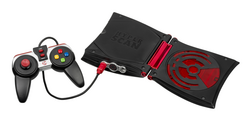
HyperScan
» see hyperscan.com as it lived, on the wayback machine
~ the obit ~
Late 2006 was the autumn of the Wii and the PlayStation 3, and I was twenty two and finishing a degree in Ankara with a PC I had specified myself. A Mattel console for American tweens was two whole categories away from anything in my life. It also never came to Turkey. It barely came to anywhere: North America only, one launch, no second wave.
The HyperScan went on sale on 23 october 2006 at $69.99. Inside was a Sunplus SPG290 system-on-chip with 16 MB of memory and composite video permanently attached to the back, which puts its raw capability roughly at the level of a mid-1990s machine. Games came on CD-ROM. The controllers used six-pin mini-DIN. None of that is what the box was about.
What the box was about sat under the lid: a 13.56 MHz RFID reader. Every game shipped with a set of physical cards, each carrying 96 bytes of user memory, and you swiped a card across the console to bring a character or a move or a level into the game. Buy X-Men, get six X-Men cards. Want the rest of the roster, buy booster packs at ten dollars for six random cards. Mattel had been selling children randomized cardboard for decades and had decided that a games console was a card dispenser with a screen attached.
~ the rap sheet ~
| Born | 23 october 2006 in North America, $69.99 with an X-Men disc and six cards |
|---|---|
| Peak | five games, none of which sold |
| Killed | 2007, quietly, after most of its life on clearance |
| Lifespan | under a year |
| Made by | Mattel |
| Killed by | asking a twelve year old to buy random cards to finish a game they already owned |
~ the cards ~
The mechanic broke in the obvious place. To select a character you had to find the card, physically, and scan it. Not from a menu. From the floor of a bedroom, where cards live. The X-Men game was planned to have 102 cards across a red series and a black series, so completing the roster of a $19.99 game meant something like $170 of randomized boosters on top, assuming no duplicates, which is never the assumption with randomized boosters.
Reviewers hit the loading times as hard as the cards. A scan led to a wait, and the games behind the wait were flat 2D fighters that looked a decade out of date next to anything else on a shelf in 2006. The VTech V.Flash had arrived the month before at a similar price and was better regarded, which made the comparison easy for anyone writing it up.
~ the postmortem ~
There was no announcement. The price came down instead. The console went to $9.99, the games to $1.99, the booster packs to $0.99, and by 2007 Mattel had stopped. Five games shipped in total: X-Men, Marvel Heroes, Ben 10, Interstellar Wrestling League and Spider-Man. Two more were finished or nearly finished and never came out.
Avatar: The Last Airbender is the one worth naming. It was completed and ready to distribute when the plug came out. Nick Extreme Sports was in early development and went at the same time. Both are on the lost media lists now, because a finished game that shipped zero copies exists only wherever the master went, and Mattel is not a company that keeps those.
Total lifetime sales are estimated at 30,000 units. PC World put it in a ten worst systems feature. Mattel, which had run a real console business in the late 1970s with the Intellivision, has not been back since.
~ what got buried with it ~
The idea did not die with the hardware, which is the part people forget when they laugh at the HyperScan. Six years later Activision shipped Skylanders and did billions of dollars with it. Disney Infinity and Nintendo's amiibo followed, working exactly the same way: a near-field chip in a physical object that the console reads to unlock content.
The difference was that Skylanders sold a figure a child wanted on a shelf, and it worked with a single tap. The HyperScan sold a piece of card in a sealed pack that might be a duplicate, and it made you scan one every time you wanted to play as somebody. Same technology, same business model, opposite outcome. Mattel got there first with the worse version of it and got out before anyone showed them what the good version looked like.
~ the long tail ~
There is a small homebrew scene. After the discontinuation, hobbyists produced a handful of demos for it, a 3D wireframe and a grayscale test among them, mostly to prove the Sunplus chip could be talked to at all. It is a very short list of software for a machine, and roughly half of it was written by people who bought the console for two dollars out of curiosity.
~ leave a rose ~
an anonymous tribute. one rose per visitor per day.
@}-->-- ... roses left here
~ leave a wreath ~
a rose fades by morning. a wreath stays on this grave for good, with your name on it.
from $1, paid once through stripe. it keeps the graveyard running: the hosting and the nightly digging. adopt it and the headstone reads "maintained in memory by" you. the groundskeeper plants new wreaths at the next tending, usually within a day.
» one email a week: new graves and the anniversaries of the dead. subscribe
other gaming: The Bitmap Brothers, Motion Twin (Flash era), Red Orb Entertainment, Catan: World Explorers
also died in the 2000s: Word.com, Clickmango.com, WTLS
~ leave a note ~
visitors before you have left these graveside notes. anonymous welcome.