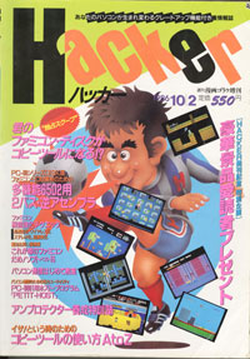
Hacker International
~ the obit ~
Hacker International sold games you could not buy in a shop. From 1990 it shipped unlicensed cartridges and disks for the Famicom, and later HuCards and CDs for the PC Engine under the brand Games Express, almost entirely by mail order, at something like thirty to fifty thousand copies per title. The games were mostly made by Taiwanese studios on contract. The hook on most of them was that playing well got you a picture of a woman with fewer clothes on, which is why the Japanese console makers would not put their seal on a single one of them.
The founder was Satoru Hagiwara, a former music producer who had been publishing a monthly PC magazine called Hacker through the 1980s. When that wound down he built a company out of what its writers had been proposing. This is a Japanese mail-order operation selling a product category that no distributor in my part of the world would have carried, in an era when I was in primary school. What I have of it is whatever survived in other people's archives, which is mostly secondhand screenshots.
Hagiwara turned the business legitimate in 1995, reincorporating as Map Japan and becoming an actual licensee for the PlayStation. Fifteen games came out under that name. Then he stopped caring, and the company closed in 2001.
~ the rap sheet ~
| Born | 1990, out of the Hacker PC magazine and the Hacker Junior hardware business |
|---|---|
| Peak | 30,000 to 50,000 mail-order copies per title, early 1990s |
| Killed | 2001 |
| Lifespan | about 11 years |
| Made by | Satoru Hagiwara, former music producer and magazine publisher |
| Killed by | its founder losing interest, plus competition it no longer had an edge on |
~ the hardware came first ~
Before any games there was the Hacker Junior, a modification for the Famicom that gave it composite video output and turbo controllers. Nintendo sued over it and the matter settled out of court.
The better product was Disk Hacker. Nintendo's Famicom Disk System was built around a rewritable disk and a business model to match: you took your disk to a game store, fed 500 yen into a Disk Writer kiosk, and walked out with a different game on it. Disk Hacker let you copy Disk System disks at home using nothing but an ordinary Disk System. Nintendo kept adding countermeasures and Hacker kept shipping new versions to answer them.
~ the yamauchi problem ~
Hiroshi Yamauchi objected to pornographic Famicom games personally, not just commercially, on the grounds that they would damage what Nintendo's name meant. He had no technical lock to enforce it with on the Japanese Famicom, so the objection had to be applied socially, and it was.
The clearest example involves a magazine. When Family Computer Magazine, published by Tokuma Shoten, ran advertisements for Hacker's games, Tokuma decided its access to Nintendo preview material was in danger. Five of the publisher's senior executives went to Nintendo to apologize to Yamauchi in person, over advertisements for games Nintendo had no legal control of.
~ what nec thought ~
NEC took the opposite view. Hacker's PC Engine output went out under the Games Express name, with the CD titles requiring a Games Express System Card to boot, and NEC's attitude was reportedly gratitude, on the basis that the games were moving consoles. A dozen or more adult PC Engine titles came out in the early 1990s on that arrangement. The same catalog went abroad with the content removed, which is how Taiwanese-built Hacker games ended up in American shops with their art repainted. Three went out in the United States for the NES with the pornography left in, published by Panesian, occasionally with the characters redrawn to look less Japanese.
~ map japan ~
The 1995 reincorporation is the interesting turn. Sony's licensing regime for the PlayStation was strict about content but indifferent to who you had been, so Hagiwara registered a new name and became a normal publisher with fifteen normal releases, while running adult PC games on the side under another brand. The company that had spent five years as Nintendo's pest spent its last six years as Sony's licensee in good standing, which is the half of its history nobody kept.
~ leave a rose ~
an anonymous tribute. one rose per visitor per day.
@}-->-- ... roses left here
~ leave a wreath ~
a rose fades by morning. a wreath stays on this grave for good, with your name on it.
paid once through stripe. payments are handled by OÜ Lakeview, the small company that keeps rip.so running. the money pays for the hosting and the nightly digging. adopt it and the headstone reads "maintained in memory by" you. the groundskeeper plants new wreaths at the next tending, usually within a day.
» one email a week: new graves and the anniversaries of the dead. subscribe
other gaming: My Brute (La Brute), PVP Live, GameFly Streaming, 3D Pinball for Windows - Space Cadet
~ leave a note ~
visitors before you have left these graveside notes. anonymous welcome.