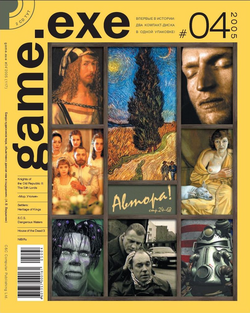
Game.EXE
» see game-exe.ru as it lived, on the wayback machine
~ the last words ~
It started as Магазин игрушек, Toy Shop, registered with the Russian press committee on 3 November 1994 and published for the first time on 27 March 1995. Dmitry Mendrelyuk, who ran the Kompyuterra publishing house, wanted a magazine about computer games in a country that had no market for them, and he staffed it with first-year students of seventeen and eighteen who had come looking for work at his main title. The second issue appeared in June. After that the schedule was whatever the editors managed, which was not much.
By the end of 1995 nearly all of them had been fired over a quarrel with an advertiser, and the advertiser went off and launched a rival magazine the following year. Igor Isupov, Kompyuterra's literary editor, was given the wreckage at the start of 1996 and told to find writers. He had a rule about where not to look: nobody who had already written for another Russian games magazine. The magazine was legally closed at the end of 1996 in a dispute between its founder and its publisher, revived immediately, and came back in January 1997 under a new name and a narrower brief, monthly and PC only.
What Game.EXE then became has no clean English equivalent. It reviewed games in long literary prose and took its positions from whatever its writers actually cared about, which kept it on publishers' blacklists for low scores, 1C's most of all. It refused press trips paid for by the companies whose games it was covering. It could afford all of that because the money came from the cover price instead of the ad pages, which Mendrelyuk claimed made it the first Russian games magazine of its kind, and which also meant it was never once profitable.
~ the record ~
| Born | 27 march 1995, as Магазин игрушек, published by Kompyuterra in Moscow |
|---|---|
| Peak | 63,500 copies, the hundredth issue, november 2003 |
| Killed | june 2006, inside a month of going weekly |
| Lifespan | eleven years and three months |
| Made by | Kompyuterra, under Igor Isupov from early 1996 |
| Killed by | a hardcore readership that stopped growing while every other audience grew |
~ a magazine with invented writers ~
The bylines were characters. Pavel Grodek wrote about shooters as Gospodin PeZhe, an old soldier with a shotgun. Alexander Bashkirov, a psychologist from Irkutsk whom Isupov found in the reader mail and later called the most impressive acquisition the magazine ever made, wrote as Frag Sibirsky. When Natalya Dubrovskaya left the staff in May 1999, Isupov and Bashkirov invented a replacement on the stated reasoning that quests were women's work. Her name was Masha Arimanova, and she reviewed Alexey Pajitnov's Pandora's Box that September and kept filing adventure reviews under her own name and biography until the magazine stopped. Andrei Podshibyakin, who was there, explained the practice years later. Games magazines of that period were membership cards more than they were media, half-closed clubs with a monthly fee, and that encouraged what he called editorial myth-making: writers were handed biographies and pseudonyms, down to their own stylistic tics.
~ the hundredth issue ~
The thing that made it famous was a format. From the beginning of 2000 the editors put out what they called conceptual issues, where every article was tied to one theme and the layout was rebuilt to match. January was the Book of Games, set like a shelf of books, and February was the Newspaper of Games, set like newsprint. Circulation started climbing from there.
It peaked at 63,500 copies in November 2003, on the hundredth issue, which was built around Vladimir Sorokin's play Землянка and shipped with a DVD of a radio production of it that the staff had recorded themselves. A games magazine put a Sorokin radio play on the cover disc for its anniversary. That is the whole magazine in one object.
~ the lithuanian edition ~
From 2000 to 2005 Game.EXE also came out in Lithuanian, abridged, 10,000 copies, which made it the first Russian games magazine with an audience outside the language it was written in. The cover discs are a separate small history: a CD went out with 20,000 of the 42,500 copies in August 1998, carrying demos and patches and the complete 1997 run of the magazine, and discs kept coming until the last DVD in May 2006.
I cannot read it. Everything above comes through translation, and the part that does not survive translation is exactly the part everyone who read it talks about, which was the writing. Russian games writing of the late 1990s was its own country with its own argument running inside it, and none of it was visible from a modem in Ankara. I came to this one through a Wikipedia article in 2026.
~ june 2006 ~
In April 2006 Isupov and Mendrelyuk started working on a plan to turn the monthly into a weekly business paper. In May the two of them fell out over money for two correspondents to go to E3, which Isupov treated as a matter of professional honor because the E3 issues set the tone for everything after them, and which Mendrelyuk later said was a misunderstanding about whether the figure was per reporter. Isupov left. The weekly went ahead without him in June, ran four issues, and was shut down with the month still running. The two websites outlived it by ten years in one case and by almost none in the other.
~ leave a rose ~
an anonymous tribute. one rose per visitor per day.
@}-->-- ... roses left here
~ leave a wreath ~
a rose fades by morning. a wreath stays on this grave for good, with your name on it.
paid once through stripe. payments are handled by OÜ Lakeview, the small company that keeps rip.so running. the money pays for the hosting and the nightly digging. adopt it and the headstone reads "maintained in memory by" you. the groundskeeper plants new wreaths at the next tending, usually within a day.
» one email a week: new graves and the anniversaries of the dead. subscribe
other news: Consensus Net (共识网), The Awl, Fightland, Builder.com
also died in the 2000s: Microsoft Fingerprint Reader, Democracy and Freedom Web, 강진축구 (Gangjin Soccer)
~ leave a note ~
visitors before you have left these graveside notes. anonymous welcome.