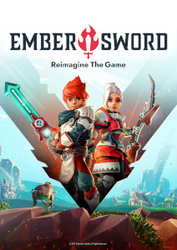
Ember Sword
» see embersword.com as it lived, on the wayback machine
~ the eulogy ~
i missed ember sword. it launched to early access on 2 december 2024 and closed on 21 may 2025. that is not a long window to catch a browser mmo, and the mmo cohort i was around for (2003 to 2009) sat in a different technical world (turkish ultima online private servers, later world of warcraft on ttnet broadband) than the nft-land-plot economy this one was built inside. by 2024 i had aged out of new mmo starts. the game shipped, ran, and closed without me looking.
bright star studios (originally so couch studios) started building ember sword in 2018 out of aarhus, denmark, under ceo mark laursen. the pitch was a browser-first sandbox mmorpg on ethereum where land plots and cosmetics were nfts, combat was skill-based rather than gear-gated, and the fictional continent of thanabus was divided into four kingdoms each broken up into thousands of individually-owned parcels. the design lineage was runescape crossed with second life crossed with the 2021 nft moment.
the 2021 land sale was the peak commercial event. bright star opened applications for land purchases and drew about 35,000 participants pledging around $203 million in interest. the actual sold value was much smaller, ~$11 million for the plots that closed, and a further ~$7.8 million came in through venture rounds led by bitkraft, delphi, mechanism, dialectic and play ventures. early access finally opened in december 2024. five and a half months later the servers went dark.
~ the dossier ~
| Born | 2018 (development start at so couch studios, aarhus, denmark) |
|---|---|
| Peak | ~35,000 participants in the 2021 land sale, ~$203M pledged |
| Killed | 21 May 2025 (bright star studios shutdown announcement) |
| Lifespan | about seven years in development, five and a half months in early access |
| Made by | Bright Star Studios (formerly So Couch Studios), Aarhus, Denmark. Mark Laursen ceo |
| Killed by | collapsed web3-gaming funding market, failure to close a rescue round |
~ how the money worked ~
ember sword's economy sat on three layers. base gameplay was free-to-play through a browser. combat and progression did not require any wallet interaction, which was a deliberate choice to keep the game legible to players who did not care about crypto. the second layer was the cosmetic marketplace, where player-crafted items and skins traded as nfts on ethereum. the third layer was land: each of the thousands of plot nfts entitled its holder to a share of transaction fees from activity in that region.
the design was better than most of the 2021 nft-game cohort at hiding the crypto layer from casual play. wallet connection was optional at the entry point. the problem was that the fee-sharing math depended on a running player economy of hundreds of thousands of active users, and the actual early-access population never came close. land holders who had paid four-figure sums for premium plots discovered that their share of a tiny fee stream was measured in dollars per month rather than the projections the 2021 pitch had implied.
~ the unraveling ~
the seven-year development cycle put ember sword through two distinct funding markets. the 2021 to 2022 window was generous with web3 games. by 2024 that window was closed. web3 game after web3 game (star atlas cutting scope, blankos block party shutting, big time on life support) hit the same wall. bright star had positioned itself to be the survivor of the cohort, the one that would build a real game rather than a speculation vehicle. that positioning turned out not to be enough.
the may 2025 shutdown letter from mark laursen said bright star had explored every possible way forward and could not find a path to keep building. no acquirer emerged. the land nfts continued to exist on ethereum, tradeable in a technical sense, but with no active game their claim on future fees was worth almost nothing. bright star did not offer buybacks. holders who had paid meaningful money for land plots were left holding tokens against a dead server.
~ what got buried with it ~
ember sword is one of the cleanest test cases for the web3-mmo thesis that ran from 2020 through 2022. the studio built a real game with a real combat system, funded it through the land sale plus vc, and shipped it. it still could not sustain itself once the funding market for web3 games retreated. axie infinity and star atlas had already shown the pattern at larger scale. ember sword closed the case at the ambitious mid-scale, the seven-year danish studio that got everything to launch and still ran out of runway inside six months.
what got buried with it was a specific hope that nft-land economies could sustain a functioning mmo. the on-chain persistence of the land tokens turned out to be the wrong kind of permanence. the game they were meant to grant a share of does not exist anymore. the tokens do. they trade for pennies to nothing and represent nothing.
~ leave a rose ~
an anonymous tribute. one rose per visitor per day.
@}-->-- ... roses left here
~ leave a wreath ~
a rose fades by morning. a wreath stays on this grave for good, with your name on it.
from $1, paid once through stripe. it keeps the graveyard running: the hosting and the nightly digging. adopt it and the headstone reads "maintained in memory by" you. the groundskeeper plants new wreaths at the next tending, usually within a day.
» one email a week: new graves and the anniversaries of the dead. subscribe
other gaming: Impulse, Square Enix Montréal, Skyforge, Duelyst
~ leave a note ~
visitors before you have left these graveside notes. anonymous welcome.