Electronic Dream Plant
~ the last words ~
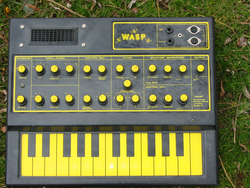
The Wasp had no keys. What looked like two octaves of black and yellow notes was a sticker, silk-screened over flat copper plates that were part of the main circuit board, and the instrument worked out which note you wanted by sensing the capacitance of your skin. Press harder and nothing happened. Play it in gloves and nothing happened at all. The first production units were made in September 1978 and the shelf price was GBP 199 with the tax in it.
Behind it were two people who had met through studio work and who built it twelve miles outside Oxford, in the middle of the countryside. Chris Huggett had come up through Ferrograph and the digital multitrack division at 3M and was maintaining studio equipment freelance, designing the thing in evenings and at weekends. Adrian Wagner was a recording musician and the great-great-grandson of Richard Wagner. They began, by Wagner's own account in 1981, on GBP 3,000. Production only happened because Rod Argent's keyboard shop in London put up GBP 10,000 to get it built, and the first hundred units sold out of that one shop in three hours.
The sound came from a mistake nobody corrected. Two digital oscillators fed a 12dB-per-octave filter built out of the wrong components: CD4069 CMOS inverters, logic chips, run as analog amplifiers in a way the datasheet never intended. The result distorted, and the distortion was the point. Doepfer still sells a Eurorack clone of that circuit and still prints the warning that comes with it, which is that the inverters die now and then.
The engineering held up better than the balance sheet. The company was losing money in 1979 while the product sold out, and Huggett left early in 1980 over exactly that. Components were the bottleneck rather than customers, and the debts that ended it were owed to the people supplying the parts. A second company, Electronic Dream Plant (Oxford) Ltd, kept the Gnat in production and was in receivership by the end of 1981. Nobody printed an obituary. The last advertisements ran in October 1981, and by May 1983 the trade papers were setting the words "now defunct" beside the name as though everyone already knew. Asked in 1984 what had gone wrong, Huggett named mismanagement and over-expansion, and added that he had never made any money out of it.
~ the record ~
| Born | About 1977, Oxfordshire, on GBP 3,000 of the founders' own money |
|---|---|
| Peak | About 30 staff, and roughly 3,000 Wasps shipped between 1978 and 1981 |
| Killed | Wound up in 1980, receivership late 1981, called defunct from 1982 |
| Lifespan | About five years |
| Made by | Chris Huggett and Adrian Wagner |
| Killed by | Debts to component suppliers, on a product that was selling out |
~ the yellow box ~
Around the Wasp sat a small catalog priced well under what a studio would expect to pay. The Spider was a 252-step digital sequencer for GBP 199, at a time when most analog sequencers offered eight steps or sixteen. The Gnat was a single-oscillator Wasp for GBP 99. The Caterpillar, a three-octave keyboard with actual moving keys, cost GBP 149 and could drive four of the others over a proprietary link bus. About thirty people worked there at the peak. Early boards were hand-soldered at eight and a half hours apiece until flow soldering brought it down to about ten seconds, and the Wasp went through ten major revisions inside thirty months.
The records came out of the cheapness. Thomas Leer and Robert Rental built The Bridge in 1979 with two of them covering keyboards and percussion, and Leer described a keyboard so sensitive you could change pitch by waving a hand above it. Dave Stewart took one to a hotel room in Wagga Wagga in 1980 with a Spider and a drum machine and recorded by miking up the Wasp's tiny built-in speaker, rattling plastic case and all. Nick Rhodes has said flatly that it was the first synthesizer he ever owned. Oscar Peterson, of all people, used three of them on a broadcast.
~ what huggett did next ~
He started again almost immediately. The Oxford Synthesiser Company was named to sound more established than it was, and it shipped the OSCar in 1983 at GBP 599. That company died too, when Europa Technologies went bankrupt without paying for a large order just as OSCar sales passed two thousand. After it he wrote the operating system for the Akai S1000 sampler, finishing the S3200 code in 1993, then advised Novation on the Bass Station before joining to design the Supernova. The Peak and the Summit are his as well. He died in Headington on 22 October 2020, aged 71, with one more synthesizer unfinished on the bench; it reached the shops as the PWM Mantis in January 2024. Wagner had died two years earlier, on 22 June 2018.
The name outlived both of them in a way neither would have picked. Music Tribe, which owns Behringer, registered WASP as a US trademark in 2020, and Behringer sells a Wasp Deluxe today for about GBP 111 that mentions Electronic Dream Plant nowhere on its own page. Cherry Audio put out a software tribute in 2025 and pointedly called it something else. Meanwhile the instrument has gone the long way round. It sold for GBP 199 in 1978, and a used-gear guide in 1993 valued one at between GBP 40 and GBP 100, which was junk-shop money. A British dealer sold one this year for GBP 1,595.
~ leave a rose ~
an anonymous tribute. one rose per visitor per day.
@}-->-- ... roses left here
~ leave a wreath ~
a rose fades by morning. a wreath stays on this grave for good, with your name on it.
paid once through stripe. payments are handled by OÜ Lakeview, the small company that keeps rip.so running. the money pays for the hosting and the nightly digging. adopt it and the headstone reads "maintained in memory by" you. the groundskeeper plants new wreaths at the next tending, usually within a day.
» one email a week: new graves and the anniversaries of the dead. subscribe
other media music: iTunes LP, MUZU.TV, Muve Music, Chaku-uta (着うた)
also died in the 1980s: Ovation Technologies, GameLine, Centronics
~ leave a note ~
visitors before you have left these graveside notes. anonymous welcome.