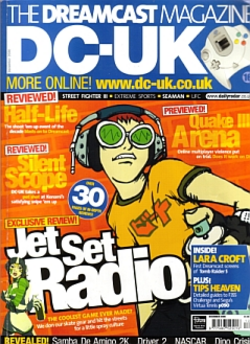
DC-UK
» see dc-uk.co.uk as it lived, on the wayback machine
~ the eulogy ~
Dennis Publishing held Sega's official UK license, so Future did what Future always did and launched the unofficial one. DC-UK arrived in August 1999, two months ahead of the console's European release, answering to nobody at Sega and selling, for a while, nearly as well as the magazine that had the license.
Caspar Field edited the first seven issues. Keith Stuart took it from there to issue 19, which is most of the magazine's life, and later became the Guardian's games writer. Lee Hart got one issue, the last one.
Sales started slipping in early 2000. British interest in the Dreamcast was draining away months before the PlayStation 2 actually arrived in Europe that November, and a magazine about one console cannot diversify its way out of that. Two British magazines were fighting each other over a machine their readers were already walking away from.
~ the dossier ~
| Born | August 1999, two months before the Dreamcast reached Europe |
|---|---|
| Peak | sales close to the official Dreamcast magazine's, through late 1999 |
| Killed | March 2001, at issue 20 |
| Lifespan | 19 months |
| Made by | Future, in Bath |
| Killed by | a 40.5 percent sales drop, in the month Future cut 15 percent of its titles |
~ the ABC table ~
On 15 February 2001 the circulation audit landed and Future's numbers were ugly across the board. DC-UK was the worst performer in the house, down 40.5 percent, and the Guardian printed that figure the next day with the magazine named in full.
The same morning Future announced it was cutting 350 jobs and shedding around 15 percent of its titles. Chris Anderson, the founder and chairman, said tougher times require tough measures and that this was absolutely the right decision for Future. Six British magazines were closing and the company would not say which six until everyone affected had been told. DC-UK's twentieth issue, cover-dated March 2001, turned out to be its last.
~ what it was for ~
I was still at school in Turkey while this was happening, in a place where the Dreamcast never became a question anybody had to answer. The fight was entirely a British newsstand event, two titles and maybe eighteen months of overlap, over a console Sega stopped manufacturing before the fight was over.
What DC-UK had going for it was freedom. The official magazine worked under Sega's approval and could not review imports, which matters enormously on a platform whose best years were its last ones, when the interesting discs came from Japan. The unofficial one had no such rule. It also had a website address printed on the cover in large type, dc-uk.co.uk, back when that was still something a magazine showed off about.
~ goodbye folks ~
The website outlasted the paper by a few weeks and shut on 8 March 2001 with a two-word farewell. The Internet Archive caught the page later that month, which is the only reason the sign-off is still readable.
The cuts were supposed to save Future £5m that year. They cost 350 jobs and around twenty magazines across four countries, and the Bath head office spent that February finding out who was going.
~ leave a rose ~
an anonymous tribute. one rose per visitor per day.
@}-->-- ... roses left here
~ leave a wreath ~
a rose fades by morning. a wreath stays on this grave for good, with your name on it.
paid once through stripe. payments are handled by OÜ Lakeview, the small company that keeps rip.so running. the money pays for the hosting and the nightly digging. adopt it and the headstone reads "maintained in memory by" you. the groundskeeper plants new wreaths at the next tending, usually within a day.
» one email a week: new graves and the anniversaries of the dead. subscribe
other news: ShortNews, OKNOtizie, News.nl, Computer Buyer
also died in the 2000s: MediaBrowser, Yugo, Newbridge Networks
~ leave a note ~
visitors before you have left these graveside notes. anonymous welcome.