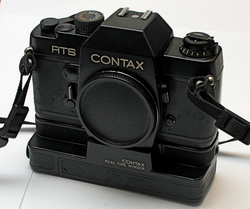
Contax
» see contax.com as it lived, on the wayback machine
~ the goodbye ~
Cameras are components where I work now. A sensor with a lens in front of it, bolted to something that has to fly, picked off a datasheet by pixel pitch and frame rate. Contax belonged to the opposite arrangement, the one where the body was the cheap half and the glass on the front was the entire reason anybody bought anything.
The name is older than most people assume. Zeiss Ikon launched it in 1932 as the direct answer to Leica, a 35mm rangefinder with a metal focal plane shutter and a viewfinder base long enough to focus a telephoto properly. The Contax II and III arrived in 1936. Then Germany was divided and so was the camera, with a Contax S coming out of Dresden in 1949 carrying the M42 screw mount, while the western side put out the IIa and IIIa and stopped in 1960.
The interesting half starts in 1975. Zeiss did not want to build camera bodies any more and Yashica did not have lenses anybody respected, so the two of them made a deal. The Contax RTS came out of it: a Japanese body with the Carl Zeiss T* line mounted on the front, and an exterior styled by the Porsche Design studio. That is a strange sentence and it was a strange camera, and it worked for twenty years.
I never owned one. In Turkey through the nineties a Contax was a thing behind glass with a number on the tag that you did not repeat out loud, bought by people whose job was photography rather than by households. What I know about the glass I learned much later and from the wrong direction, reading about lens signature while doing work where lens signature is a defect to be calibrated out.
~ the chronicle ~
| Born | 1932, Zeiss Ikon, as the answer to Leica |
|---|---|
| Peak | 1975 to 1996, the RTS bodies and the G rangefinders |
| Killed | September 2005 |
| Lifespan | seventy-three years, in two halves |
| Made by | Zeiss Ikon, then Yashica under Kyocera |
| Killed by | Kyocera walking out of the camera business |
~ how it landed ~
Kyocera bought Yashica in 1983 and the Contax line came with it. What followed was fifteen years of cameras that were technically odd on purpose. The RTS III had a vacuum plate that sucked the film flat against the back before the shutter fired, on the theory that film curvature was costing sharpness the lenses had already paid for. Very few other manufacturers thought this was worth doing.
The G1 and G2 in the mid-nineties were the ones that got a cult. Autofocus rangefinders with a titanium body, which nobody else was making, and a set of Zeiss primes for them that people still buy adapters to use on digital bodies thirty years later. That is the actual afterlife of this brand: the bodies are gone and the glass is still on working cameras.
~ the day it died ~
The Contax N Digital in 2002 should have been the win. It was the first full-frame digital SLR to reach the market, a 6-megapixel Philips sensor at the full 24 by 36 millimeters, announced in late 2000 and delayed into spring 2002. Then it turned out to be noisy above ISO 100 and slow to write, and Canon shipped the EOS-1Ds later the same year. The N Digital was off the market inside twelve months.
Kyocera announced on 12 April 2005 that it was terminating the Contax camera business, saying it had not been able to keep up with how fast the market was changing. Shipments of bodies and lenses stopped that September, with the 645 medium format system running on to December in some markets. Service was promised for up to ten years per model, which was more than the industry standard and which has now also run out.
The brand rights sit with Carl Zeiss AG, where they started. Nothing has been made under the name in twenty years. Kyocera did not sell the camera business to anyone, it simply stopped, which is the version of a company death that leaves no successor to be angry at.
~ leave a rose ~
an anonymous tribute. one rose per visitor per day.
@}-->-- ... roses left here
~ leave a wreath ~
a rose fades by morning. a wreath stays on this grave for good, with your name on it.
from $1, paid once through stripe. it keeps the graveyard running: the hosting and the nightly digging. adopt it and the headstone reads "maintained in memory by" you. the groundskeeper plants new wreaths at the next tending, usually within a day.
» one email a week: new graves and the anniversaries of the dead. subscribe
other gadgets: Escom AG, Microsoft Origami (UMPC), Convex Computer, Intel Movidius Neural Compute Stick
also died in the 2000s: Grendel, 1stUp.com, Amazon Auctions
~ leave a note ~
visitors before you have left these graveside notes. anonymous welcome.