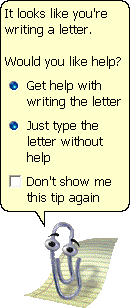
Microsoft Clippy
~ the goodbye ~
clippit (officially never "clippy" in microsoft documentation, but called clippy by everyone) launched with microsoft office 97 on 19 november 1996. he was an animated paperclip with eyebrows that lived in the bottom corner of your office documents. he watched what you typed. when he thought you were doing something he could help with, he would interrupt with suggestions.
the most famous interruption was: "it looks like you're writing a letter. would you like help?" if you typed "dear" at the start of a word document, clippy would appear and ask this. nobody who used office in 1998 did not encounter this prompt. nobody who saw it found it useful.
i used office through middle school and high school in turkey, mostly office 97 and 2000 on a windows 98 machine that my dad set up at home. clippy was on by default. i learned three keystrokes to dismiss him before learning how to actually format a document. eventually i found the right help menu to turn off the office assistant entirely and the relief was real. for a year clippy had been the official mascot of "i was about to think but a paperclip stopped me." when i finally killed him in the settings, the room got quieter.
clippy was made by kevan atteberry, a designer at microsoft. the animation was done in a flash-like vector format. clippy could blink, scratch his head, lean to the side, and do a few other small motions. he was supposed to be friendly. he was widely perceived as annoying.
microsoft made clippy disabled by default starting with office XP in 2001. they kept the office assistant feature but turned the default character to none. you had to actively choose to enable an assistant. most users did not. office 2007 removed the assistant feature entirely. clippy has not appeared in any microsoft product since, except as a nostalgic reference.
~ the chronicle ~
| Born | 19 November 1996 (Office 97 launch) |
|---|---|
| Disabled by default | 2002 (Office XP) |
| Killed | 30 January 2007 (removed entirely from Office 2007) |
| Lifespan | ~10 years (5 enabled by default, 5 hiding in settings) |
| Made by | Microsoft (designed by Kevan Atteberry) |
| Killed by | user backlash, Microsoft's own focus groups, the eventual rise of ChatGPT |
~ what was clippy ~
clippy was the office assistant feature in microsoft office, which was a wider system for letting an animated character offer suggestions while you used office applications. there were several characters available. clippy was the default. the others included:
- the dot (a smiley red dot)
- the genius (an einstein-style cartoon figure)
- rocky the dog (a cartoon dog)
- links the cat
- f1 the robot
- the office logo (a flying paperclip alternative)
each character had its own animations. you could change which one appeared in your office settings. most users did not change. clippy was the default, so clippy was who you got, and clippy is who everybody remembers.
behind the scenes, the assistant was a rule-based system. it watched what you were typing, what menu options you opened, what errors you hit, and used pattern matching to decide when to interrupt. the rules covered hundreds of cases. some of them were genuinely useful. most were not.
~ why everybody hated him ~
clippy had a specific kind of bad. he was:
insistent. when you dismissed him, he would come back. when you closed him, he would reappear. when you actively turned him off in settings, he would show up again on your next launch. you had to fight him.
condescending. he assumed you did not know what you were doing. "it looks like you're writing a letter" implied you needed help with the basic concept of writing a letter. for users who were experienced with office, this was insulting.
wrong. his pattern matching was crude. he would identify "writing a letter" based on the literal word "dear" at the start of your text. if you were drafting an email, a memo, a school essay, or a story that started with the word "dear," clippy would appear. his accuracy was much lower than his eagerness.
distracting. the animation was constant. he blinked. he scratched his head. he leaned over to look at your document. when you were trying to focus on actual work, having a paperclip with eyebrows in your peripheral vision was disruptive.
~ the marketing campaign ~
microsoft's marketing in the late 1990s leaned into clippy. there were TV ads with clippy in them. there were promotional postcards. there was a stuffed plush clippy you could buy. microsoft was committed to the character.
the user response was the opposite of the marketing. tech bloggers wrote columns titled "how to disable clippy permanently." the first published "how to remove clippy" guide on the web is from 1998. there was an entire genre of jokes about clippy being annoying. by 2000 he was a punchline.
microsoft did its own internal user research. the focus groups confirmed that people hated clippy. but the team that owned the office assistant feature kept defending it. there was reportedly real internal conflict between the marketing team that had committed to clippy and the user research team that had data showing he was hated.
~ how he died ~
office XP in 2001 turned the office assistant off by default. you could re-enable it but you had to actively choose to. most users did not. clippy went from being a constant presence in everyone's office experience to being a feature you had to opt into. the cultural footprint shrank fast.
office 2003 still had the assistant feature for users who wanted it. office 2007 removed the feature entirely. there is no clippy in office 2007 or any office version since. on 30 january 2007, with the office 2007 launch, clippy was officially gone.
microsoft has occasionally referenced clippy as a nostalgic mascot since then. a 2018 marketing experiment briefly brought clippy back as a microsoft teams sticker pack. there have been clippy emojis added to microsoft 365 in 2021. these are deliberate retro moments. the actual feature has been dead for almost twenty years.
~ what he was trying to do ~
clippy was a 1997 try at the same product category as ChatGPT. an AI assistant that watched what you were doing and offered help. the technology was rule-based pattern matching, which is not the same thing as a real language model. but the goal was the same. clippy wanted to be the helpful AI sidekick in your software.
twenty-five years later, ChatGPT shipped and largely succeeded at this. the difference is that ChatGPT actually works. its language understanding is real. its suggestions are usually relevant. it does not interrupt unprompted (unless you ask copilot in word to do so, which is its own debate). it knows what it does not know.
clippy was the right idea with the wrong technology and the wrong implementation. the implementation made him hated. the right idea was correct enough that microsoft kept trying for decades. copilot in office, which started shipping in 2023, is essentially clippy 2.0 with a real language model behind it. nobody calls copilot clippy. but the lineage is direct.
~ what he left ~
the cultural reference. clippy is shorthand for "annoying AI helper that interrupts you." every time someone shipped a chatbot in the 2010s, the obvious comparison was "is this clippy again?" the comparison was usually accurate.
the lesson about user-facing AI. clippy is the canonical case study in why AI assistants need to know when to shut up. interrupting users with help they did not request is worse than offering no help. the modern generation of AI assistants (siri, alexa, copilot, chatgpt) all wait to be invoked. they do not pop up unprompted. that design choice traces directly back to the clippy backlash.
the affection. clippy is also genuinely loved. some of the same people who hated him in 1999 now have nostalgic feelings about him. there is a clippy emoji in modern microsoft products. there are clippy plushies sold on ebay. he has become a small icon of late-90s computing in a way that is almost endearing now. time launders ux crimes. by 2030 someone will have built a clippy revival as a deliberate retro feature, and people will pretend to like it.
~ leave a rose ~
an anonymous tribute. one rose per visitor per day.
@}-->-- ... roses left here
~ leave a wreath ~
a rose fades by morning. a wreath stays on this grave for good, with your name on it.
paid once through stripe. payments are handled by OÜ Lakeview, the small company that keeps rip.so running. the money pays for the hosting and the nightly digging. adopt it and the headstone reads "maintained in memory by" you. the groundskeeper plants new wreaths at the next tending, usually within a day.
» one email a week: new graves and the anniversaries of the dead. subscribe
~ epitaphs from visitors ~
"RIP clippy.. I never ran out of tokens with you :‘("
left by smithn, 2026-04-29
"I suspect that microsoft will make a twist of it. No doubt. But I dont know if it will awesome as it was before"
left by b0zy, 2026-04-29
"I think I hated the dog more it wouldn’t stop moving!And the had the stupid dog in the PC’s search so every time I need to find a file or setting the a-hole was there with it’s cartoon tongue out. I refused to use Mic..."
left by darkocean, 2026-09-26
other ai assistants: Yupp AI, Cue, Replika (pre-2023 romantic era), Project Mariner
also died in the 2000s: PhotoPoint, Falcon 4.0, XFree86
~ leave a note ~
visitors before you have left these graveside notes. anonymous welcome.