Channel America
~ the obituary ~
David Post founded Channel America in 1987 with the idea of building a national television network out of a thousand low-power stations. Low-power TV was the cheap end of American broadcasting, small transmitters covering a few miles each on licenses that nobody else wanted. The theory was that if you stacked enough of them together and fed them all the same satellite signal, the arithmetic would come out looking like a network. He never got near a thousand, but the thing went on air in 1988 anyway, the first American terrestrial network deliberately assembled out of LPTV licensees rather than real stations.
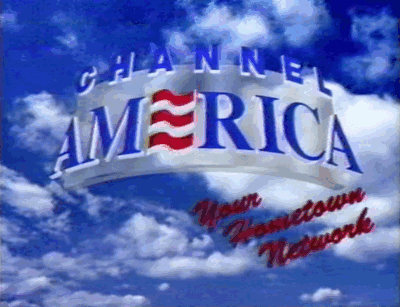
The feed ran around the clock on whatever was affordable. The flagship was Hot Seat, Wally George's shouting match of a talk show, produced by KDOC-TV in Anaheim, a station that never actually joined the network carrying it. Around that sat a shelf of Columbia Pictures reruns that had already been through two or three syndication cycles, Hazel and The Flying Nun among them. In 1990 the network went after cable operators too, offering a three hour interactive package called Hometown USA that systems could drop onto their local-origination channels, and American Television and Communications signed up for a best-of-local-access series provisionally titled Off Broadway. The on-screen identity was a chrome banner floating in a photographic blue sky, with the words "Your Hometown Network" written underneath it in red script.
In late 1995 the count peaked at 44 million households through 100 affiliates, which sounds enormous until you remember how those households were counted. A low-power transmitter covering a few miles of one city still puts a large number of people inside its contour on paper. Many of the affiliates had been established by the network itself, so the distribution and the programmer were the same balance sheet in two columns.
Low-power television is an entirely American artifact, a licensing category with no equivalent in any country I have lived in. None of this reached Ankara in 1995, where television meant a handful of national channels and whatever your building's satellite dish could find.
~ the case file ~
| Born | 1987 as a company, on air through 1988 |
|---|---|
| Peak | late 1995, 44 million households through 100 affiliates |
| Killed | 1996 |
| Lifespan | 8 years on air |
| Made by | David Post, later EVRO Corporation of Kissimmee, Florida |
| Killed by | no capital, then a pivot to home shopping |
~ the shell company ~
On 18 September 1995, a company called EVRO, out of Kissimmee, Florida, bought 51 percent of the network, holding an option on the remaining 49. EVRO's own history is the strangest document in this story. It was organized on 5 February 1946 as the Moreno-Cripple Creek Corporation, renamed Moreno Uranium in 1954, renamed EnviroSearch in 1970, became EVRO Financial in 1986 and EVRO Corporation in 1994. A fifty-year-old mining shell wandered through four identities and finished up owning a television network.
In June 1996 EVRO announced it would move Channel America's operations to Glendale Studios in California, a move the local paper reported could bring 200 jobs. That October its shareholders voted to rename the whole company Channel America Broadcasting, and the board voted to put the channel on a home shopping format, temporarily.
~ seven cents ~
The signal went dark some time in 1996. The parent company was delisted from NASDAQ later that year for insufficient capital and surplus, with the stock coming off a high of $2.50 to finish at seven cents. No exact shutdown date was recorded anywhere, which answers the question of how closely anyone was watching.
~ the last deal ~
In March 1997 what was left of the parent agreed to merge with LDE Media Techniqs, a company belonging to Morton Downey Jr., the confrontational talk host whose own syndicated show had been canceled years earlier. Downey's plan for the revived channel included a news magazine with the working title Boyz Night Out. The parent company is recorded as defunct that same year, and the news magazine never aired.
~ leave a rose ~
an anonymous tribute. one rose per visitor per day.
@}-->-- ... roses left here
~ leave a wreath ~
a rose fades by morning. a wreath stays on this grave for good, with your name on it.
paid once through stripe. payments are handled by OÜ Lakeview, the small company that keeps rip.so running. the money pays for the hosting and the nightly digging. adopt it and the headstone reads "maintained in memory by" you. the groundskeeper plants new wreaths at the next tending, usually within a day.
» one email a week: new graves and the anniversaries of the dead. subscribe
other streaming: eyeSpot, Gaikai, JioCinema, Voddler
also died in the 1990s: Sensible Software, Tynesoft Computer Software, Amstar
~ leave a note ~
visitors before you have left these graveside notes. anonymous welcome.