CERN httpd
» see w3.org/Daemon as it lived, on the wayback machine
~ the obit ~
This one sits in the part of internet history I can read about but cannot remember. By the time I got a modem in 1998, CERN httpd had already been unmaintained for two years and Apache was serving most of the web. I have only ever met this program the way everybody under a certain age meets it, as a footnote in the story of how the thing I was using came to exist.
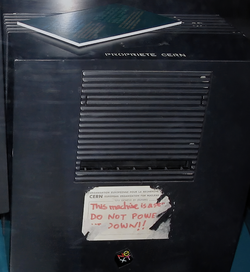
It began on a NeXT cube in an office at CERN, running the daemon Tim Berners-Lee had written to sit at the other end of his own browser. Ari Luotonen and Henrik Frystyk Nielsen did most of what came afterward. Version 0.1 went out in June 1991, and that August the source was posted to Usenet under the name WWWDaemon, which is how anyone outside the building got hold of it. It shipped inside the CERN Program Library alongside the physics code.
Calling it the first web server undersells what that meant at the time. There was no category yet. A web server was whatever this program did, so every convention it happened to pick became the assumption the next fifteen years of servers were written against: the directory it served files out of, the way it turned a URL into a path on disk.
CERN put the whole thing in the public domain in 1993, which is the single decision the modern web rests on. The last release carried an MIT license with an acknowledgement to CERN instead. Both amount to the same thing: nobody ever had to ask.
~ the rap sheet ~
| Born | 24 december 1990, on a NeXT cube at CERN |
|---|---|
| Peak | 1993 to 1994, when it was most of the web's server population |
| Killed | 15 july 1996, with the final release 3.0A |
| Lifespan | under six years, followed by thirty of being left up |
| Made by | Tim Berners-Lee at CERN, later maintained by the W3C |
| Killed by | NCSA httpd and then Apache, and a W3C that moved to Java |
~ how it landed ~
For a couple of years it was effectively the entire installed base, because there was nothing else to install. Then NCSA httpd arrived from Illinois and took the developers with it, and in April 1995 a group of people maintaining patches for NCSA's abandoned code released the collection under the name Apache. That was the end of CERN httpd's market share, well before it was the end of CERN httpd.
Its second life is the one people forget. Version 3.0 could run as a proxy in front of a network, caching what it fetched so the next person asking got it off local disk. Universities and companies with one expensive link to the outside world ran it for exactly that. The first widely deployed caching proxy on the internet was the first web server, wearing a different hat.
~ the day it stopped ~
Version 3.0A is dated 15 July 1996 and there was never a 3.1. The W3C had already turned toward Jigsaw, a web server written in Java, which in 1996 read as the obvious direction of travel. The official page was updated to say that CERN httpd was no longer maintained and that only security patches would follow. It has said that ever since.
The same page carries a line noting at least one known Y2K bug in the July 1996 release. That warning was written for administrators who were still running it in 1999 and had to be told, gently, that the first web server was not going to be fixed for them. Some of them were still running it anyway.
~ what replaced it ~
Jigsaw, the successor, is also dead. Its last release was 2.2.6 in April 2007 and almost nothing ran on it. The replacement outlived the original by eleven years and mattered less, which happens more often than the tidy version of software history admits.
W3C once described CERN httpd as the Volkswagen of the web, and that is about right. Not the fastest thing on the road and not the one anyone kept, but the one that established what the shape of the thing was, so completely that the shape stopped being visible. Every server you have ever talked to is answering a question this program defined the format of.
~ leave a rose ~
an anonymous tribute. one rose per visitor per day.
@}-->-- ... roses left here
~ leave a wreath ~
a rose fades by morning. a wreath stays on this grave for good, with your name on it.
from $1, paid once through stripe. it keeps the graveyard running: the hosting and the nightly digging. adopt it and the headstone reads "maintained in memory by" you. the groundskeeper plants new wreaths at the next tending, usually within a day.
» one email a week: new graves and the anniversaries of the dead. subscribe
other software: Springpad, XFree86, Aurasma (HP Reveal), Symantec WinFax PRO
also died in the 1990s: XBAND, ThunderByte Antivirus, Peter Norton Computing
~ leave a note ~
visitors before you have left these graveside notes. anonymous welcome.