Cascade Games
~ the goodbye ~
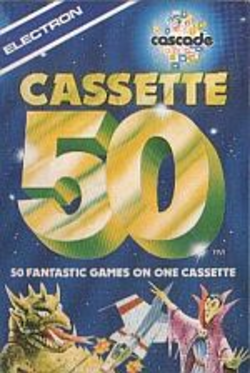
Cascade Games sold a single object better than it ever sold a game. Cassette 50 was fifty programs on one tape for £9.95, advertised by full-page coupon through 1983 and 1984, and the order form let you tick almost any machine on the British market, eleven of them, from the Commodore 64 and the Spectrum down to the ZX81, the Dragon and the Oric-1. The Amstrad CPC got a version too, sold as Disk 50. At some point the company began including a free Timex calculator watch with every tape, an item Guy Wilhelmy later put at about fifteen pounds retail, and the promotion ran large enough that he described Cascade as taking up the entire output of a watch factory in Hong Kong.
The company behind it started with two Loughborough students. Wilhelmy had written gambling programs on university mainframes and come back from the United States to set up a one-man operation in Harrogate called UTS. Nigel Stevens had studied human biology and spent nights on the anatomy department's PDP-11. Stevens was selling an earlier compilation by post from his family house in South Wales, a house called Cascades, and customers trusted a home address more than a Yorkshire PO box. The house named the company. It was incorporated on 23 September 1983.
The receivers went in before I turned six, which settles the era question on its own. The ordering mechanism settles the rest. You cut a coupon out of a British magazine, wrote a cheque payable to Cascade Games Ltd and posted it to Suite 4, 1-3 Haywra Crescent, and the volume got heavy enough that postmen carried the sacks in through the office door rather than fight the letterbox. That is a machine for moving tapes around one postal system, and it had no reason to reach anyone outside it.
~ the chronicle ~
| Born | 23 September 1983, Harrogate, North Yorkshire, as Cascade Games Limited |
|---|---|
| Peak | Cassette 50 at £9.95 across eleven machines, then ACE in 1985 |
| Killed | 15 May 1990, administrative receivers appointed by National Westminster Bank |
| Lifespan | 7 years trading, 28 more as a dormant shell |
| Made by | Guy Wilhelmy and Nigel Stevens, company no. 01755554 |
| Killed by | a 1987 bank debenture, with Activision's Chapter 11 as the trigger |
~ ten pounds and all rights ~
The same adverts that sold the tape also stocked it. "WE PAY TOP PRICES FOR TOP QUALITY GAMES," they said, and the top price was ten pounds and a signature handing over everything. Matthew Lewis was fourteen when he answered a small anonymous newspaper ad with a game called Galaxy Defence, written in about twelve hours, with graphics by his father Ernest. He got his ten pounds. The game went onto a tape that sold for a tenner a copy.
Quality control matched the acquisition budget. The Acorn Electron release lists fifty titles on the inlay and holds forty-eight, because Exchange and The Force are simply not on the tape. The Spectrum version records Motorway twice and reuses one filename for two different programs. Most of it was unprotected BASIC, which is the detail that would eventually give the thing a second life.
~ advertised, never reviewed ~
There is no CRASH review of Cassette 50, none in Your Sinclair, none in Personal Computer Games. The Spectrum press index for the title is adverts and nothing else: ten months of Big K, a run in Computer and Video Games from April 1983, Personal Computer News and Popular Computing Weekly through the autumn of 1983. Cascade bought that press rather than submitting to it.
The handful of reviews that do exist are oddly gentle. Games Computing looked at the Commodore 64 version in November 1984 and treated the listable BASIC as a selling point, a tour guide that let the user learn by experimentation, and concluded that for the price of one arcade game you got a little something extra. The savagery came twenty years later, from people who had owned it as children. Cassette 50 is the acknowledged inspiration for the comp.sys.sinclair Crap Games Competition and its Commodore equivalent, so a tape of fifty throwaway programs ended up seeding two annual traditions of writing deliberately terrible ones.
~ the flight simulator that paid for itself ~
Wilhelmy held a pilot's licence and thought the flight simulators on sale were accurate and dull. ACE: Air Combat Emulator came out in 1985, built by Ian Martin and Damon Redmond around a horizon that moved fast enough to feel like flying, and it became the biggest thing Cascade ever published. The launch got promotional films shot in London, a party at the Royal Garden Hotel and Raymond Baxter hired to front it. Sequels followed in 1987 and 1989, and the company picked up an RAF licence along the way.
The rest of the catalog is a decent mid-eighties shelf that almost nobody remembers, Sky Runner and Implosion and DNA Warrior among them. John Lewis, credited on Sky Runner for graphics and design, later turned up as a partner in Vektor Grafix.
~ two stories about one ending ~
The version in the magazines is that Nigel Stevens visited Electronic Arts' UK office, saw a million-dollar budget attached to PGA Tour Golf, worked out what that meant for a Harrogate company, and decided to stop. The version in the register is colder. In 1988 Cascade developed 19 Part One: Boot Camp, a Vietnam game riding the Platoon wave, as the first of a four-title distribution deal with Activision. Activision went into Chapter 11. 19 Part 2: Combat Zone was announced and never released. A creditor presented a winding-up petition on 20 April 1990, and on 15 May National Westminster Bank appointed R. Marsh and G. C. Horsfield of Price Waterhouse in Leeds as joint administrative receivers under a mortgage debenture it had taken out over the company in July 1987. The London Gazette printed it six days later and listed the trade as Computer Games Manufacturer and Distribution. Winding up commenced on 17 July. That is not a man closing a company, it is a bank closing it for him.
The name had already gone. Company 01755554 stopped being Cascade Games Limited on 21 November 1988 and became Artronic Products Limited, which is why a search of the Gazette for "Cascade Games" returns nothing at all. The shell then sat at the same Harrogate address for twenty-eight years with the 1987 NatWest charge still outstanding against it, and was finally struck off on 30 October 2018. The registered office on the dissolution record is character for character the address printed on the 1984 coupon.
~ leave a rose ~
an anonymous tribute. one rose per visitor per day.
@}-->-- ... roses left here
~ leave a wreath ~
a rose fades by morning. a wreath stays on this grave for good, with your name on it.
paid once through stripe. payments are handled by OÜ Lakeview, the small company that keeps rip.so running. the money pays for the hosting and the nightly digging. adopt it and the headstone reads "maintained in memory by" you. the groundskeeper plants new wreaths at the next tending, usually within a day.
» one email a week: new graves and the anniversaries of the dead. subscribe
other gaming: Playfire, Virgin Interactive, BarrysWorld, Marvel Super Hero Squad Online
also died in the 1990s: Paperback Software, Kaleida Labs, iGuide
~ leave a note ~
visitors before you have left these graveside notes. anonymous welcome.