B News
~ the obit ~
A News, the first Usenet server, assumed the network would stay small. B News was what happened when that assumption broke. Matt Glickman and Mary Ann Horton wrote it at UC Berkeley, Glickman still in high school at the time, and it went into use on Unix systems from 1981. In 1983 the work passed to Rick Adams, who maintained every release from 2.10.2 onward and went on to found UUNET.
The changes it made are the ones nobody notices anymore because they became the format. B News gave articles named, extensible headers instead of a fixed layout, and with version B2.10 in 1983 those headers became mail-compatible so articles could move across the ARPAnet without translation. It added a history database and article expiry, so a server could forget things. It added control messages: articles whose job is to delete other articles, or to create and remove newsgroups. That is the machinery an unowned network needs if it is going to be administered at all.
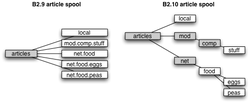
The storage change in B2.10 is the one that outlived everything. Before it, every newsgroup lived in a single parent directory, which got slow as the group list grew and forced the first fourteen characters of every group name to be unique, because of an old Unix filename limit. B2.10 split group names at the periods and made a directory tree out of them. Forty years on, that layout is still how articles sit on disk in newsreaders and caches.
~ the rap sheet ~
| Born | 1981, at UC Berkeley, as the replacement for A News |
|---|---|
| Peak | the most widely run Usenet server of the 1980s |
| Killed | 1989, last patch set, release 2.11 patchlevel 19 |
| Lifespan | 8 years of development |
| Made by | Matt Glickman and Mary Ann Horton, then Rick Adams from 1983 |
| Killed by | C News and INN, and its own maintainer's verdict |
~ what it became ~
Moderation arrived awkwardly and then properly. B2.10 supported it by convention: a moderated group had to sit under a mod. prefix, and anyone posting had to mail their submission to a human who would post it on their behalf. B2.11, in 1986, let moderated groups live anywhere in the hierarchy and mailed the submission off quietly in the background, so the poster no longer had to understand the arrangement. Usenet had a working editorial mechanism before most people had an email address.
Its own replacement started as a complaint. Henry Spencer, at Toronto, hit a bug in B News and rewrote it from scratch with Geoff Collyer. That became C News, a faster and cleaner thing that stayed in development into the mid-1990s. Around 1989 Eric S. Raymond tried a separate rewrite under the name Teenage Mutant Ninja Netnews. A rough version got released and drew attention from across the network, then the project was abandoned. The last B News patch set shipped in 1989, release 2.11 patchlevel 19, and Rick Adams declared the product obsolete rather than leaving anyone to wonder. Sites moved to C News or to INN.
~ the headers that outlived it ~
I came to Usenet through a browser, years after all of this, when the way you read it in Turkey was a web archive on somebody else's site rather than a news server your provider ran. The software was two generations dead by then and the format was not. RFC 1036 was published in 1987 to describe what B News already did, and it is still what a Usenet article has to look like.
~ leave a rose ~
an anonymous tribute. one rose per visitor per day.
@}-->-- ... roses left here
~ leave a wreath ~
a rose fades by morning. a wreath stays on this grave for good, with your name on it.
paid once through stripe. payments are handled by OÜ Lakeview, the small company that keeps rip.so running. the money pays for the hosting and the nightly digging. adopt it and the headstone reads "maintained in memory by" you. the groundskeeper plants new wreaths at the next tending, usually within a day.
» one email a week: new graves and the anniversaries of the dead. subscribe
other protocols: MathJax CDN, FeedSync, WAIS, FastTrack
also died in the 1980s: Otrona Advanced Systems, Forethought, Inc., Ariolasoft
~ leave a note ~
visitors before you have left these graveside notes. anonymous welcome.