ATV (Associated TeleVision)
~ the obit ~
The company that went on the air on Saturday 24 September 1955 was called the Associated Broadcasting Company, and it had to stop being called that after three weeks. Associated British Picture Corporation ran a chain of cinemas under the initials ABC and wanted the name for its own station, so it sued for prior ownership. From 8 October 1955 the company was Associated TeleVision. It was the second ITV contractor to reach the air, holding the London weekend contract, and from 17 February 1956 the Midlands on weekdays as well.
It existed because two failed applications were pushed together. The Associated Broadcasting Development Company, run by Norman Collins, had won a contract and did not have the money to operate it. The Incorporated Television Programme Company, run by the theatrical agents Prince Littler and Lew Grade, had the money and had been refused a contract over what the authority saw as conflicts of interest. When the funding gap opened, the Independent Television Authority invited Grade and Littler into the consortium. That solved the money and left Collins on the outside of his own company.
The first two years of ITV lost money at a rate nobody had planned for. Associated-Rediffusion, the London weekday contractor, carried part of ATV's losses, and more funding came from selling shares to the Daily Mirror. The corporate shape kept changing until 1966, when ATV and ITC both became subsidiaries of a new holding company, Associated Communications Corporation. That was the point at which Lew Grade moved from being the company's largest influence to controlling it outright.
In the 1968 franchise round the authority redrew the map. ATV lost the London weekend to the consortium that became London Weekend Television, and was given the Midlands for all seven days from Tuesday 30 July 1968. The company renamed itself ATV Network Limited and spent the next thirteen years making a very large share of what the rest of Britain watched on the other channel.
~ the rap sheet ~
| Born | 24 September 1955, the second ITV company on air |
|---|---|
| Peak | one of the Big Four that made most of ITV's networked schedule |
| Killed | 1 January 1982, at 12.34am |
| Lifespan | 26 years, 3 months |
| Made by | Associated Communications Corporation, under Lew Grade |
| Killed by | an IBA franchise review that demanded a new company |
~ the shadowed eye ~
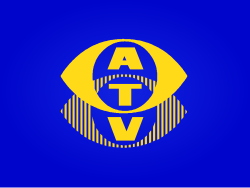
The logo was an eye in shadow with the letters inside it, borrowed fairly openly from the CBS eye, and reputedly sketched by Lew Grade on a flight home from America. It had been drawn for the name ABC and had to be redrawn in a hurry when the lawsuit landed, which is why the first version was out of proportion. It stayed the mark of the company for twenty-six years.
The version people remember arrived in 1969 with color. Three lightspots grow and merge into a single cream dot, which opens out into the eye in yellow while the background goes from gray to dark blue, over a twelve-beat fanfare written by ATV's musical director Jack Parnell and arranged by Angela Morley. A separate black and white variant existed for programs that were still monochrome. It ran from the first color transmissions until the name stopped being used.
~ losing london ~
Losing the London weekend did not move the company out of London. ATV had bought the Elstree studios in Borehamwood in May 1958, a film lot since 1914, intending to shoot ITC's filmed series there, and then converted it to electronic production with the first of four studios opening in November 1960. After 1968 the Midlands franchise was still being served out of a studio complex in Hertfordshire.
There were Midlands studios. The originals were at Aston in Birmingham, owned jointly with ABC under the name Alpha Television, supplying both companies. For color, ATV built the ATV Centre off Broad Street in central Birmingham to replace them, and sold Aston. The ATV Centre lasted until 1997, by which time two of its production studios had already been mothballed. Alpha Tower is still standing and listed; most of the rest has been demolished.
~ the night it ended ~
Through the 1970s ATV was criticized steadily for how little it made about its own region, and the east of that region complained loudest of all. The charge was that local output had a Birmingham focus and a Hertfordshire address. In 1980 the Independent Broadcasting Authority agreed, and ruled that whoever held the Midlands next would have to be based in the region with separate facilities for the East and West Midlands.
ACC applied through a shell company it had created for the purpose, ATV Midlands Limited, and won, but the award came with conditions. ACC had to sell down to 51 percent, give up executive roles, sell Elstree, and rename the company so that it was visibly a new business. The outside shareholders who took the rest included DC Thomson and Ladbrokes, with Robert Maxwell's Pergamon holding nine percent.
ATV stopped transmitting at 12.34am on Friday 1 January 1982, which was the end of the Thursday night, after Scottish Television's networked Hogmanay show. Shaw Taylor, one of ATV's original announcers, gave a short tribute. The duty announcer Mike Prince signed off, and what played out was the national anthem on an organ, recorded at St Chad's Cathedral in Birmingham. Central Independent Television came on at 9.25am the same morning with an extended promo.
~ what carlton bought back ~
Central inherited the news archive and the regional programs, along with anything already in production and the schools output. The rest of the ATV archive was sold off by ACC, and spent the next seventeen years being reassembled by somebody else. Carlton Communications bought up ACC's intellectual property through the 1980s and 1990s, including the rights to the logo and the company name, and in January 1999 bought ITC's film and television library from PolyGram for 91 million pounds, which put ATV's programs and Central's back in the same building. The regional news film sits at the Media Archive for Central England at the University of Lincoln.
Where I live the three letters belong to somebody else entirely. Turkey's atv launched in 1993, eleven years after this one closed, and it is still on air, so the abbreviation that means a shadowed eye and Sunday Night at the London Palladium to a British viewer of a certain age means a Turkish general entertainment channel to me. Brands outlive the companies that earn them, and they do not always stay in the same country.
~ leave a rose ~
an anonymous tribute. one rose per visitor per day.
@}-->-- ... roses left here
~ leave a wreath ~
a rose fades by morning. a wreath stays on this grave for good, with your name on it.
paid once through stripe. payments are handled by OÜ Lakeview, the small company that keeps rip.so running. the money pays for the hosting and the nightly digging. adopt it and the headstone reads "maintained in memory by" you. the groundskeeper plants new wreaths at the next tending, usually within a day.
» one email a week: new graves and the anniversaries of the dead. subscribe
other streaming: Voot, Mega Filmes HD, TPS Star, Warner Archive Instant
also died in the 1980s: Oric, Ohio Scientific, American Multiple Industries
~ leave a note ~
visitors before you have left these graveside notes. anonymous welcome.