ARK Logic
» see arklogic.com as it lived, on the wayback machine
~ the obit ~
ARK stood for Advanced Rendering Kernels, which tells you the company thought it was going to matter. Ruey Lu founded it in Santa Clara in 1993 and hired Lewis Eggebrecht, the chief designer of the original IBM Personal Computer, as chief scientific officer. The first two chips went out in October 1994, a 32-bit accelerator and a 64-bit one, both built to sit on either the PCI bus or VESA Local Bus because nobody knew yet which of those was going to win. The first design win came a month later, when Western Digital's Paradise division put the 32-bit part on a budget card.
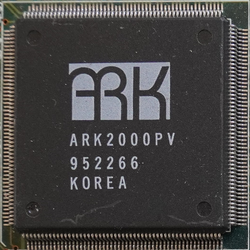
If you had a PC in 1995 there is a real chance one of these was in it, and almost no chance you knew. I did not have a PC in 1995. The first machine I ever got a modem into never once raised the question of what was driving its screen, and the first time I opened a case and read the writing on a graphics chip was years after ARK had stopped making them. The name survives on the die and nowhere else, because the box it shipped inside had somebody else's logo on it.
Integrated Circuit Systems, a clock and RAMDAC maker out of Valley Forge in Pennsylvania, bought 51 percent of ARK in April 1995 for $7.3 million with an option on the rest, and the company moved down the road to San Jose. ICS had bought most of Turtle Beach two years before that, and between the two purchases it had decided it was a multimedia company. Its own president called that judgment wrong in public later, saying the acquisitions were so far outside what ICS did best that they ended up hurting it.
Sales slowed at the end of 1996 and ARK shipped nothing new for a year. Lu stepped down as chief executive on 13 January 1997 and stayed on as operations chief. That July, ICS sold 80 percent of its holding to Vision 2000 Ventures, a Cayman Islands company, in exchange for being relieved of $2.3 million of debt, then sold Turtle Beach too and walked away from the rest of its ARK stake.
~ the rap sheet ~
| Born | 1993, founded in Santa Clara by Ruey Lu, with the IBM PC's chief designer as chief scientist |
|---|---|
| Peak | the ARK2000PV in Diamond's Stealth64 and Hercules' Stingray 64, 1995 |
| Killed | september 2002, the month the website went dark |
| Lifespan | nine years |
| Made by | Ruey Lu, then Integrated Circuit Systems, then Vision 2000 Ventures |
| Killed by | arriving in the 3D market about two years late |
~ the cards you may have owned ~
The ARK2000PV is the chip with a history, because it powered Hercules' Stingray 64 and then Diamond Multimedia's Stealth64, which was one of the cards people actually bought in 1995. The follow-ups kept adding video: an MPEG-1 decoder in December 1995, then an MPEG-2 decoder in August 1996 that could hold thirty frames a second. The 1996 part ran 1600 by 1200 in 16.7 million colors, which was more screen than most people had.
The strangest thing ARK built was the APEX bus, introduced on the Quadro64 in May 1996. It was a semi-proprietary internal connector based on a VESA proposal that let the graphics chip take on work unrelated to putting pixels on a monitor. Given the right converter attached to it, the card became a television tuner. Eggebrecht had looked at building a media processor of the sort everyone was promising that year and decided to do it this way instead.
~ five words on a white page ~
ARK announced its first 3D chip, the Tiger 3D, in May 1998, with manufacturing lined up at TSMC and LG Semicon. In February 1999 it tried again with the Ark 8800 Cougar 3D and invited comparison with Intel's i740 and ATI's 3D Rage Pro. Both of those were already old by the time the Cougar was announced, and the i740 was a commercial failure that Intel was dumping at steep discounts. Analysts said out loud that ARK could not compete. After the Cougar announcement the record goes quiet.
Wayback holds a last capture of the working homepage, dated 14 September 2002. It is 553 bytes. There is no text on it at all: one 465 by 381 pixel image with a six-region map cut into it and a small animated strip underneath. One of those six regions points at a page called jobs. The page title is Untitled Document.
The capture from 26 September 2002 is 251 bytes and it reads, in full, that this website no longer exists. By September the following year the address was a parking page explaining to visitors how much money a parked domain could earn. The part that outlived all of it is a driver: X.Org still shipped 2D support for ARK chips as of February 2023, two decades past the month the company went quiet.
~ leave a rose ~
an anonymous tribute. one rose per visitor per day.
@}-->-- ... roses left here
~ leave a wreath ~
a rose fades by morning. a wreath stays on this grave for good, with your name on it.
paid once through stripe. payments are handled by OÜ Lakeview, the small company that keeps rip.so running. the money pays for the hosting and the nightly digging. adopt it and the headstone reads "maintained in memory by" you. the groundskeeper plants new wreaths at the next tending, usually within a day.
» one email a week: new graves and the anniversaries of the dead. subscribe
other gadgets: Oculus Rift, Lumo Lift, VLSI Technology, KC 85
~ leave a note ~
visitors before you have left these graveside notes. anonymous welcome.