ARI (Autofahrer-Rundfunk-Information)
~ the goodbye ~
The idea started with a motoring club. In 1969 the ADAC went looking for a way to extend the traffic bulletins that German radio had settled into during the previous decade, and the first version of the plan was almost charmingly mechanical: broadcast a signal that would start a tape recorder, so the driver could play the bulletin back whenever they wanted it. The club also invented the name. Between 1970 and 1973 it installed listening posts at seventeen motorway service areas where the recorded traffic news could be played on demand.
Blaupunkt came in as the hardware partner, having just failed at something similar with RWTH Aachen, and the engineering went through several years of audible tones that car radios could not reliably recognize. Tests in the Swiss mountains settled it: the stable answer was an inaudible subcarrier at 57 kHz, locked to the 19 kHz stereo pilot tone and sitting at exactly three times its frequency. On 1 June 1974 West Germany put it on the air, at first only on selected ARD transmitters. Switzerland followed in 1980, where the same three letters stood for Auto-Radio-Information. The DDR carried traffic news with ARI on Radio DDR I using a different activation tone, and from January 1987 Czechoslovak radio ran it along the motorway between Prague and Bratislava with decoders built by Tesla.
What it actually sent was small. The presence of the 57 kHz carrier meant this station carries traffic news, and an amplitude modulation on top of it encoded one of six area codes, A through F, so the radio also knew which part of the country the station was responsible for. A separate 125 Hz modulation meant a bulletin is on the air at this moment. That is the entire protocol. It ran unchanged for thirty years, and it was how most of central Europe found out there was a jam ahead.
~ the chronicle ~
| Born | 1 June 1974 on selected ARD transmitters, from a 1969 ADAC initiative |
|---|---|
| Peak | the default traffic signal on West German FM, with Switzerland following in 1980 |
| Killed | 1 March 2005, when the ARD stopped transmitting it |
| Lifespan | 31 years in Germany, 34 counting the Austrian switch-off |
| Made by | Blaupunkt with the ARD broadcasters, engineering led by the Institut für Rundfunktechnik |
| Killed by | RDS, which carried the same two functions as TP and TA |
~ the yellow lamp ~
The driver-facing version of all this was a lamp and a button. A radio tuned to an ARI station lit a small yellow indicator, which accounts for the otherwise unexplained extra light on the faceplate of a whole generation of German car radios. The button was usually labeled VF or SDK. Switched on, a mechanical push-button set would mute completely unless it found a station carrying the signal; a digitally tuned radio would instead go hunting for one as soon as the current station faded out.
The announcement code is the feature people actually remember. With traffic priority engaged, a muted radio came up on its own and a playing cassette was interrupted, and the bulletin went out at a fixed volume so it did not matter where you had left the knob. You could cancel an announcement that had gone on too long or did not concern you. Blaupunkt pushed the idea further in 1983 with a radio called the Berlin IQR 83, which loaded a database of transmitters from a data cassette and used a second background receiver to scan the FM band, so it could display a station name instead of a letter and hop to a stronger transmitter when you drove out of range. The station landscape kept changing, so owners were expected to buy a fresh cassette now and then. The last of those radios went out of production in 1989.
~ the blue signs ~
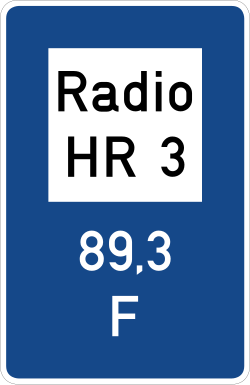
ARI had a physical layer on the roadside. From February 1974 the German traffic code carried blue signs, numbers 368 and 369, printed with the frequency and the area letter of the traffic station you could receive where you were standing. After private radio arrived in 1984 and the number of traffic broadcasters multiplied, you got several of them a few hundred meters apart on the same stretch of autobahn. Sign 369 was dropped from the code in 1992. Sign 368 lost its legal validity on 31 December 2002 and crews started taking them down the next day, two years before the signal itself was turned off.
That six-letter area table also shows exactly how far the system ever reached. A through F covered German federal states and the Swiss language regions and nothing else, so the switch on the radio was only meaningful inside a particular set of borders. Nothing on the Turkish FM dial ever answered it. A car radio imported into Ankara with a VF button on the front had a working decoder listening for a code that was never transmitted anywhere near it. Those buttons came into Turkey on the hardware anyway, and nobody holding one had any reason to find out what the letters stood for.
~ one station left ~
RDS went official on 1 April 1988 and absorbed both of ARI's useful signals, the station flag becoming TP and the announcement flag becoming TA. The two systems then ran in parallel for fifteen years, and ARI kept one genuine advantage the whole time: it needed less signal, so it stayed readable in noisy reception where RDS data fell apart. By the middle of the 1990s you could barely buy a car radio without RDS, which made the parallel broadcast an expense with a shrinking audience.
Switzerland switched off on 1 September 2003 and the ARD followed on 1 March 2005. Austria held on until 19 May 2008, and one transmitter kept going after that: Radio Hamburg stayed on area code C at 103.6 MHz as the last station in the world sending ARI, and owners of old radios around Hamburg could still use the feature until at least August 2012. Thirty-eight years after the first ARI transmitter went on the air, one yellow lamp in northern Germany was still lighting up.
~ leave a rose ~
an anonymous tribute. one rose per visitor per day.
@}-->-- ... roses left here
~ leave a wreath ~
a rose fades by morning. a wreath stays on this grave for good, with your name on it.
paid once through stripe. payments are handled by OÜ Lakeview, the small company that keeps rip.so running. the money pays for the hosting and the nightly digging. adopt it and the headstone reads "maintained in memory by" you. the groundskeeper plants new wreaths at the next tending, usually within a day.
» one email a week: new graves and the anniversaries of the dead. subscribe
~ leave a note ~
visitors before you have left these graveside notes. anonymous welcome.