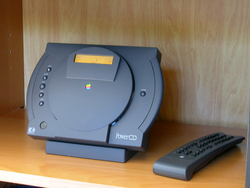
Apple PowerCD
~ the obituary ~
the powercd sat in the part of internet history i can read about but cannot personally remember. it shipped in 1993, i was nine years old in a turkish elementary school, and my exposure to apple at that age was magazine racks and nothing more. the home machine in my building was a relative's msx that loaded cassette tapes. apple's industrial design output of the early 1990s landed for me later, as folklore.
the device was apple's first consumer-oriented product you could use as a standalone object. it had a small lcd plus a remote and a battery compartment, so it could sit on a shelf next to a stereo and act like a portable cd player. when you plugged it into a mac with a scsi cable it became a generic cd-rom drive. when you fed it a kodak photo cd it sent slides to a tv set through composite or s-video.
under the apple plastic was a philips cdf-100. philips designed the unit and apple's industrial design group (specifically a small team named mac like things in mid-1992) rebadged it with the apple wordmark and a tighter color palette. that was the whole apple contribution to the hardware. the brief was a portable audio-cd player that doubled as a peripheral, and the design language was already a philips object before it was an apple one.
~ the case file ~
| Born | 1993 (rebadged Philips CDF-100, designed by Mac Like Things) |
|---|---|
| Peak | 1993 holiday window as an Apple-branded portable CD player |
| Killed | 1995, quietly cleared from the catalog before the iMac era |
| Lifespan | about two years |
| Made by | Philips for Apple under the Apple PowerCD brand |
| Killed by | weak retail traction and a confused product brief |
~ what it was good at ~
the photo cd reader was the part that almost made sense. kodak's photo cd format from 1992 was meant to digitize a roll of film into 35mm scans on a cd that could be read by a tv-attached player. the powercd handled this on a tv set without a computer. for a few months in 1993 that was a real value proposition for a family who wanted to look at vacation pictures on the couch.
the audio cd side was unremarkable. discman-class portable players from sony cost less and ran longer on the same batteries. the scsi cd-rom mode was useful if you owned a mac without a cd drive, which by 1993 was a shrinking pool of customers. apple was already shipping internal cd-rom drives in most performa and quadra units by the time the powercd hit retail.
~ how it ended ~
the powercd did not get a press-release death. it left the catalog quietly in 1995 after roughly two years on the price list. by then the photo cd format itself was losing relevance. flatbed scanners had dropped in price. the kodak picture cd format that followed photo cd shipped on regular audio-cd-style discs that any pc could read without specialist hardware.
apple did not try the standalone-consumer-electronics category again until the ipod in 2001. the philips cdf-100 outlived the apple version by a couple of years inside philips's own catalog, which is the cleanest indicator of who actually owned the design.
~ the long tail ~
a working powercd with its remote and original power brick goes for around two hundred dollars at auction in 2026. collectors mention it in the same sentence as the macintosh tv and the twentieth anniversary mac, the small set of mid-1990s apple hardware that did not catch on but became distinctive later because nobody else tried the same combination. the kodak photo cd format itself shut down support in 2014.
~ leave a rose ~
an anonymous tribute. one rose per visitor per day.
@}-->-- ... roses left here
~ leave a wreath ~
a rose fades by morning. a wreath stays on this grave for good, with your name on it.
from $1, paid once through stripe. it keeps the graveyard running: the hosting and the nightly digging. adopt it and the headstone reads "maintained in memory by" you. the groundskeeper plants new wreaths at the next tending, usually within a day.
» one email a week: new graves and the anniversaries of the dead. subscribe
other gadgets: Rodime, Maxtor Corporation, IBM MT/ST, Sun Cobalt Qube
also died in the 1990s: Rodime, Microsoft Mail, Mandic BBS
~ leave a note ~
visitors before you have left these graveside notes. anonymous welcome.