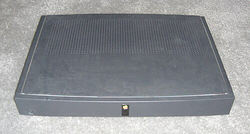
Apple Interactive Television Box
~ the obit ~
Nobody bought one of these, because they were never for sale. The Apple Interactive Television Box exists in a handful of thousands of units, almost all of them installed by a telephone company in somebody's living room for a trial that had an end date printed on it from the beginning. When the trial finished, the service was switched off and the box on top of the television stopped doing anything at all.
Apple started building it around 1993, at the exact moment when every large company in the world had decided that interactive television was the future and that the future was arriving next year. The set-top box was going to be the thing everybody had, and the fight was over whose operating system would be inside it. Apple's answer was to put a Macintosh in the box. Not something inspired by a Macintosh, an actual Macintosh, based on the LC 475 logic board with a customized System 7.1 burned into ROM so the thing would boot instantly and never show a user a desktop.
British Telecom ran the first technology trial in march 1994, in Kesgrave in Suffolk, with about sixty of its own employees. The second trial was the real one, around Ipswich, with roughly 2,500 households getting video on demand over a phone line. Belgacom ran something similar. Apple also put units into hotels at Disneyland in California and into a six-state American trial in 1995. That is the entire deployment history of the product.
In 1994 I was ten years old in Turkey, watching terrestrial television on a set with a dial, in a house that would not have a modem for another four years. Video on demand over the phone line to a box under the TV was not a thing anyone I knew was going to be offered, and as it happens it was not a thing anyone in Ipswich was going to be offered either once the trial ended. This is a product with almost no users anywhere, which makes it unusually honest as a grave. There is nothing to be nostalgic about. There is only the plan.
~ the rap sheet ~
| Born | March 1994, first British Telecom trial in Kesgrave, Suffolk, with 60 staff |
|---|---|
| Peak | about 2,500 units in homes around Ipswich for BT's second trial |
| Killed | 1995, canceled once the trials wound up |
| Lifespan | roughly two years, none of it on sale |
| Made by | Apple Computer, with British Telecom and Belgacom |
| Killed by | interactive television turning out to be the web |
~ what was actually in the box ~
The hardware was more serious than a trial device needed to be. A 68LC040 processor, the Mac ROM modified to boot straight into a television interface, MPEG decoding for video, S-Video and composite output, and an RJ-45 socket taking an E1 or T1 data stream from the telephone exchange. There was an infrared remote instead of a keyboard, and the whole point was that the user never learned they were operating a computer.
That architecture is why the trials could work at all. The box was not storing anything. The film lived on a video server at the exchange, the network carried it in real time, and the box decoded it and put it on the screen. Everyone in 1994 understood this to be an enormously expensive way to deliver a movie, which it was. The telephone companies were prepared to spend the money because they believed the alternative was letting cable operators own the household.
~ the funny part ~
Because the boxes were Macs, they did not stay dead. Once the trials ended, units leaked out into the surplus market, and hobbyists worked out that with the right modification you could boot the thing as an ordinary Macintosh. One prototype sold on eBay in 2010 for forty six dollars, which is a fair market price for a piece of hardware whose only recorded function was to be switched off.
People are still taking them apart. There is documentation online from as recently as 2023 of somebody dumping the modified System 7.1 ROM and picking through what Apple changed to make a desktop operating system pretend it was a television. The device has had a much longer second life as an object of curiosity than it ever had as a product, which is roughly the opposite of how this normally goes.
~ what survived ~
Everyone was wrong in the same direction. Time Warner's Full Service Network in Orlando, BT's Ipswich trial, the American cable experiments, all of them assumed interactive television meant an expensive box in the living room fed by a dedicated video network the operator controlled. Within three years the answer showed up as a general-purpose data connection to a general-purpose computer, and the entire interactive TV industry was quietly written off.
Apple came back to the same room eventually, with the Pippin in 1996, then with the first Apple TV in 2007. The 2007 box worked because by then the network was already in the house and Apple did not have to build one. The 1994 box failed because the network was the product and the network cost more than anyone was ever going to pay for a film.
~ leave a rose ~
an anonymous tribute. one rose per visitor per day.
@}-->-- ... roses left here
~ leave a wreath ~
a rose fades by morning. a wreath stays on this grave for good, with your name on it.
from $1, paid once through stripe. it keeps the graveyard running: the hosting and the nightly digging. adopt it and the headstone reads "maintained in memory by" you. the groundskeeper plants new wreaths at the next tending, usually within a day.
» one email a week: new graves and the anniversaries of the dead. subscribe
other gadgets: Tseng Labs, TI-99/4A, Swyp Card, Sanyo
also died in the 1990s: Advanced Network and Services, Barings Bank, Tseng Labs
~ leave a note ~
visitors before you have left these graveside notes. anonymous welcome.