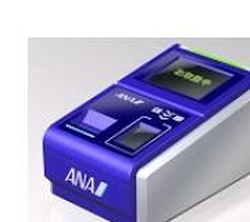
ANA SKiP Service
» see ana.co.jp as it lived, on the wayback machine
~ the eulogy ~
The whole promise fit into a subtitle on the press release: just go to the boarding gate ten minutes before departure. ANA switched SKiP on at twenty-four Japanese airports on Friday 1 September 2006, and what it deleted was the check-in counter. You settled the booking and the seat in advance, and the airport then asked you for nothing except a surface to touch.
Two kinds of surface worked. One was a two-dimensional barcode, which anyone could use and which could sit on a printout or a phone screen. From July 2017 it was printed on the face of the mileage card as well. The other was FeliCa, restricted to ANA Mileage Club members and carried either on a card with an Edy or transit chip in it or on an Osaifu-Keitai handset. The rule that mattered was that both touches had to come from the same object. Present the card at security and the phone at the gate and you got an authentication error.
By September 2007 ANA had committed to all fifty of its domestic airports, starting at Matsuyama on the fourth of that month, and used the rollout to abolish the magnetic ticket. The gate deadline was ten minutes against fifteen for everybody else. The security deadline was fifteen minutes, which became twenty minutes at Haneda on 1 December 2018 and then twenty across the whole network from 27 October 2019.
~ the dossier ~
| Born | 1 september 2006, at twenty-four Japanese airports |
|---|---|
| Peak | about 50% of ANA domestic passengers by 2022, up from 10 to 20% in 2007 |
| Killed | 31 march 2023, announced ten months earlier |
| Lifespan | sixteen and a half years |
| Made by | All Nippon Airways |
| Killed by | online check-in, which worked for the other half |
~ fifty percent, and flat ~
ANA's press office told ITmedia in July 2007 that monthly usage was running at ten to twenty percent of passengers. Fifteen years later the figure was about half, and the executive who gave it added the part that decided the outcome: it had not changed for years. Half of ANA's domestic passengers were still being handled the old way, so every airport had to keep both procedures running.
The replacement had been sitting next to it since 24 June 2020. Online check-in launched that morning under a release whose headline said it was being added to SKiP rather than replacing it, which left ANA running both for nearly three years. When the airline finally announced the end, on 24 May 2022, the public reason was airport congestion and contactless handling. The reason its own CX strategy lead gave in an interview that August was blunter and came in two parts, with the second explicitly marked as the larger: maintaining two systems was expensive, and passengers were telling ANA that having both was very hard to understand.
~ the people it did not fit ~
The same interview says what capped it at fifty percent. SKiP needed either a compatible card or a smartphone, so passengers traveling with an infant could not use it, and passengers who were not Japanese found it confusing. Against that the same executive set out the standard a universal service has to meet, which is that everybody gets to have the same experience.
The infant exclusion did not creep in over time either. ANA's own 2020 release announcing online check-in names passengers with small children as exactly the group SKiP had never been able to serve, which means the airline had identified the defect, built a second system beside the first to work around it, and then, sixteen years after launch, cited that original defect as the reason to switch the first one off.
SKiP covered domestic Japanese flights only, and its convenient half ran on a Japanese loyalty account, so a foreign passenger arriving at Haneda belonged by construction to the group ANA eventually decided it had been failing. The argument behind the shutdown is familiar from a different direction though, and any engineer has sat through it: two paths through a system, the clever one good for half the users and the dull one good for everybody. Online check-in was the dull one, and it is what ANA domestic runs on now.
~ JAL kept it ~
All Nippon was not even first. Japan Airlines had put a FeliCa touch at the gate on 15 February 2005, a year and a half earlier, and in December 2005 an ANA manager was quoted explaining why the airline would not copy it: airport staff needed to look at a boarding pass, so operationally it was better to have the ticket exist. ANA's version, when it arrived, went further than JAL's in the one way that counted, because JAL still made you check in online first and SKiP never did. JAL's touch and go is alive today, and it has quietly dropped the advance check-in requirement, so JAL now runs the thing ANA invented and then walked away from.
The 2022 announcement also said ANA would phase out its domestic check-in machines. On 2 October 2024 the airline reversed that, citing how customers were actually behaving, and said new machines carrying some of the old functions would go in from autumn 2025. The counters came back. SKiP did not.
~ leave a rose ~
an anonymous tribute. one rose per visitor per day.
@}-->-- ... roses left here
~ leave a wreath ~
a rose fades by morning. a wreath stays on this grave for good, with your name on it.
paid once through stripe. payments are handled by OÜ Lakeview, the small company that keeps rip.so running. the money pays for the hosting and the nightly digging. adopt it and the headstone reads "maintained in memory by" you. the groundskeeper plants new wreaths at the next tending, usually within a day.
» one email a week: new graves and the anniversaries of the dead. subscribe
other protocols: Web Intents, Qube, SSL 3.0, Usenet (the ISP-bundled era)
also died in the 2020s: Save This Life, Relatieplanet, Upstream
~ leave a note ~
visitors before you have left these graveside notes. anonymous welcome.