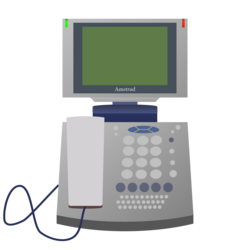
Amstrad E-m@iler
~ the eulogy ~
The E-m@iler was a British object at the wiring level. It only makes sense in a country where the landline already sat in the hall and where a premium rate telephone number counted as a business model on its own. Take those two conditions away and there is no product left.
Amstrad launched it in March 2000 at £79.99, which was below what it cost to build. That was intentional. Alan Sugar's plan was to give away the hardware and collect the money afterward in small amounts, over years. It was 20p every time you went and got your mail, and 50p to send a text message to a mobile. Advertising downloaded itself onto the screen over free numbers while the thing sat idle, and if you did not want the advertising you could pay £15 to have it removed.
It sold. 110,000 of the first model went out and around 280,000 people were using one by October 2003, with 450,000 units shipped in total across the range. Those are not the numbers of a product nobody wanted. They are the numbers of a product that arrived at exactly the moment a household could see the point of email but could not see the point of a computer.
The second model in 2002 was the E-m@iler Plus at £99.99, with a card reader for buying things and a catalog of around forty ZX Spectrum games you could rent for 50p over four days. Amstrad had bought Sinclair's computer business back in 1986, so Sugar was renting people their own childhood on a telephone. The E3 followed in 2004 with a better screen and video calling, by which point the market it was aimed at had been eaten from both directions.
In 2000 i was on a 56k modem reading mail in a browser, and the E-m@iler answers a question i had already answered with equipment i already owned. It is also unimaginable in Turkish telephone economics of that era, where the line was a monopoly and the idea of a device funding itself out of call revenue would have needed a different phone company to exist first.
~ the dossier ~
| Born | March 2000 at £79.99, a landline handset with a small screen and a keyboard |
|---|---|
| Peak | 450,000 units across three models, around 280,000 users by October 2003 |
| Killed | June 2011, Sky shut down the Amserve mail system |
| Lifespan | eleven years |
| Made by | Amstrad, under Alan Sugar |
| Killed by | broadband, and a device that billed you for opening your inbox |
~ the money ~
The subsidy hurt immediately and the payback never fully arrived. Amstrad took a £3.9 million loss on E-m@iler sales while Sugar was publicly describing demand as encouraging. In October 2001 the chief executive resigned over the company's commitment to the product, which is an unusual way for a telephone to make the trade press.
Sugar maintained afterward that the whole program roughly broke even in the end, and there are people who worked there who do not agree. What is certain is that a company known for cheap capable hardware spent most of a decade on a device whose economics depended on customers behaving in a way that broadband was already ending.
~ the day it died ~
Sky bought Amstrad in 2007 for about £125 million, mostly for the set-top box business, and inherited an email service it had no interest in. Amserve, the back end every E-m@iler dialed into, was closed in June 2011. Roughly 150,000 units were still in use at that point and all of them stopped being email machines on the same day. They kept working as telephones, which is a gentler ending than most connected devices get.
~ what it got right ~
The diagnosis was correct. Millions of people did want email without wanting a PC, and for a few years no one else was selling that. The prescription was wrong in one specific way: the device charged for the thing people wanted to do with it, at a moment when the rest of the industry was moving to flat monthly pricing.
The answer eventually turned up in everyone's pocket, free at the point of use and paid for inside a phone bill they had stopped reading line by line. Sugar was early, and being early with a metered product is the same as being wrong.
~ leave a rose ~
an anonymous tribute. one rose per visitor per day.
@}-->-- ... roses left here
~ leave a wreath ~
a rose fades by morning. a wreath stays on this grave for good, with your name on it.
from $1, paid once through stripe. it keeps the graveyard running: the hosting and the nightly digging. adopt it and the headstone reads "maintained in memory by" you. the groundskeeper plants new wreaths at the next tending, usually within a day.
» one email a week: new graves and the anniversaries of the dead. subscribe
other gadgets: Cyrix, Rover, Leading Edge, Psion Series 5
~ leave a note ~
visitors before you have left these graveside notes. anonymous welcome.