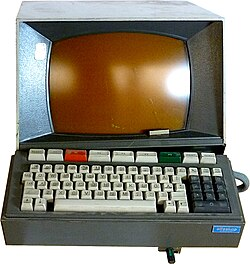
Alfaskop
» see alfaskop.se as it lived, on the wayback machine
~ the obit ~
The first Alfaskop shipped in 1969 and the last one was built in 1994. Its buyers were institutions rather than households, which puts the entire hardware life of this product outside anything a person at home would have met. The name is here anyway, because it took another seven years after the factory closed to stop being a company.
Standard Radio & Telefon AB in Stockholm built military radar and air traffic control systems, and between 1966 and 1968 a group there worked out how to turn that expertise into something cheaper. Stig Martin Eriksson took the initiative to build an inexpensive alphanumeric display terminal that could compete with IBM, using a Philco integrated circuit capable of holding one row of pixels in internal memory. Kjell Mellberg drew the first version, and the final signal generator was patented by Lars Fossum and Lennart Wangberg as US3696392A. The immediate customer was a patient data system at Karolinska University Hospital.
The first model launched in 1969 as the Alfaskop 3100, with every character held in a nickel-wire delay line, and a magnetic key called the authorization pen that you needed in order to use the thing at all. It was designed to be pin compatible with IBM equipment and to undercut it, first against the IBM 2260 and later with the Alfaskop 3500 against the IBM 3270. Airlines took them in volume: by the mid-1970s Scandinavian Airlines alone had a thousand of them running reservations.
Then the brand began changing hands, which is the real story here. SRT put the technology into Stansaab in 1971, a joint venture with Saab and a state-owned development company, and Facit's data terminal operations were folded in the following year. Stansaab merged with Saab's own data division in 1978 to become Datasaab. Ericsson bought Datasaab in 1981 on the theory that office automation would outgrow telecommunications, which was one of the more expensive wrong calls of the decade, and the Alfaskop group inside Ericsson Information Systems was handed the job of designing Ericsson's first PC. The EPC appeared sixteen months later, in 1984, at the Hanover fair.
~ the rap sheet ~
| Born | 1969, the Alfaskop 3100, developed at Standard Radio & Telefon from 1966 |
|---|---|
| Peak | about 600 terminals on Sweden's central tax system from 1 January 1979 |
| Killed | September 2001, bankruptcy of Alfaskop AB |
| Lifespan | 32 years, of which 25 as hardware |
| Made by | Standard Radio & Telefon AB, Stockholm, and six owners after it |
| Killed by | the PC, then the 2001 consulting crash |
~ the state projects ~
The Swedish government is what made these terminals matter. The Rafa project of 1970 computerized the national social insurance system for Riksförsäkringsverket, and Stansaab supplied the screens. The engineering notes from that deployment are better than most product histories: the terminals turned out to be sensitive to static electricity generated by the nylon blouses the operators wore, which was solved by grounding the floor mats with copper wire, and the operators were getting headaches from screen flicker, which was solved by raising the refresh rate from 25 to 50 Hz. The numeric keypad was added during the same project because the people using it needed one.
The RS project ran from 1975 to 1979 and did the same thing to the tax system under Olli Aronsson, centralizing the state tax registers onto a single Unisys mainframe with around 600 Alfaskop terminals attached to it across the country. The new system went live on 1 January 1979. For roughly a decade, if you were a Swedish citizen with an income and an insurance number, the state's view of you lived behind a screen built in Stockholm by a radar company.
~ six changes of hands ~
Five generations shipped, running from the 3100 of 1969 through to the A91. The 3500 had a processor built from discrete components and was technically programmable, though in practice only the manufacturer's own programmers used that. It sold in real volume and was also produced in Poland as the MERA 7900. Its replacement, the 3700, was the same machine with a different paint job and a different sales pitch. The System 41 and the A91 were where microprocessors and floppy disks finally arrived.
Ownership kept moving long after it had stopped meaning anything. Ericsson sold the division to Nokia in 1988, after retreating from its paperless-office ambitions and a disappointing American PC launch. Nokia was happy to trade on a name Ericsson had been trying to replace, and by 1989 there was an Alfaskop Workgroup System pairing 80386 servers with 80286 desktops over Ethernet or Token Ring. ICL bought it in 1990 and sold it on to Wyse Technology, which wound the manufacturing down. Production of Alfaskop hardware ended in 1994.
~ the last company to hold the name ~
Nokia Data had started building something else in 1990: a network of franchised Swedish companies selling PCs and networking gear. From 1994 those companies worked closely together on network technology and Microsoft deployments, and in 1995 they were consolidated into a single firm called Alfaskop AB. It listed on the Stockholm exchange in 1997. By 2000 it had 660 employees across 18 sales offices in Sweden and had outsourced its logistics to the distributor Scribona in February of that year.
Then the consulting market went over the cliff with everything else. Alfaskop AB filed itself into bankruptcy, and Scribona put out a press release about it on 20 September 2001, booking a 13 million krona loss on receivables it had already provisioned for and warning that fifty million krona of goodwill might need reassessing. The remaining 400 employees were let go. English Wikipedia cites a Tornado Insider article for the bankruptcy, which is actually about a different company called M2S, so the death as recorded there has no working citation behind it at all.
~ leave a rose ~
an anonymous tribute. one rose per visitor per day.
@}-->-- ... roses left here
~ leave a wreath ~
a rose fades by morning. a wreath stays on this grave for good, with your name on it.
paid once through stripe. payments are handled by OÜ Lakeview, the small company that keeps rip.so running. the money pays for the hosting and the nightly digging. adopt it and the headstone reads "maintained in memory by" you. the groundskeeper plants new wreaths at the next tending, usually within a day.
» one email a week: new graves and the anniversaries of the dead. subscribe
other gadgets: McDonnell Douglas, Northgate Computer Systems, Motorola ROKR E1, Gumstix
also died in the 2000s: Derive, Storytlr, CNET Newsburst
~ leave a note ~
visitors before you have left these graveside notes. anonymous welcome.