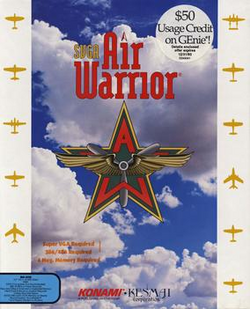
Air Warrior
~ the last words ~
By the time I had a modem in 1998, Air Warrior was on its third version and its fourth home, and the version that mattered had already been over for years. The one that mattered was on GEnie. GEnie was a United States online service with local dial numbers inside the United States and a billing relationship to match, which put it about as far out of reach from Ankara as a library card in Ohio. The wall was never knowledge. It was a phone network with somebody else's account number attached to it.
Kesmai was founded in 1981 in Charlottesville by Kelton Flinn and John Taylor, and it spent the eighties doing the thing almost nobody was doing, which was building persistent worlds for the commercial online services. Island of Kesmai and MegaWars III both went onto CompuServe first. Air Warrior went onto GEnie in 1987, and it is usually named as the first graphical massively multiplayer game, the point where the shared world stopped being made of text.
The design is worth stating plainly because it was unusual. The graphics ran on your own machine, so there were clients for boxes that shared nothing but a modem port, the Amiga and the Atari ST included. GEnie was doing the part a server does now, holding the world and telling each machine what it ought to be drawing. What you got for that was a World War Two sky with other human beings in it, hundreds of them during the busy hours, flying bombers that needed more than one person aboard to work properly.
That was a decade before anybody I knew had heard the phrase online game. The thing separating me from it was not the hardware, since a 33.6k modem in 1998 would have handled it. It was that the whole apparatus assumed you were standing inside the United States phone system.
~ the record ~
| Born | 1987, on the GEnie online service |
|---|---|
| Peak | hundreds of pilots in one sky during busy hours |
| Killed | 2001 |
| Lifespan | fourteen years |
| Made by | Kesmai, founded 1981 by Kelton Flinn and John Taylor |
| Killed by | Electronic Arts, within two years of buying the studio |
~ what it cost ~
Six dollars an hour on a 1200-baud connection, with later accounts putting the real cost above ten. A four-hour evening in there cost more than a boxed retail game, every time you did it. That number is the reason the population looked the way it did: people who could absorb a hobby that billed by the minute, and who mostly turned out to be adults with jobs rather than teenagers.
Kesmai understood the problem better than the services it sold through. In late 1997 it launched GameStorm with three other publishers at ten dollars a month flat, at a moment when the industry was still billing for connected hours. That was the correct read of where the pricing was going, arrived at about two years before it stopped mattering, because the free internet was already underneath it and about to take the whole business model out.
~ the four owners ~
Rupert Murdoch's News Corp bought Kesmai in April 1994, which is a sentence that still reads oddly, a newspaper empire buying a flight simulator studio in Virginia. The publishing division was spun off in 1996 and GameStorm arrived the year after, with the games still carried on AOL alongside Kesmai's own service.
News Corp sold to Electronic Arts in 1999. EA announced the closures in May 2000, taking Air Warrior Classic off alongside Legends of Kesmai, and Air Warrior III: Millennium Version went off in 2001. The studio was dismantled the same year. There was no dramatic cause here and no lawsuit. A company bought a catalog it had no plan for and switched the parts off in order.
~ the long tail ~
Interactive Magic published Air Warrior II and III in 1997 while also running WarBirds, which is the same game with the serial numbers filed off and a much longer lifespan. The genre it opened, the persistent combat sky with a live population and no reset, is still being made. Flinn and Taylor were given the Online Game Legend award at the 2011 Game Developers Choice Awards, which is a late acknowledgement of a fairly plain fact: they got there first, and everyone since has been working inside their shape.
What Air Warrior never got was the audience that would have made it famous. It peaked when being online was itself the expensive part, so the number of people who could have told you about it was capped by their phone bills. The games that took the idea mainstream did it after the meter came off.
~ leave a rose ~
an anonymous tribute. one rose per visitor per day.
@}-->-- ... roses left here
~ leave a wreath ~
a rose fades by morning. a wreath stays on this grave for good, with your name on it.
from $1, paid once through stripe. it keeps the graveyard running: the hosting and the nightly digging. adopt it and the headstone reads "maintained in memory by" you. the groundskeeper plants new wreaths at the next tending, usually within a day.
» one email a week: new graves and the anniversaries of the dead. subscribe
other gaming: MAIET Entertainment, CastleVille, PopTop Software, Silmarils
also died in the 2000s: PopTop Software, PatroNet, Silmarils
~ leave a note ~
visitors before you have left these graveside notes. anonymous welcome.