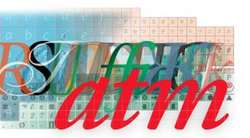
Adobe Type Manager
» see adobe.com/products/atm as it lived, on the wayback machine
~ the last words ~
By the time I had a machine that was mine, the job this program did had already been moved inside the operating system. That is the whole distance. Not a country and not an age, just a utility that got absorbed about two years after I came online, so the window in which I could have needed it was narrow and I spent it on a 33.6k modem looking at whatever type the browser felt like using.
Here is the problem it solved. A PostScript Type 1 font was two files: an outline the printer understood, and a set of screen bitmaps drawn at a few fixed point sizes. Ask for a size nobody had drawn a bitmap for and the screen gave you a staircase. Adobe Type Manager sat underneath everything and rasterized the outline itself, live, at whatever size you asked for. It also let those fonts print properly to cheap printers that had never heard of PostScript, which for most people was the larger of the two favors.
On Windows it worked by reaching into the system at a level nobody sane reaches into. Versions 3.0 through Me were patched from below, which held up until Windows NT refused to be patched that way. Microsoft's first answer was to convert Type 1 fonts to TrueType at install time, which is the kind of answer that solves nothing. In NT 4.0 they added a font driver interface, largely so that Adobe's program could plug into it, and ATM became a supported part of the machine rather than a burglar.
~ the record ~
| Born | 1989, on the macintosh, in the year apple and microsoft announced truetype |
|---|---|
| Peak | the font layer under windows 3.1 through windows me, and under a decade of mac publishing |
| Killed | 2005, when adobe stopped selling it |
| Lifespan | sixteen years, of which the last five were unnecessary |
| Made by | adobe systems |
| Killed by | its own code, licensed into windows 2000 and mac os x |
~ the war it was fired in ~
On 20 September 1989, at the Seybold conference in San Francisco, Apple and Microsoft announced they were building an alternative to PostScript together. TrueType was the outline format and the point of it was to stop paying Adobe. John Warnock, watching from the audience, called what he had just heard the biggest bunch of garbage mumbo jumbo he had ever heard in his life, and by several accounts was in tears about it afterward.
Adobe answered in two moves inside six months. It announced Type Manager, which at the time of the announcement had not been written yet, and in March 1990 it published the complete Type 1 specification in a book so that anyone could make fonts in the format without asking permission. The company broke its own monopoly on purpose to keep the format alive. Both moves worked, which is the part people forget when they tell this story as a defeat.
~ what the screen looked like without it ~
Around 1996 Adobe split the product. The original became ATM Light and stayed free, and ATM Deluxe was the paid one, which turned it from a rasterizer into a font manager: switching typefaces on and off, grouping them into sets that loaded together, printing specimen sheets, hunting duplicates and reporting fonts missing half their files. Anyone with a thousand licensed typefaces on a Macintosh needed this in a way that is hard to explain to people who have never watched a machine try to load all of them at once.
The versions were also a minefield. ATM 4.0 installed on Windows 2000 or XP could take the machine down, and Adobe spent years telling people not to do it. Version 4.1.2 was the last one ever released and it was the one that behaved. Windows Vista could not run either edition, and by then it did not need to.
~ where the code went ~
Around 2000, Apple put Type 1 and OpenType support into Mac OS X and Microsoft put it into Windows 2000, both of them using core code Adobe had handed over. That was the end of the product as a thing anyone had to buy. Adobe stopped developing the Deluxe version after Apple moved to OS X and stopped selling it in 2005, and the free one sat on the download page for years afterward like a lamp nobody unplugs.
The code outlived the product by fifteen years. It lived inside Windows as atmfd.dll, quietly parsing every font the machine met, until Microsoft pulled it out of Windows 10 starting with version 1709 and moved font handling into a sandboxed process. The machines that still had it made the news one last time in March 2020, when two remote code execution holes in the Adobe Type Manager Library came under active attack and Microsoft's emergency advice was to go and rename the file. The last thing written about Adobe Type Manager was a security advisory telling people to disable it.
~ leave a rose ~
an anonymous tribute. one rose per visitor per day.
@}-->-- ... roses left here
~ leave a wreath ~
a rose fades by morning. a wreath stays on this grave for good, with your name on it.
paid once through stripe. payments are handled by OÜ Lakeview, the small company that keeps rip.so running. the money pays for the hosting and the nightly digging. adopt it and the headstone reads "maintained in memory by" you. the groundskeeper plants new wreaths at the next tending, usually within a day.
» one email a week: new graves and the anniversaries of the dead. subscribe
other software: Microsoft Office Mix, Smolt, Today's Plan, Apple Shake
also died in the 2000s: PlanetOut, Incognito Entertainment, Urban Desires
~ leave a note ~
visitors before you have left these graveside notes. anonymous welcome.